
Columbia University Libraries Digital Collections: The Real Estate Record
Use your browser's Print function to print these pages.
Real estate record and builders' guide: [v. 93, no. 2391: Articles]: January 10, 1914
Text version:
Please note: this text may be incomplete. For more information about this OCR, view About OCR text.
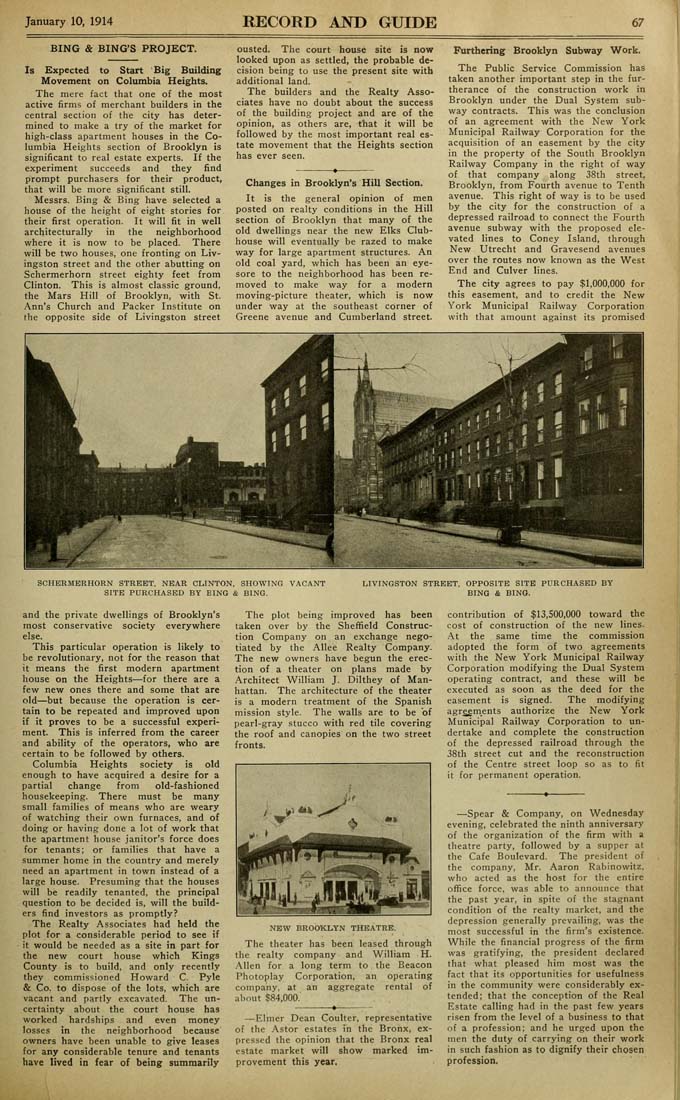
January 10, 1914 RECORD AND GUIDE 67 BING & BING'S PROJECT. Is Expected to Start Big Building Movement on Columbia Heights. The mere fact that one of the most active firms of merchant builders in the central section of the city has deter¬ mined to make a try of the market for high-class apartment houses in the Co¬ lumbia Heights section of Brooklyn is significant to real estate experts. If the experiment succeeds and they find prompt purchasers for their product, that will be more significant still. Messrs. Bing & Bing have selected a house of the height of eight stories for their first operation. It will fit in well architecturally in the neighborhood where it is now to be placed. There will be two houses, one fronting on Liv¬ ingston street and the other abutting on Schermerhorn street eighty feet from Clinton. This is almost classic ground, the Mars Hill of Brooklyn, with St. Ann's Church and Packer Institute on the opposite side of Livingston street ousted. The court house site is now looked upon as settled, the probable de¬ cision being to use the present site with additional land. The builders and the Realty Asso¬ ciates have no doubt about the success of the building project and are of the opinion, as others are, fhat it will be followed by the most important real es¬ tate movement that the Heights section has ever seen. Changes in Brooklyn's Hill Section. It is the general opinion of men posted on realty conditions in the Hill section of Brooklyn that many of the old dwellings near the new Elks Club¬ house will eventually be razed to make way for large apartment structures. An old coal yard, which has been an eye¬ sore to the neighborhood has been re¬ moved to make way for a modern moving-picture theater, which is now under way at the southeast corner of Greene avenue and Cumberland street. Furthering Brooklyn Subway Work. The Public Service Commission has taken another important step in the fur¬ therance of the construction work in Brooklyn under the Dual System sub¬ way contracts. This was the conclusion of an agreement with the New York Municipal Railway Corporation for the acquisition of an easement by the city in the property of the South Brooklyn Railway Company in the right of way of that company along 38th street, Brooklyn, from Fourth avenue to Tenth avenue. This right of way is to be used by the city for the construction of a depressed railroad to connect the Fourth avenue subway with the proposed ele¬ vated lines to Coney Island, through New Utrecht and Gravesend avenues over the routes now known as the West End and Culver lines. The city agrees to pay $1,000,000 for this easement, and to credit the New York Municipal Railway Corporation with that amount against its promised SCHER.MEHHORN STREET, NEAR CLINTON, SHOWING VACANT SITE PURCHASED BY BING & BING. LIVINGSTON STREET, OPPOSITE SITE PURCHASED BY BING & BING. and the private dwellings of Brooklyn's most conservative society everywhere else. This particular operation is likely to be revolutionary, not for the reason that it means the first modern apartment house on the Heights—for there are a few new ones there and some that are old—but because the operation is cer¬ tain to be repeated and improved upon if it proves to be a successful experi¬ ment. This is inferred from the career and ability of the operators, who are certain to be followed by others. Columbia Heights society is old enough to have acquired a desire for a partial change from old-fashioned housekeeping. There must be many small families of means who are weary of watching their own furnaces, and of doing or having done a lot of work that the apartment house janitor's force does for tenants; or families that have a summer home in the country and merely need an apartment in town instead of a large house. Presuming that the houses will be readily tenanted, the principal question to be decided is, will the build¬ ers find investors as promptly? The Realty Associates had held the plot for a considerable period to see if it would be needed as a site in part for the new court house which Kings County is to build, and only recently they commissioned Howard C. Pyle & Co. to dispose of the lots, which are vacant and partly excavated. The un¬ certainty about the court house has worked hardships and even money losses in the neighborhood because owners have been unable to give leases for any considerable tenure and tenants have lived in fear of being summarily The plot being improved has been taken over by the Sheffield Construc¬ tion Company on an exchange nego¬ tiated by the Allee Realty Company. The new owners have begun the erec¬ tion of a theater on plans made by Architect William J. Dilthey of Man¬ hattan. The architecture of the theater is a modern treatment of the Spanish mission style. The walls are to be of pearl-gray stucco with red tile covering the roof and canopies on the two street fronts. contribution of $13,500,000 toward the cost of construction of the new lines. .\t the same time the commission adopted the form of two agreements with the New York Municipal Railway Corporation modifying the Dual System operating contract, and these will be executed as soon as the deed for the easement is signed. The modifying agrgjements authorize the New Y'ork Municipal Railway Corporation to un¬ dertake and complete the construction of the depressed railroad through the 38th street cut and the reconstruction of the Centre street loop so as to fit it for permanent operation. NEW BROOKLYN THEATRE. The theater has been leased through the realty company and William H. Allen for a long term to the Beacon Photoplay Corporation, an operating company, at an aggregate rental of about $84,000. ---------*———^— —Elmer Dean Coulter, representative of the Astor estates in the Bronx, ex¬ pressed the opinion that the Bronx real estate market will show marked im¬ provement this year. —Spear & Company, on Wednesday evening, celebrated the ninth anniversary of the organization of the firm with a theatre party, followed by a supper at the Cafe Boulevard. The president of the company, Mr. Aaron Rabinowitz, who acted as the host for the entire office force, was able to announce that the past year, in spite of the stagnant condition of the realty market, and the depression generally prevailing, was the most successful in the firm's existence. While the financial progress of the firm was gratifying, the president declared that what pleased him most was the fact that its opportunities for usefulness in the community were considerably ex¬ tended; that the conception of the Real Estate calling had in the past few years risen from the level of a business to that of a profession; and he urged upon the men the duty of carrying on their work in such fashion as to dignify their chosen profession.