
Columbia University Libraries Digital Collections: The Real Estate Record
Use your browser's Print function to print these pages.
Real estate record and builders' guide: [v. 93, no. 2394: Articles]: January 31, 1914
Text version:
Please note: this text may be incomplete. For more information about this OCR, view About OCR text.
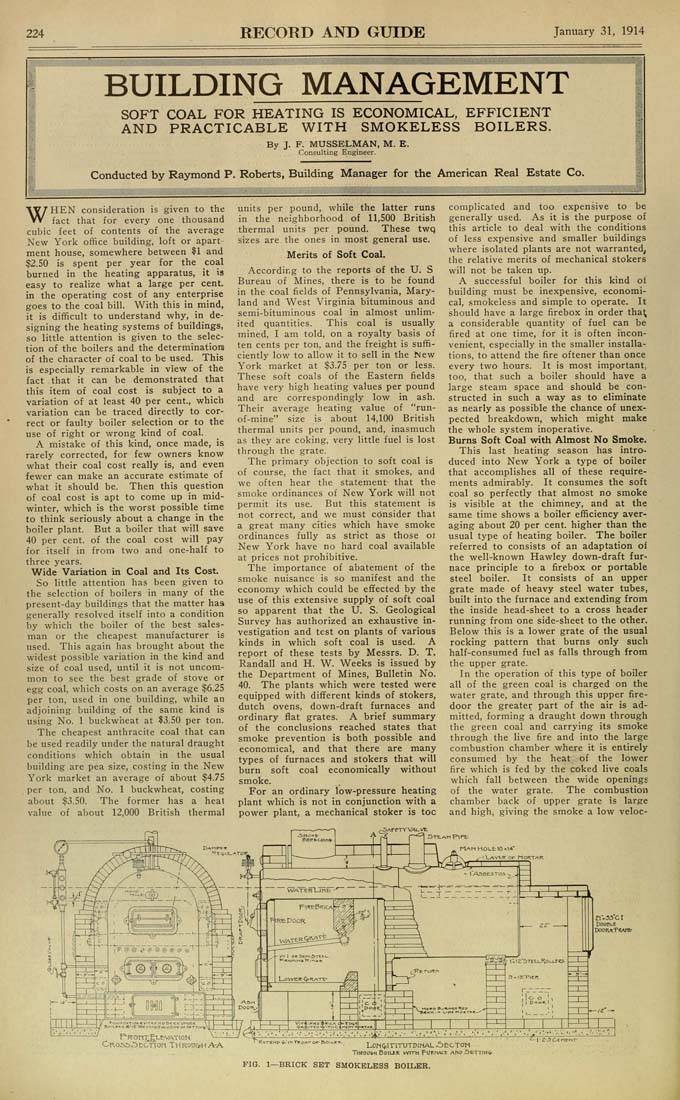
224 RECORD AND GUIDE January 31, 1914 piiiii^^ BUILDING MANAGEMENT SOFT COAL FOR HEATING IS ECONOMICAL, EFFICIENT AND PRACTICABLE WITH SMOKELESS BOILERS. By J. F. MUSSELMAN, M. E. Consulting Engineer. a m Conducted by Raymond P. Roberts, Building Manager for the American Real Estate Co. llllillllllM^^^^^^^^ .....■■■^^^^^^^^^ ......■■■■I.....liillliiililiiliililllilll......■■■■■■IP WHEN consideration is given to the fact that for every one thousand cubic feet of contents of the average New York office building, loft or apart¬ ment house, somewhere between ¥1 and $2.50 is spent per year for the coal burned in the heating apparatus, it is easy to realize what a large per cent in the operating cost of any enterprise goes to the coal bill. With this in mind, it is difficult to understand why, in de¬ signing the heating systems of buildings, so little attention is given to the selec¬ tion of the boilers and the determination of the character of coal to be used. This is especially remarkable in view of the fact .that it can be demonstrated that this item of coal cost is subject to a variation of at least 40 per cent., which variation can be traced directly to cor¬ rect or faulty boiler selection or to the use of right or wrong kind of coal. A mistake of this kind, once made, is rarely corrected, for few owners know what their coal cost really is, and even fewer can make an accurate estimate of what it should be. Then this question of coal cost is apt to come up in mid¬ winter, which is the worst possible time to think seriously about a change in the boiler plant. But a boiler that will save 40 per cent, of the coal cost will pay for itself in from two and one-half to three years. Wide Variation in Coal and Its Cost. So little attention has been given to the selection of boilers in many of the present-day buildings that the matter has generally resolved itself into a condition by which the boiler of the best sales¬ man or the cheapest manufacturer is used. This again has brought about the widest possible variation in the kind and size of coal used, until it is not uncom¬ mon to see the best grade of stove or egg coal, which costs on an average $6.25 per ton, used in one building, while an adjoining building of the same kind is using No. 1 buckwheat at 13.50 per ton. The cheapest anthracite coal that can be used readily under the natural draught conditions which obtain in the usual building are pea size, costing in the New York market an average of about $4.75 per ton, and No. 1 buckwheat, costing about $3.50. The former has a heat value of about 12,000 British thermal units per pound, while the latter runs in the neighborhood of 11,500 British thermal units per pound. These twq sizes are the ones in most general use. Merits of Soft Coal. According to the reports of the U. S Bureau of Mines, there is to be found in the coal fields of Pennsylvania, Mary¬ land and West Virginia bituminous and semi-bituminous coal in almost unlim¬ ited quantities. This coal is usually mined, I am told, on a royalty basis of ten cents per ton, and the freight is suffi¬ ciently low to allow it to sell in the Mew York market at $3.75 per ton or less. These soft coals of the Eastern fields have very high heating values per pound and are correspondingly low in ash. Their average heating value of "run- of-mine" size is about 14,100 British thermal units per pound, and, inasmuch as they are coking, very little fuel is lost through the grate. The primary objection to soft coal is of course, the fact that it smokes, and we often hear the statement- that the smoke ordinances of New York will not permit its use. But this statement is not correct, and we must consider that a great many cities which have smoke ordinances fully as strict as those ot New York have no hard coal available at prices not prohibitive. The importance of abatement of the smoke nuisance is so manifest and the economy which could be effected by the use of this extensive supply of soft coal so apparent that the U. S. Geological Survey has authorized an exhaustive in¬ vestigation and test on plants of various kinds in which soft coal is used. A report of these tests by Messrs. D. T. Randall and H. W. Weeks is issued by the Department of Mines, Bulletin No. 40. The plants which were tested were equipped with different kinds of stokers, dutch ovens, down-draft furnaces and ordinary flat grates. A brief summary of the conclusions reached states that smoke prevention is both possible and economical, and that there are maiiy types of furnaces and stokers that will burn soft coal economically without smoke. For an ordinary low-pressure heating plant which is not in conjunction with a power plant, a mechanical stoker is toe complicated and too expensive to be generally used. As it is the purpose of this article to deal with the conditions of less expensive and smaller buildings where isolated plants are not warranted, the relative merits of mechanical stokers will not be taken up. A successful boiler for this kind of building must be inexpensive, economi¬ cal, smokeless and simple to operate. It should have a large firebox in order tha^ a considerable quantity of fuel can be fired at one time, for it is often incon¬ venient, especially in the smaller installa¬ tions, to attend the fire oftener than once every two hours. It is most important, too, that such a boiler should have a large steam space and should be con¬ structed in such a way as to eliminate as nearly as possible the chance of unex¬ pected breakdown, which might make the whole system inoperative. Burns Soft Coal with Almost No Smoke. This last heating season has intro¬ duced into New York a type of boiler that accomplishes all of these require¬ ments admirably. It consumes the soft coal so perfectly that almost no smoke is visible at the chimney, and at the same time shows a boiler efficiency aver¬ aging about 2() per cent, higher than the usual type of heating boiler. The boiler referred to consists of an adaptation of the well-known Hawley down-draft fur¬ nace principle to a firebox or portable steel boiler. It consists of an upper grate made of heavy steel water tubes, built into the furnace and extending from the inside head-sheet to a cross header running from one side-sheet to the other. Below this is a lower grate of the usual rocking pattern that burns only such half-consumed fuel as falls through from the upper grate. In the operation of this type of boiler all of the green coal is charged on the water grate, and through this upper fire- door the greater part of the air is ad¬ mitted, forming a draught down through the green coal and carrying its smoke through.the live fire and into the large combustion chamber where it is entirely consumed by the heat^ of the lower fire which is fed by the coked live coals which fall between the wide openings of the water grate. The combustion chamber back of upper grate is large and high, giving the smoke a low veloc- (■^AfeTrSaKL-V^ Steam P\pe Mam HOLE 10 «^4" ^ ' J-AYtiR OF MORT/^^ PRonT;gl.E-W\TlOK CRoss3coTlon ThroucpH A-A sr - ilZ^TEtuR0l.l.fRS 1^ ° 1 LONt^lTlTUTDIMAL /5ECT0N 7>lroii»rt BoiLtK WITH PUKPMCC KHO 3ETTIM* FIG. 1—BRICK SET SMOKELESS BOIIaER. I I ^^ I "I ei'«33"cr Double l>»R.rFiMnb i^r ^