
Columbia University Libraries Digital Collections: The Real Estate Record
Use your browser's Print function to print these pages.
Real estate record and builders' guide: [v. 93, no. 2399: Articles]: March 7, 1914
Text version:
Please note: this text may be incomplete. For more information about this OCR, view About OCR text.
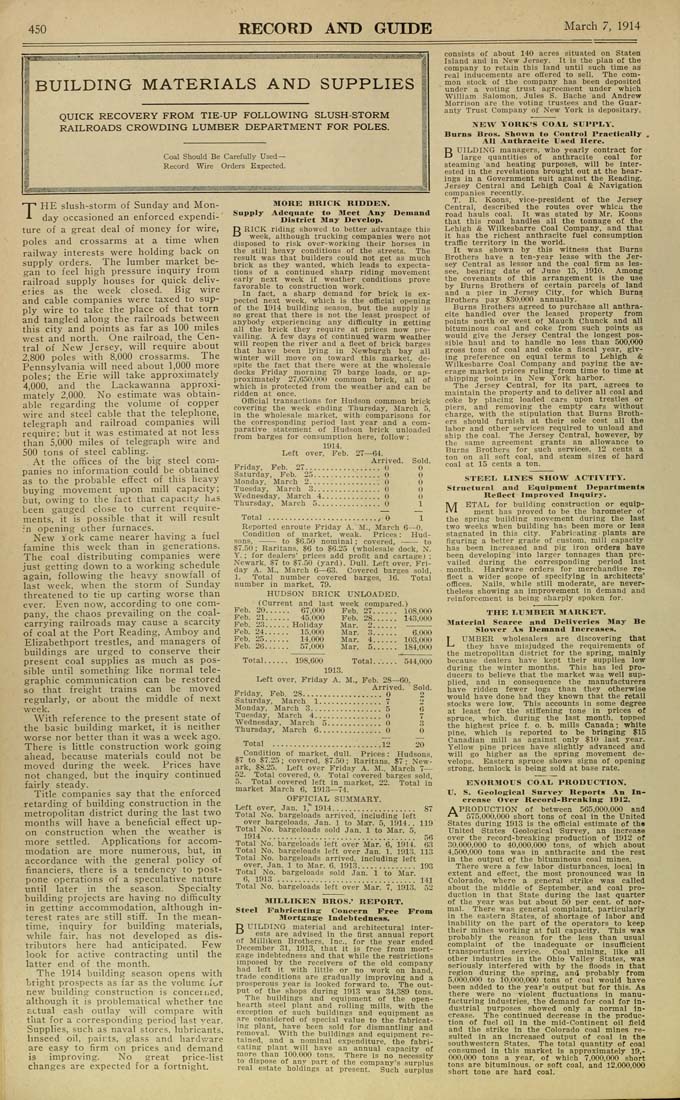
450 RECORD AND GUIDE March 7, 1914 1 BUILDING MATERIALS AND SUPPLIES I QUICK RECOVERY FROM TIE-UP FOLLOWING SLUSH-STORM RAILROADS CROWDING LUMBER DEPARTMENT FOR POLES. Coal Should Be Carefully Used- Record Wire Orders Expected. ■MIMIIIIlliyiMMIEIIIIIIIIIMIIMIMllBlillMlll^^^ THE slush-storm of Sunday and Mon¬ day occasioned an enforced expend!-' ture of a great deal of money for wire, poles and crossarms at a time when railway interests were holding back on supply orders. The lumber market be¬ gan to feel high pressure inquiry from railroad supply houses for quick deliv- ,e!ies as the week closed. Big wire and cable companies -were taxed to sup¬ ply wire to take the place of that torn and tangled along the railroads between this city and points as far as 100 miles v/est and north. One railroad, the Cen¬ tral of New Jersey, will require about 2,800 poles with 8,000 crossarms. The Pennsylvania will need about 1,000 more poles; the Erie will take approximately 4,000, and the Lackawanna approxi¬ mately 2,000. No estimate was obtain¬ able regarding the volume of copper wire and steel cable that the telephone, telegraph and railroad companies will require; but it was estimated at not less than 5,000 miles of telegraph wire and SOO tons of steel cabling. At the offices of the big steel com¬ panies no information could be obtained as to the probable effect of this heavy buying movement upon mill capacity; but, owing to the fact that capacity h'are are easy to firm on prices and demand is improving. No great price-list changes are expected for a fortnight. more: brick ridden. Supply Adequate to Meet Any Deinand District May Develop. D RICK riding showed to better advantage this ^ week, although trucking companies were not disposed to risk over-working their horses in the still heavy conditions of the streets. The result was that builders could not get as much brick as they wanted, which leads to expecta¬ tions ot a continued sharp riding movement early next week if weather conditions prove favorable to construction work. In fact, a sharp demand tor brick is ex¬ pected next week, which is the official opening of the 1914 building season, but the supply is so great that there is not the least prospect of anybody experiencing any difficulty in getting all the brick they require at prices now pre¬ vailing. A few days of continued warm weather will reopen the river and a fleet ot brick barges that have been lying in Newburgh hay all winter will move on toward this market, de¬ spite the tact that there were at the wholesale docks Friday morning 79 barge loads, or ap¬ proximately 27,650,000 common brick, ail ot which is protected trom the weather and can be ridden at once. Official transactions for Hudson common brick covering the week ending Thursday, March 5, in the wholesale market, with comparisons lor the corresponding period last year and a com¬ parative statement ol Hudson brick unloaded from barges tor consumption here, follow: 1914. Lett over, Peb. 27—64. Arrived. Sold. Friday, Peb. 27..................0 0 Saturday, Feb. 25................0 0 Monday, March 2.................' 0 0 Tuesday, March 3................0 0 Wednesday, March 4.............. 0 0 Thursday, March 5...............0 1 Total ..........................,,0 1 Reported enroute Friday A. M., March 6—0. Condition ot market, weak. Prices: Hud¬ sons, ------ to $6,50 nominal; covered, ------ to $7.50; Raritans. $6 to $6.25 (wholesale dock, N. Y.; lor dealers' prices add proflt and cartage) ; Newark, $7 to $7.50 (yard). Dull. Lett over, Fri¬ day A. M., March 6—63. Covered barges sold, 1. Total number covered barges, 16. Total number in market, 79. HUDSON BRICK UNLOADED. (Current and last week compared.) Feb. 20...... 67,000 Peb. 27...... 108,000 Feb. 21...... 45.000 Peb. 28...... 143,000 Feb. 23......Holiday Mar. 2...... —------ Feb. 24...... 15,000 Mar. 3...... 6,000 Feb. 25...... 14,000 Mar. 4...... 103,000 Feb. 26...... 57,000 Mar. 5...... 184,000 Total...... 198,600 Total...... 544,000 1913. Left over, Friday A. M., Peb. 28—60. Arrived. ' Sold. Friday, Feb, 28...................0 2 Saturday, March 1...............7 2 Monday, March 3.................5 6 Tuesday, March 4................0 7 Wednesday, March 5............. 0 3 Thursday, March 6...............0 0 Total ....................'......12 20 Condition of market, dull. Prices: Hudsons, $7 to $7.25; covered, $7.50; Raritans, $7; New¬ ark, $8.25. Lett over Friday A. M.. March 7— 52. Total covered, 0. Total covered barges sold, 5. Total covered left in market, 22. Total in market March 6, 1913—74. OFFICIAL SUMMARY. Lett over, Jan. 1,* 1914.................... 87 Total No. bargeloads arrived, including left over bargeloads, Jan. 1 to MaOr. 5, 1914.. 119 Total No. bargeloads sold Jan. 1 to Mar. 5, 1914 ................................... 56 Total No. bargeloads left over Mar. 6, 1914. 63 Total No. bargeloads left over Jan. 1. 1913. 113 Total No. bargeloads arrived, including left over, Jan. 1 to Mar. 6, 1913.............. 193 Total No. bargeloads sold Jan. 1 to Mar. 6, 1913 ................................. 141 Total No. bargeloads left over Mar. 7, 1913. 52 MILLIKEN BROS.' REPORT. Steel Fabricating Concern Free Prom Mortgage Indebtedness. p UILDING material and architectural inter- *-* ests are advised in the flrst annual report ot Milliken Brothers, Inc., tor the year ended December 31, 1913, that it is tree trom mort¬ gage indebtedness and that while the restrictions imposed by the receivers of the old company had left it with little or no work on hand, trade conditions are gradually improving and a prosperous year is looked forward to. The out¬ put ol the shops during 1913 was 34,389 tons. The buildings and equipment ol the open- hearth steel plant and rolling mills, with the exception ol such buildings and equipment as are considered ot special value to the labrlcat- ing plant, have been sold tor dismantling and removal. With the buildings and equipment re¬ tained, and a nominal expenditure, the labri- cating plant will have an annual capacity ot more than 100,000 tons. There is no necessity to dispose ot any part ol the company's surplus real estate holdings at present. Such surplus consists ot about 140 acres situated on Staten Island and in New Jersey. It is the plan ot the company to retain this land until such time as real inducements are offered to sell. The com¬ mon stock of the company has been deposited ' under a voting trust agreement under which William Salomon,. Jules S. Bache and Andrew Morrison are the voting trustees and the Guar¬ anty Trust Company of New York is depositary. NEW YORK'S COAL SUPPLY. Burns Bros. Shown to Control Practically . AU Anthracite ITsed Here. BUILDING managers, who yearly contract for large quantities of antiiracite coal for steaming and heating purposes, will be Inter¬ ested in the revelations brought out at the hear¬ ings in a Government suit against the Reading, Jersey Central and Lehigh Coal & Navigation companies recently. T. B. Koons, vice-president of the Jeraey Central, described the routes over whicii the road hauls coal. It was stated by Mr. Koons that this road handles all the tonnage ot the Lehigh & Wilkesbarre Coal Company, and that it has the richest anthracite fuel consumption traffic territory in the world. It was shown by this witness that Burns Brothers have a ten-year lease with the Jer¬ sey Central as lessor and the coal firm as les¬ see, bearing date of June 15, 1910. Among the covenants of this arrangement is the use by B'urns Brothers ot certain parcels of land and a pier in Jersey City, for which Burns Brothers pay $30,000 annually. Burns Brothers agreed to purchase all anthra¬ cite handled over the leased property from points north or west ol Mauch Chunck and all bituminous coal and coke Irom such points as would give the Jersey Central the longest pos¬ sible haul and to handle no less than 500,000 gross tons ol coal and coke a fiscal year, giv¬ ing prelerence on equal terms to Lehigh & Wilkesbarre Coal Company and paying the av¬ erage market prices ruling from time to time at shipping points in New York harbor. The Jersey Central, for its part, agrees to maintain the property and to deliver all coal and coke by placing loaded oars upon trestles or piers, and removing the empty cars without charge, with the stipulation that Burns Broth¬ ers should furnish at their sole cost all the labor and other services required to unload and ship the coal. The Jersey Central, however, by the same agreement grants an allowance to Burns Brothers lor such services, 12 cents a ton on all soft coal, and steam sizes of hard coal at 15 cents a ton. 1 M STEEL LINES SHOW ACTIVITY. Structural and Equipment Departments Reflect Improved Inquiry. ETAL tor building construction or equip¬ ment has proved to be the barometer of the spring building movement during the laat two weeks when building hag been more or less stagnated in this city. Fabricating ■ plants are figuring a better grade ot custom, mill capacity has been increased and pig iron orders have been developing into larger tonnages than pre¬ vailed during the corresponding period last month. Hardware orders tor merchandise re¬ flect a wider scope of specifying in architects' offices. Nails, while still moderate, are never¬ theless showing an improvement in demand and reinforcement is being sharply spoken for. THE LUMBER MARKET. Material Scarce and Deliveries May Be Slower As Demand Increases. LUMBER wholesalers are discovering that they have misjudged the requirements ot the metropolitan district tor the spring, mainly because dealers have kept their supplies low during the winter months. This has led pro¬ ducers to believe that the market was well eup- plied, and in consequence the manufacturers have ridden fewer logs than they otherwise would have done had they known that the retail stocks were low. This accounts in some degree at least for the stifCening tone in prices ot spruce, which, during the last month, topped the highest price f. o. b. mills Canada; white pine, which is reported to be bringing $15 Canadian mill as against only $10 last year. Yellow pine prices have slightly advanced and wili go higher as the spring movement de¬ velops. Eastern spruce shows signs ot opening strong, hemlock is being sold at base rate. ENORMOUS COAL PRODUCTION. IJ. S. Geologieal Survey Reports An In¬ crease Over Record-Breaking 1912. A PRODUCTION ol between 565,000,000 and 575,000,000 short tons ot coal In the United States during 1913 is the official estimate ot the United States Geological Survey, an increase over the record-breaking production ol 1912 ol 30,000,000 to 40,000,000 tons, ot which about 4,500,000 tons was in anthracite and the rest in the output ot the bituminous coal mines. There were a lew labor disturbances, local in extent and effect, the most pronounced was In Colorado, where a general strike waa called about the middle ot September, and coal pro¬ duction in that State during the last quarter ot the year was hut about 50 per cent, of nor¬ mal. There was general complaint, particularly in the eastern States, ol shortage ol labor and inability on the part ol the operators to keep their mines working at lull capacity. This was probably the reason lor the less than usual complaint ol the inadequate or insufficient transportation service. Coal mining, like all other Industries in the Ohio Valley States, was seriously interfered with hy the floods in that region during the spring, and probably from 5,000,000 to 10,000,000 tons ot coal would have been added to the year's output but for this. As there were no violent, fluctuations in manu¬ facturing Industries, the demand for coal lor In¬ dustrial purposes showed only a normal In¬ crease. The continued decrease in the produc¬ tion ot tuel oil in the mid-Continent oil fleld and the strike In the Colorado coal mines re¬ sulted in an Increased output of coal in the southwestern States. The total quantity of coal consumed in this market is approximately 19,- 000.000 tons a year, ol which 7,000,000 short tons are bituminous, or solt coal, and 12,000,000 short tone are hard coal.