
Columbia University Libraries Digital Collections: The Real Estate Record
Use your browser's Print function to print these pages.
Real estate record and builders' guide: [v. 93, no. 2400: Articles]: March 14, 1914
Text version:
Please note: this text may be incomplete. For more information about this OCR, view About OCR text.
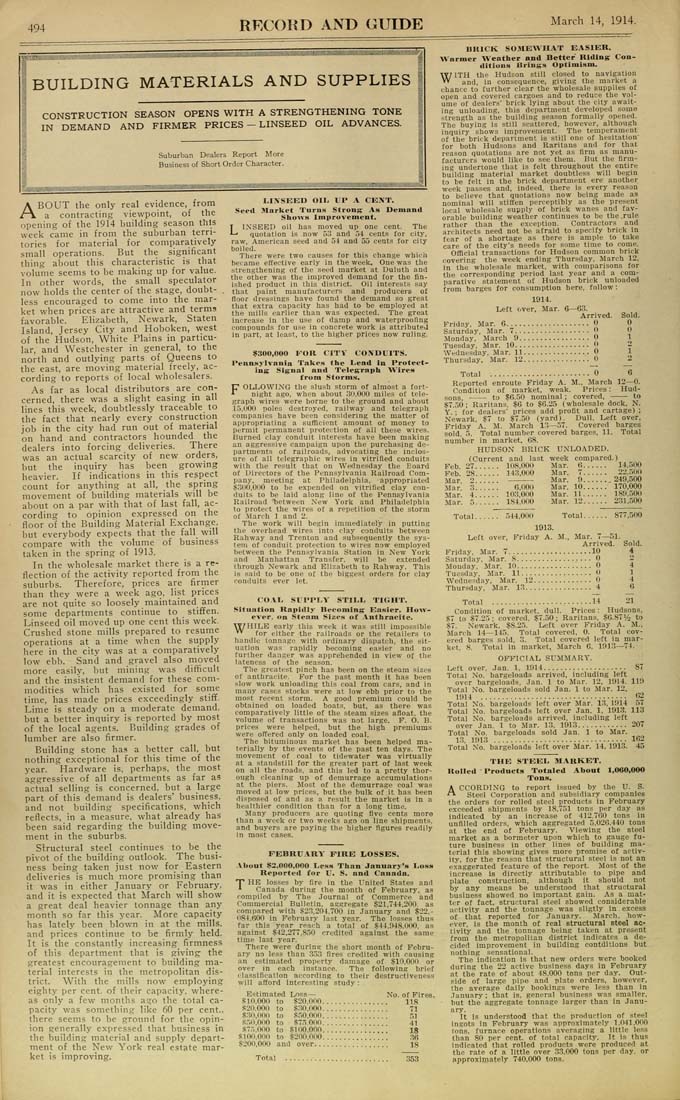
494 RECORD AND GUIDE March 14, 1914. giiHiiiiiiii^^ I BUILDING MATERIALS AND SUPPLIES | CONSTRUCTION SEASON OPENS WITH A STRENGTHENING TONE | IN DEMAND AND FIRMER PRICES — LINSEED OIL ADVANCES. | Suburban Dealers Report More Business of Short Order Character. ■ ■MIMIMIlMMMiylMlllMI'Mi''""'''^ ■■■■■llliilllllMlM IBIIIIIlllWIIMIBIIIIWimR ABOUT the only real evidence, from a contracting viewpoint, of the opening of the 1914 building season this week came in from the suburban terri¬ tories for material for comparatively small operations. But the significant thing about this characteristic is that volume seems to be making up for value. In other words, the small speculator now holds the center of the stage, doubt- . less encouraged to come into the mar¬ ket when prices are attractive and terms favorable. Elizabeth, Newark, Staten Island, Jersey City and Hoboken, west of the Hudson, White Plains in particu¬ lar, and Westchester in general, to the north and outlying parts of Queens to the east, are moving material freely, ac¬ cording to reports of local wholesalers. As far as local distributors are con¬ cerned, there was a slight easing in all lines this week, doubtlessly traceable to the fact that nearly every construction job in the city had run out of material on hand and contractors hounded the dealers into forcing deliveries. There was an actual scarcity of new orders, but the inquiry has been growing heavier. If indications in this regpect count for anything at all, the spring movement of building materials will be about on a par with that of last fall, ac¬ cording to opinion expressed on the • floor of the Building Material Exchange, but everybody expects that the fall will compare with the volume of business taken in the spring of 1913. In the wholesale market there is a re¬ flection of the activity reported from the suburbs. Therefore, prices are firmer than they were a week ago, list prices are not quite so loosely maintained and some departments continue to stiffen. Linseed oil moved up one cent this week. Crushed stone mills prepared to resume operations at a time when the supply here in the city was at a comparatively low ebb. Sand and gravel also moved more easily, but mining was difficult and the insistent demand for these com¬ modities which has existed for some time, has made prices exceedingly stiff. Lime is steady on a moderate demand, but a better inquiry is reported by most of the local agents. Building grades of lumber are also firmer. Building stone has a better call, but nothing exceptional for this time of the year. Hardware is, perhaps, the most aggressive of all departments as far as actual selling is concerned, but a large part of this demand is dealers' business, and not building specifications, which reflects, in a measure, what already has been said regarding the building move¬ ment in the suburbs. Structural steel continues to be the pivot of the building outlook. The busi¬ ness being taken just now for Eastern deliveries is much more promising than it was in either January or February, and it is expected that March will show a great deal heavier tonnage than any month so far this year. More capacity has lately been blown in at the mills, and prices continue to be firmly held. It is the constantly increasing^ firmness of this department that is giving the greatest encouragement to building ma¬ terial interests in the metropolitan dis¬ trict. With the mills now employing eighty per cent, of their capacity, where¬ as only a few months a9;o the total ca¬ pacity was something like 60 per cent., there seems to be ground for the opin- 1 ion generally expressed that business in the building material and supply depart¬ ment of the New York real estate mar- I ket is improving. LINSCED OIL UP A CENT. Seed Market Turns Strons As Demand ShOT>'s Improvement. LINSEED oil has moved up one cent. The quotation is now 53 and 54 cents for city, raw, American seed and 54 and 55 cents for city boiled. There were two causes for this change which became effective early in the week. One was the strengthening ot the seed market at Duluth and the other was the improved demand for the fin¬ ished product in this district. Oil interests say that paint manufacturers and producers of fioor dressings bave found the demand so great that extra capacity has had to be employed at the mills earlier than was expected. The great increase in the use of damp and waterprooflng compounds for use in concrete work is attributed in part, at least, to the higher prices now ruling. .¥300,000 FOR CITV CONDUITS. Pennsylvania Takes the Lead In Protect¬ ing Signal and Telegraph 'Wires from Storms. FOLLOWING the slush storm of almost a fort¬ night ago, when about 30,000 miles of tele¬ graph wires were borne to the ground and about 15,000 poles destroyed, railway and telegraph companies have been considering the matter of appropriating a sufflcient amount of money to permit permanent protection of all these wires. Burned clay conduit interests have been making an aggressive campaign upon the purchasing de¬ partments of railroads, advocating the inclos- ure of all telegraphic wires in vitrified conduits with the result that on Wednesday the Board ot Directors of the Pennsylvania Railroad Com¬ pany, meeting at Philadelphia, -appropriated $300,000 to be expended on vitrified clay con¬ duits to be laid along line of the Pennsylvania Railroad "between New York and Philadelphia to protect the wires ot a repetition of the storm ot March 1 and 2. The work will begin immediately in putting the overhead wires into clay conduits between Rahway and Trenton and subsequently the sys¬ tera of conduit protection to wires now employed between the Pennsylvania Station in New "York and Manhattan Transfer, will be extended through Newark and Elizabeth to Rahway. This is said to be one ot the biggest orders tor clay conduits ever let, BRICK SOMEWHAT EASIER. ■Warmer 'Weather and Better Riding Con¬ ditions Brings Optimism. WITH the Hudson still closed to navigation and, in consequence, giving the market a chance to further clear the wholesale supplies of open and covered cargoes and to reduce the vol¬ ume of dealers' brick lying about the city await¬ ing unloading, this department developed some strength as tbe building season formally opened. The buying is still scattered, however, although inquiry shows improvement. The temperament of the brick department is still one of hesitation' tor both Hudsons and Raritans and for that reason quotations are not yet as firm as manu¬ facturers would like to see them. But the firm¬ ing undertone that is felt throughout the entire building material market doubtless will begin to be felt in the brick department ere another week passes and, indeed, there is every reason to believe that quotations now being made as nominal will stiffen perceptibly as the present local wholesale supply of brick wanes ahd fav¬ orable building weather continues to he the .rule rather than the exception. Contractors and architects need not be afraid to specify brick in fear of a shortage as there is ample to take care ot the city's needs for some time to come. Official transactions tor Hudson common brick covering the week ending Thursday, March 12, in the wholesale market, with comparisons for the corresponding period last year and a com¬ parative statement of Hudson brick unloaded from barges for consumption here, follow: 1914. Lett over. Mar. 6—63. Arrived. Sold. Friday, Mar. 6.................... 0 0 Saturday, Mar. 7.................. 0 0 Monday, March 9................. 0 1 Tuesday, Mar. 10.................. 0 ^ Wednesday, Mar. 11................ 0 1 Thursday, Mar. 12................ 0 2 Total ........................0 6 Reported enroute Friday A. M., March 12—0. Condition of market, weak. Prices: Hud¬ sons, ------ to $6.50 nominal; covered, ------ to $7.50; Raritans, $6 to $6.25 (wholesale dock, N. Y • for dealers' prices add profit and cartage) ; Newark, $7 to $7.50 (yard). Dull. Left over, Friday A. M. March 13—57. Covered barges sold. 5. Total number covered barges, 11. Total number in market. 68. HUDSON BRICK UNLOADED. (Current and last week compared.) CO.VL SUPPLY STILL TIGHT. Situation Rapidly Becoming Easier, Hotv- ever, on Steam Sizes of Anthracite. VY7HILE early this -R'eek it was still impossible " for either the railroads or the retailers to handle tonnage with ordinary dispatch, the sit¬ uation was rapidly becoming easier and no further danger was apprehended in view of the lateness of the season. The greatest pinch has been on the steam sizes of anthracite. For the past month it has been slow work unloading this coal from cars, and in many cases stocks were at low ebb prior to the most recent storm. A good premium could be obtained on loaded boats, but, as there was comparatively little of the steam sizes afloat, the volume of transactions was not large. P. O. B. prices were helped, but the high premiums were offered only on loaded coal. The bituminous market has been helped ma¬ terially by the events of the past ten days. The movement of coal to tidewater was virtually at a standstill for the greater part of last week on all the roads, and this led to a pretty thor¬ ough cleaning up of demurrage accumulations at the piers. Most of the demurrage coal was moved at low prices, but the bulk of it has been disposed of and as a result the market is in a healthier condition than for a long time. Many producers are quoting five cents more than a week or two weeks ago on line shipments, and buyers are paying the higher figures readily in most cases. FEBRUARY FIRE LOSSES. About $2,000,000 Less Than January's Loss Reported for U. S. and Canada. T" HE losses by fire in the United States and * Canada during the month of February, as compiled by The Journal of Commerce and Commercial Bulletin, aggregate $21,744,200. as compared with $23,204,700 in January and $22.- 084.(500 in Pebruary last year. The losses thus far this year reach a total of $44,948,000, as against $42,277,850 credited against the same time last year. There were during the short month of Febru¬ ary no less than 353 fires credited with causing an estimated property damage of $10,000 or over in each instance. The following brief classification according to their destructiveness will afford interesting study : Estimated Loss— No. of Fires. $10,000 to $20.000................ 118 $20,000 to $30,000................ 71 $30,000 to .$.50.000................ ,51 ,«.50,0no to $75,000................ 41 ,'i;7s.ooo to $100,000................ is $100,090 to $200,000................ 36 $200,000 and over.................. 18 Total ......................... 353 Feb. 27..____ 108,000 Peb. 28...... 143,000 Mar. 2...... --------- Mar. 3...... 6,000 Mar. 4...... 103.000 Mar. 5...... 184,000 Mar. 6...... 14,500 Mar. 7...... 22,500 Mar. 0.......249,500 Mar. 10...... 170,000 Mar. 11...... 189,500 Mar. 12...... 231,500 Total...... 544,000 Total...... 877,500 1913. Left over, Friday A. M., Mar. 7—51. Arrived. Sold. Friday, Mar. 7....................10 4 Saturday, Mar. 8.................. 0 2 Monday, Mar. 19.................. 0 4 Tuesday, Mar. 11................. 0 1 Wednesday, Mar. 12.............. 0 4 Thursday, Mar. 13................4 6 Total ........................14 21 Condition of market, dull. Prices: Hudsons, $7 to $7.25; covered, $7.50; Raritans, $6.87% to $7. Newark, $8.25. Left over Friday A. M., March 14—145. Total covered, 0. Total cov¬ ered barges sold, 3. Total covered left in mar¬ ket, 8. Total in market, March 6, 1913—74. OFFICIAL SUMMARY. Lett over, Jan. 1, 1914.................... 87 Total No. bargeloads arrived, including left over bargeloads, Jan. 1 to Mar. 12, 1914. 119 Total No. bargeloads sold Jan. 1 to Mar. 12, 1914................................... 02 Total No. bargeloads left over Mar. 13,1914 57 Total No. bargeloads left over Jan. 1, 1913. 113 Total No. bargeloads arrived, including left over Jan. 1 to Mar. 13, 1913............ 207 Total No. bargeloads sold Jan. 1 to Mar. 13, 1913 ................................162 Total No. bargeloads left over Mar. 14,1913. 45 THE STEEL MARKET. Rolled - Products Totaled About 1,060,000 Tons. ACCORDING to report issued by the U. S. Steel Corporation and subsidiary companies the orders tor rolled steel products in Pebruary exceeded shipments by 18,751 tons per day as indicated by an increase of 412,760 tons in unfilled orders, which aggregated 5,026,440 tons at the end of February. Viewing the steel market as a bormeter upon which to gauge fu¬ ture business in other lines of building ma¬ terial this showing gives more promise of activ¬ ity, for the reason that structural steel is not an exaggerated feature of the report. Most of the increase is directly attributable to pipe and plate construction, although it should not by any means be understood that structural business showed no important gain. As a mat¬ ter of fact, structural steel showed considerable activity and the tonnage was sligtly in excess of that reported for January. March, .how¬ ever, is the month of real structural steel ac¬ tivity and the tonnage being taken at present from the metropolitan district indicates a de¬ cided improvement in building contditions but nothing sensational. The indication is that new orders were booked during the 22 active business days in February at the rate of about 48.000 tons per day. Out¬ side of large pipe and plate orders, however, the average daily bookings were less than in January; that is, general business was smaller, but the aggregate tonnage larger than in Janu¬ ary. It is understood that the production of steel Ingots in February was approximately 1.041.000 tons, furnace operations averaging a little less than 80 per cent, of total capacity. It is thus indicated that rolled products were produced at. the rate of a little over 33,000 tons per day, or approximately 740,000 tons.