
Columbia University Libraries Digital Collections: The Real Estate Record
Use your browser's Print function to print these pages.
Real estate record and builders' guide: [v. 93, no. 2412: Articles]: June 6, 1914
Text version:
Please note: this text may be incomplete. For more information about this OCR, view About OCR text.
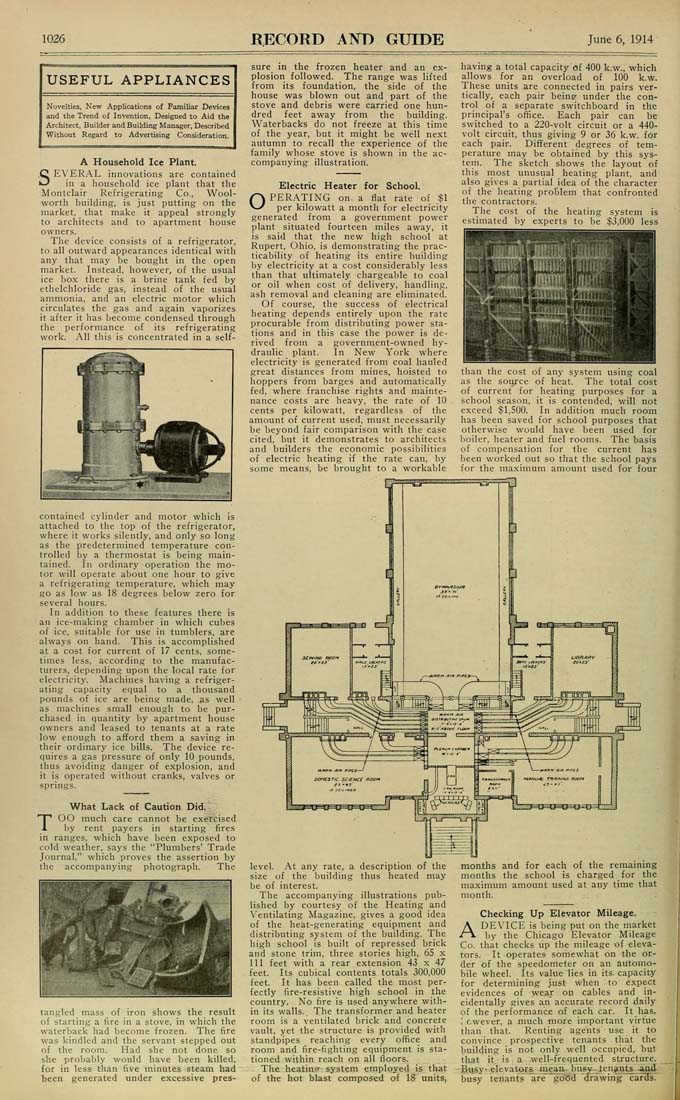
1026 R:EC0RD AND GUIDE June 6, 1914 USEFUL APPLIANCES Novelties, New Applications of Familiar Devices and the Trend of Invention, Designed to Aid the Architect, Builder and Building Manager, Described Without Regard to Advertising Consideration. A Household Ice Plant. SEVERAL innovations are contained in a household ice plant that the Montclair Refrigerating Co., Wool- worth building, is just putting on the market, that make it appeal strongly to architects and to apartment house owners. The device consists of a refrigerator, to all outward appearances identical with any that may be bought in the open market. Instead, however, of the usual ice box there is a brine tank fed by ethelchloride gas, instead of the usual ammonia, and an electric motor which circulates the gas and again vaporizes it after it has become condensed through the performance of its refrigerating work. All this is concentrated in a self- contained cylinder and motor which is attached to the top of the refrigerator, where it works silently, and only so long as the predetermined temperature con¬ trolled by a thermostat is being main¬ tained. In ordinary operation the mo¬ tor will operate about one hour to give a refrigerating temperature, which may go as low as 18 degrees below zero for several hours. In addition to these features there is an ice-making chamber in which cubes of ice, suitable for use in tumblers, are always on hand. This is accomplished at a cost for current of 17 cents, some¬ times less, according to the manufac¬ turers, depending upon the local rate for electricity. Machines having a refriger¬ ating capacity equal to a thousand pounds of ice are beina; made, as well as machines small enough to be pur¬ chased in quantity by apartment house owners and leased to tenants at a rate low enough to afford them a saving in their ordinary ice bills. The device re¬ quires a gas pressure of only 10 pounds, thus avoiding danger of explosion, and it is operated without cranks, valves or springs. What Lack of Caution Did.' TOO much care cannot be exeiiised by rent payers in starting fires in ranges, which have been exposed to cold weather, says the "Plumbers' Trade Journal," which proves the assertion by the accompanying photograph. The tangled mass of iron shows the result of starting a fire in a stove, in which the waterback had become frozen. The fire was kindled and the servant stepped out of the room. Had she not done so she probably would have been killed, for in less than five minutes st^am had been generated under excessive pres- sure_ in the frozen heater and an ex¬ plosion followed. The range was lifted from its foundation, the side of the house was blown out and part of the stove and debris were carried one hun¬ dred feet away from the building. Waterbacks do not freeze at this time of the year, but it might be well next autumn to recall the experience of the family whose stove is shown in the ac¬ companying illustration. Electric Heater for School. OPERATING on a flat rate of $1 per kilowatt a month for electricity generated from a government power plant situated fourteen miles away, it is said that the new high school at Rupert, Ohio, is demonstrating the prac¬ ticability of heating its entire building by electricity at a cost considerably less than that ultimately chargeable to coal or oil when cost of delivery, handling, ash removal and cleaning are eliminated. Of course, the success of electrical heating depends entirely upon the rate procurable from distributing power sta¬ tions and in this case the power is de¬ rived from a government-owned hy¬ draulic plant. In New York where electricity is generated from coal hauled great distances from mines, hoisted to hoppers from barges and automatically fed, where franchise rights and mainte¬ nance costs are heavy, the rate of 10 cents per kilowatt, regardless of the amount of current used, must necessarily be beyond fair comparison with the case cited, but it demonstrates to architects and builders the economic possibilities of electric heating if the rate can, by some means, be brought to a workable having a total capacity of 400 k.w., which allows for an overload of 100 k.w. These units are connected in pairs ver¬ tically, each pair beine- under the con¬ trol of a separate switchboard in the principal's office. Each pair can be switched to a 220-volt circuit or a 440- volt circuit, thus giving 9 or 36 k.w. for each pair. Different degrees of tem¬ perature may be obtained by this sys¬ tem. The sketch shows the layout of this most unusual heating plant, and also gives a partial idea of the character of the heating problem that confronted the contractors. The cost of the heating system is estimated by experts to be $3,000 less mi r 1 than the cost of any system using coal as the soijrce of heat. The total cost of current for heating purposes for a school season, it is contended, will not exceed $1,500. In addition much room has been saved for school purposes that otherwise would have been used for boiler, heater and fuel rooms. The basis of compensation for the current has been worked out so that the school pays for the maximum amount used for four J level. At any rate, a description of the size of the building thus heated may be of interest. The accompanying illustrations pub¬ lished by courtesy of the Heating and Ventilating Magazine, gives a good idea of the heat-generating equipment and distributing system of the building. The high school is built of repressed brick and stone trim, three stories high, 65 x 111 feet with a rear extension 43 x 47 feet. Its cubical contents totals 300,000 feet. It has been called the most per¬ fectly fire-resistive high school in the country. No fire is used anywhere with¬ in its walls.. The transformer and heater room is a ventilated brick and concrete vault, yet the structure is provided with standpipes reaching every office and room and fire-fighting equipment is sta¬ tioned within reach on all floors^ - The heatin.?- system eniployed is that of the hot blast composed of 18^ units. months and for each of the remaining months the school is charged _ for the maximum amount used at any time that month. Checking Up Elevator Mileage. A DEVICE is being put on the market by the Chicago Elevator Mileage Co. that checks tip the mileage Of eleva¬ tors. It operates somewhat on the or¬ der of the speedometer on an avftomo:- bile wheel. Its value lies in its. capacity for deterniining j.ust when to expect evidences of wear on cables and in¬ cidentally gives an accurate record daily of the performance of each car. It has, however, a much more important virtue than that. Renting agents- use it to convince prospective tenants that the building is not only well occupied, but that it.; is a Avell-freqiiented structurp. -^ijsy• el e va tors -laeaii-b usy-i e njtnts an.it busy tenants are goTfd'"drawiiig cards.