
Columbia University Libraries Digital Collections: The Real Estate Record
Use your browser's Print function to print these pages.
Real estate record and builders' guide: [v. 93, no. 2412: Articles]: June 6, 1914
Text version:
Please note: this text may be incomplete. For more information about this OCR, view About OCR text.
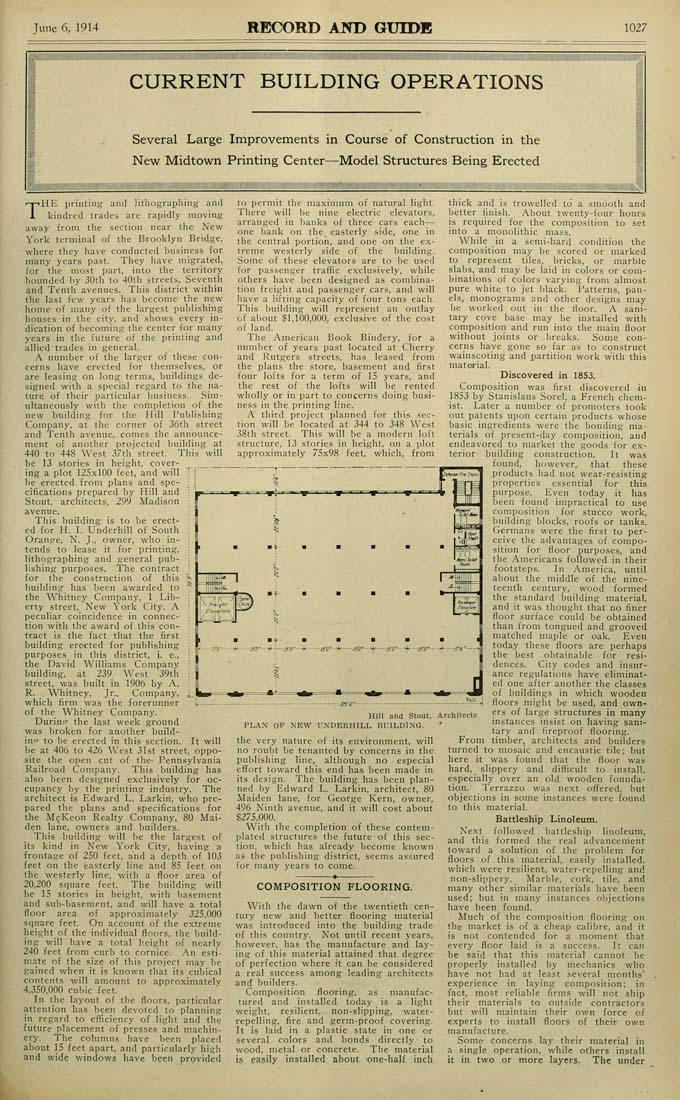
June 6, 1914 RECORD AND GUIDE 1027 illliBiH^^^^^^^^^^ .......I.....xiiinin.......(f I CURRENT BUILDING OPERATIONS I Several Large Improvements in Course of Construction in the | I New Midtown Printing Center—Model Structures Being Erected | I I .Bum.....■.....I.....■lilllM^^^^^^^^ THE printing and lithographing and to permit the maximum of natural light kindred trades are rapidly moving J_'^^|;<^__;^'!}. 1^1_,"_'"!, ^J".*!'^. 1'^^?'.°''^ away from the section near the New York terminal of the Brooklyn Bridge, where they have conducted business for many years past. They have migrated, for the most part, into the territory bounded by 30th to 40th streets. Seventh ahd Tenth avenues. This district within the last few years has become the new arranged in banks of three cars each- one bank on the_ easterly side, one in the central portion, and one on the ex¬ treme westerly side of the building. Some of these elevators are to be used for passenger traffic exclusively, while others have been designed as combina¬ tion freight and passenger cars, and will have a lifting capacity of four tons each. home of many of the largest publishing This building will represent an outlay I houses in the city, and shows every in dication of becoming the center for many years in the future of the printing and allied trades in general. A number of the larger of these con¬ cerns have erected for themselves, or are leasing on long terms, buildings de¬ signed with a special regard to the na¬ ture of their particular business. Sim¬ ultaneously with the completion of the new building for the Hill Publishing Company, at the corner of 36th street and Tenth avenue, comes the announce¬ ment of another projected building at 440 to 448 West 37th street. This will be 13 stories in height, cover-_____ ing a plot 125x100 feet, and will Tl be erected from plans and spe¬ cifications prepared by Hill and Stout, architects, 299 Madison ; avenue. i This building is to be erect- ; ed for H. I. Underhill of South ; Oranp-e, N. J., owner, who in- ; tends to lease it for printing, i lithographing and general pub- i lishing purposes. The contract \ for the construction of this 'j building has been awarded to ^ the Whitney Coinpany, 1 Lib- ; erty street, New York City. A i peculiar coincidence in connec- i tion with the award of this con- i tract is the fact that the first i building erected for publishing | purposes in this district, i. e., I the David Williams Company i building, at 239 West 39th j street, was built in 1906 by A. i R. Whitney, Jr., Company, i_ which firm was the forerunner k.......... of the Whitney Company. Durinsr the last week ground was broken for another build- ino- to be erected in this section. It will be at 406 to 426 West 31st street, oppo¬ site the open cut of the- Pennsylvania Railroad Company. This building has also been designed exclusively for oc¬ cupancy by the printing industry. The architect is Edward L. Larkin, who pre¬ pared the plans and specifications for the MfKeon Realty Company, 80 Mai¬ den lane, owners and builders of about $1,100,000, exclusive of the cost of land. The American Book Bindery, for a nuinber of years past located at Cherry and Rutgers streets, has leased from the plans the store, basement and first four lofts for a term of 15 years, and the rest of the lofts will be rented wholly or in part to concerns doing busi¬ ness in the printing line. A third project planned for this sec¬ tion will be located at 344 to 348 West 38th street. This will be a modern loft structure, 13 stories in height, on a plot approximately 75x98 feet, which, from I 'ffvm-Rn Sivifs ffn i^ \ Freit Freight f/eyafars / Nil/ M /S'S----if.--—IS'0'---if----lff--Jf—-a1ll'--^»--i Hill and Stout, PLAN OF NBW UNDERHILL BUILDING. the very nature of its environment, will no roubt be tenanted by concerns in the publishing line, although no especial effort toward this end has been made in its design. The building has been plan¬ ned by Edward L. Larkin, architect, 80 Maiden lane, for George Kern, owner, 496 Ninth avenue, and it will cost about $275,000. With the completion of these contem- This building will be the largest of plated structures the future of this sec- its kind in New York City, having a tion, which has already become known frontage of 250 feet, and a depth of 103 as the publishing district, seems assured feet on the easterly line and 85 feet on for many years to come. the westerly line, with a floor area of -----------*----------- 20,200 square feet. The building will be 15 stories in height, with basement and sub-basement, and will have a total floor area of approximately 325,000 COMPOSITION FLOORING. With the dawn of the twentieth cen- - - . tury new and better flooring material square feet. On account of the extreme was introduced into the building trade height of the individual floors, the build ing will have a total height of nearly 240 feet from curb to cornice. An esti¬ mate of the size of this project may be gained when it is known that its cubical contents will amount to approximately ■4,350,000 cubic feet. In the layout of the floors, particular of this country. Not until recent years, however, has the manufacture and lay¬ ing of this material attained that degree of perfection where it can be considered a real success among leading architects and builders. Composition flooring, as manufac¬ tured and installed today is a light attention has been devoted to planning weight, resilient,, non-slipping, water m regard to efficiency of light and the repelling, fire and germ-proof covering, future placement of presses and machin- It is laid in a plastic state in one or ery. The columns have been placed several colors and bonds directly to about IS feet apart, and particularly high wood, metal or concrete. The material and wide windows have been provided i? easily installed about one-half inch thick and is trowelled td a smooth and better finish. About twenty-four hours is required for the composition to set into a monolithic mass. While in a semi-hard condition the composition may be scored or marked to represent tiles, bricks, or marble slabs, and may be laid in colors or com¬ binations of Colors varying from almost pure white to jet black. Patterns, pan¬ els, monograms and other designs may be worked out in the floor. A sani¬ tary cove base may be installed with composition and run into the main floor without joints or breaks. Some con¬ cerns have gone so far as to construct wainscoting and partition work -with this material. Discovered in 1853. Composition was first discovered in 1853 by Stanislaus Sorel, a French chem¬ ist. Later a number of promoters took out patents upon certain products whose basic ingredients were the bonding ma¬ terials of present-day composition, and endeavored to market the goods for ex¬ terior building construction. It was found, however, that these products had not wear-resisting properties essential for this purpose. Even today it has been found impractical to use composition for stucco work, building blocks, roofs or tanks. Germans were the first to per¬ ceive the advantages of compo¬ sition for floor purposes, and the Americans followed in their footsteps. In America, until about the middle of the nine¬ teenth century, wood formed the standard building material, and it was thought that no finer floor surface could be obtained than from tongued and grooved matched maple or oak. Even today these floors are perhaps the best obtainable for resi¬ dences. City codes and insur¬ ance regulations have eliminat¬ ed one after another the classes of buildings in which wooden floors might be used, and own¬ ers of large structures in many instances insist on having sani¬ tary and fireproof flooring. From timber, architects and builders turned to mosaic and encaustic tile; but here it was found that the floor was hard, slippery and difficult to install, especially over an old wooden founda¬ tion. Terrazzo was next offered, but objections in some instances were found to this material. Battleship Linoleum. Next followed battleship linoleum, and this formed the real advancement toward a solution of the problem for floors of this material, easily installed, which were resilient, water-repelling and non-slippery. Marble, cork, tile, and many other sii-nilar materials have been used; but in many instances objections have been found. Much of the composition flooring on the market is of a cheap calibre, and it is not contended for a moment that every floor laid is a success. It can be said that this material cannot be properly installed by mechanics who have not had at least several months' experience in laying composition; in fact, most reliable firms will not ship their materials to outside contractors but will maintain their own force of experts to install floors of their own manufacture. Some- concerns lay their material in a single operation, while others install it in two or more layers. "The under ->f—-/r'6-— Architects