
Columbia University Libraries Digital Collections: The Real Estate Record
Use your browser's Print function to print these pages.
Real estate record and builders' guide: [v. 94, no. 2420: Articles]: August 1, 1914
Text version:
Please note: this text may be incomplete. For more information about this OCR, view About OCR text.
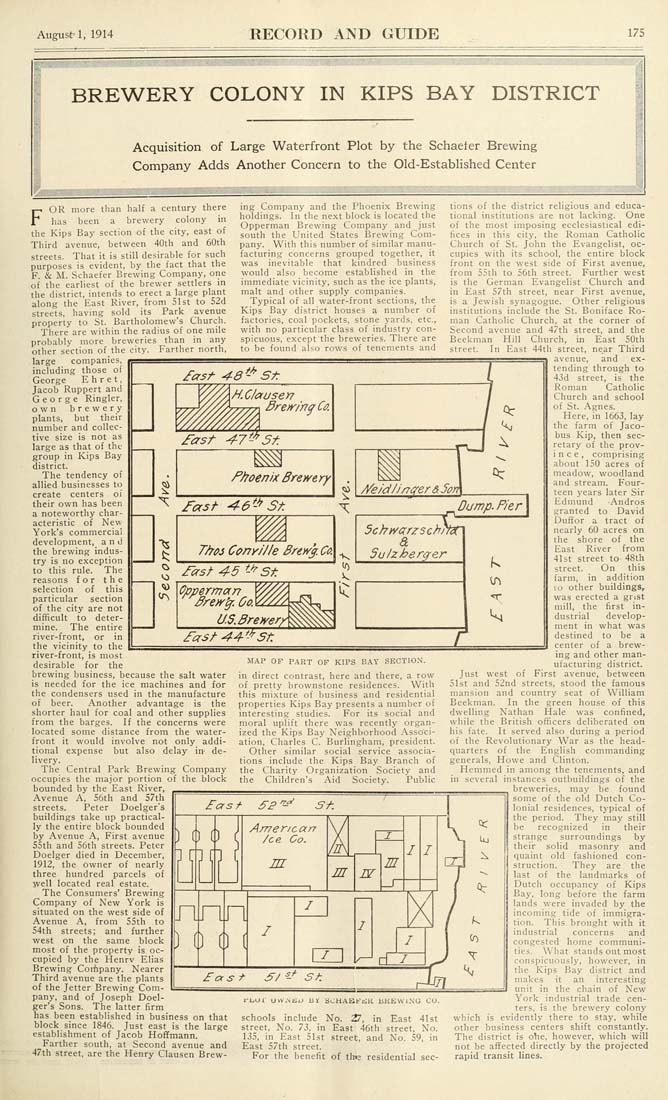
August'1, 1914 RECORD AND GUIDE 175 iii^^ ■ I BREWERY COLONY IN KIPS BAY DISTRICT Acquisition of Large Waterfront Plot by the Schaeter Brewing Company Adds Another Concern to the Old-Established Center ■Mil ililili iiiiaiiiliiiil^ !'"Ei3ili Farther north, HXhusen £ast ^7 t ^ Sasf ^e'-''St p. OR more than half a century there r* has been a brewery colony in the Kips Bay section of the city, east of Third avenue, between 40th and 60th streets. That it is still desirable for such purposes is evident, by the fact that the F. & M. Schaefer Brewing Company, one of the earliest of the brewer settlers in the district, intends to erect a large plant along the East River, from Slst to 52d streets, having sold its Park avenue property to St. Bartholomew's Church. There are within the radius of one mile probably more breweries than in any other section of the city. ■^- ■' *"'- large companies, including those of George Ehret, Jacob Ruppert and George Ringler, own brewery plants, but their number and collec¬ tive size is not as large as that of the group in Kips Bay district. The tendency of allied businesses to create centers oi" their own has been a noteworthy char¬ acteristic of New York's commercial development, and the brewing indus¬ try is no exception to this rule. The reasons for the selection of this particular section of the city are not difficult to deter¬ mine. The entire river-front, or in the vicinity to the river-front, is most desirable for the brewing business, because the salt water is needed for the ice machines and for the condensers used in the manufacture of beer. Another advantage is the shorter haul for coal and other supplies from the barges. If the concerns were located some distance from the water¬ front it would involve not only addi¬ tional expense but also delay in- de¬ livery. The Central Park Brewing Company occupies the major portion of the block bounded by the East River, Avenue A, 56th and 57th streets. Peter Doelger's buildings take up practical¬ ly the entire block bounded by Avenue A, First avenue S5th and 56th streets. Peter Doelger died in December, 1912, the owner of nearly three hundred parcels of svell located real estate. The Consumers' Brewing Company of New York is situated on the west side of Avenue A, from 55th to 54th streets; and further west on the same block most of the property is oc¬ cupied by the Henrv Elias Brewing Corhpany. Nearer Third avenue are the plants of the Jetter Brewing Com¬ pany, and of Joseph Dod¬ ger's Sons. The latter firm has been established in business on that block since 1846. Just east is the large establishment of Jacob Hoffmann. Farther south, at Second avenue and 47th street, are the Henry Clausen Brew¬ ing Company and the Phoenix Brewing holdings. In the next block is located the Opperman Brewing Company and just south the United States Brewing Com¬ pany. With this number of similar manu¬ facturing concerns grouped together, it was inevitable that kindred business would also become established in the immediate vicinity, such as the ice plants, malt and other supply companies. Typical of all water-front sections, the Kips Bay district houses a number of factories, coal pockets, stone yards, etc., with no particular class of industry con¬ spicuous, except the breweries. There are to be found also rows of tenements and £ast ^6'^ St Ftroenix Brovery T/r^j Corry/'/le Bre^v^. Ca fas)- 45 ^-^St Oppermo(r7 ^^ 'TksTTWst A^eld/Jn^er & So> ____________ DumpPier Schy/arzschrtdT a Su/zbergrer MAP OF PAHT OF KIPS BAY SECTION. in direct contrast, here and there, a row of pretty brownstone residences. With this mixture of business and residential properties Kips Bay presents a number of interesting studies. For its social and moral uplift there was recently organ¬ ized the Kips Bay Neighborhood Assoti- ation, Charles C. Burlingham, president. Other similar social service associa¬ tions include the Kips Bay Branch of the Charity Organization Society and the Children's Aid Society. Public ) 0 0 tions of the district religious and educa¬ tional institutions are not lacking. One of the most imposing ecclesiastical edi¬ fices in this city, the Roman Catholic Church of St. John the Evangelist, oc¬ cupies with its school, the entire block front on the west side of First avenue, from 55th to 56th street. Further west is the German Evangelist Church and in East 57th street, near First avenue, is a Jewish synagogue. Other religious institutions include the St. Boniface Ro¬ man Catholic Church, at the corner of Second avenue and 47th street, and the Beekman Hill Church, in East 50th street. In East 44th street, ne,ar Third avenue, and ex¬ tending through to 43d street, is the Roman Catholic Church and school of St. Agnes. Here, in 1663, lay the farm of Jaco¬ bus Kip, then sec¬ retary of the prov- i n c e , comprising about 150 acres of meadow, woodland and stream. Four¬ teen years later Sir Edmund Andros granted to David Duffor a tract of nearly 60 acres on the shore of the East River from 41st street to 48th street. On this farm, in addition LO other buildings, was erected a grist mill, the first in¬ dustrial develop¬ ment in what was destined to be a ___________________ center of a brew¬ ing and other man¬ ufacturing district. Just west of First avenue, between Slst and 52nd streets, stood the famous mansion and country seat of William Beekman. In the green house of this dwelling Nathan Hale was confined, while the British officers deliberated on his fate. It served also during a period of the Revolutionary War as the head¬ quarters of the English commanding generals, Howe and Clinton. Hemmed in among the tenements, and in several instances outbuildings of the breweries, may be found ± Fasf SF nc^ s/-. nnn J 0 0 ( Amer/can /ce Co. m m JY I I I I Fast S/ ^-^ St rL.ui uvVNuJiJ HX SCHABFclR BKEWlNG CO. schools include No. 27, in East 41st street, No. 73, in East 46th street. No. 135, in East Slst street, and No. 59, in East 57th street. For the benefit of th«2 residential sec- some of the old Dutch Co¬ lonial residences, typical of the period. They may still be recognized in their strange surroundings by their solid masonry and quaint old fashioned con¬ struction. They are the last of the landmarks of Dutch occupancy of Kips Bay, long before the farm lands were invaded by the incoming tide of immigra¬ tion. This brought with it industrial concerns and congested home communi¬ ties. What stands out most conspicuously, however, in k^ the Kips Bay district and makes it an interesting unit in the chain of New York industrial trade cen¬ ters, is the brewery colony which is evidently there to stay, while other business centers shift constantly. The district is ohe, however, which will not be aflfected directly by the projected rapid transit lines.