
Columbia University Libraries Digital Collections: The Real Estate Record
Use your browser's Print function to print these pages.
Real estate record and builders' guide: [v. 94, no. 2425: Articles]: September 5, 1914
Text version:
Please note: this text may be incomplete. For more information about this OCR, view About OCR text.
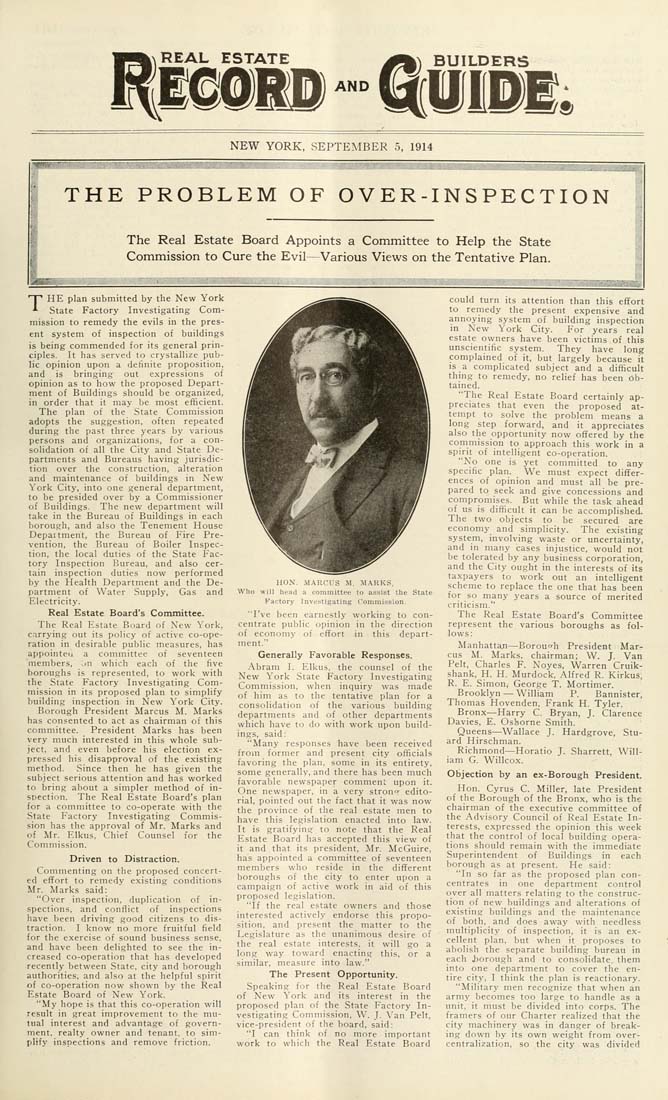
REAL ESTATE AND NEW YORK, vSEPTEMBER 5, 1914 liinBllliBlBilililH^ iiliilHIIiiilli^^^^ THE PROBLEM OF O V ER-INS PECTI ON ■ ■ s iBBiPI The Real Estate Board Appoints a Committee to Help the State Commission to Cure the Evil—Various Views on the Tentative Plan. IliliiWiiiiM^^^ aBiiiiiiliWIMWiM^^^ T^ HE plan submitted by the New York ^ State Factory Investigating Com¬ mission to remedy the evils in the pres¬ ent system of inspection of buildings is being commended for its general prin¬ ciples. It has served to crystallize pub¬ lic opinion upon a definite proposition, and is bringing out expressions of opinion as to how the proposed Depart¬ ment of Buildings should be organized, in order that it may be most efficient. The plan of the State Commission adopts the suggestion, often repeated during the past three years by various persons and organizations, for a con¬ solidation of ail the City and State De¬ partments and Bureaus having jurisdic¬ tion over the construction, alteration and maintenance of buildings in New York City, into one general department, to be presided over by a Commissioner of Buildings. The new department will take in the Bureau of Buildings in each borough, and also the Tenement House Department, the Bureati of Fire Pre¬ vention, the Bureau of Boiler Inspec¬ tion, the local duties of the State Fac¬ tory Inspection Bureau, and also cer¬ tain inspection duties now performed by the Health Department and the De¬ partment of Water Supply, Gas and Electricity. Real Estate Board's Committee. The Real Estate Board of New York, carrying out its policy of active co-ope¬ ration in desirable public measures, has appointeu a committee of seventeen members, -on which each of the five boroughs is represented, to work with the State Factory Investigating Com¬ mission in its proposed plan to simplify building inspection in New York City. Borough President Marcus M. Marks has consented to act as chairman of this committee. President Marks has been very mucn interested in this whole sub¬ ject, and even before his election ex¬ pressed his disapproval of the existing method. Since then he has given the subject serious attention and has worked to bring about a simpler method of in¬ spection. The Real Estate Board's plan for a committee to co-operate with the State Factory Investigating Commis¬ sion has the approval of Mr. Marks and of Mr. Elkus. Chief Counsel for the Commission. Driven to Distraction. Commenting on the proposed concert¬ ed effort to remedy existing conditions Mr. Marks said: "Over inspection, duplication of in¬ spections, and coniiict of inspections have been driving good citizens to dis¬ traction. I know no more fruitful field for the exercise of sound business sense, and have been delighted to see the in¬ creased co-operation that has developed recently between State, city and borough authorities, and also at the helpful spirit of co-operation now shown by the Real Estate Board of New York. "My hope is that this co-operation will result in great improvement to the mu¬ tual interest and advantage of govern¬ ment, realty owner and tenant, to sim¬ plify inspections and remove friction. HON. MARCUS M. MARKS, Who will head a committee to assist the State Factory Investigating Commission. "T've been earnestly working to con¬ centrate public opinion in the direction of economy of effort in this depart¬ ment.'' Generally Favorable Responses. Abram I. Elkus. the counsel of the New York State Factory Investigating Commission, when inquiry was made of him as to the tentative plan for a consolidation of the various building departments and of other departments which have to do with work upon build¬ ings, said: "Many responses have been received from former and present city officials favoring the plan, some in its entirety, some generally, and there has been much favorable newspaper comment upon it. One newspaper, in a very strono- edito¬ rial, pointed out the fact that it was now the province of the real estate men to have this legislation enacted into law. It is gratify ins: to note that the Real Estate Board has accepted this view of it and that its president, Mr. McGuire, has appointed a committee of seventeen members who reside in the different boroughs of the city to enter upon a campaign of active work in aid of this proposed legislation. "If the real estate owners and those interested actively endorse this propo¬ sition, and present the matter to the Legislature as the unanimous desire of the real estate interests, it will go a long way toward enactincr this, or a similar, measure into law." The Present Opportunity. Speaking for the Real Estate Board of New York and its interest in the proposed plan of the State Factory In¬ vestigating Commission. W. J. \'an Pelt, vice-president of the board, said: "I can think of no more important work to which the Real Estate Board could turn its attention than this effort to remedy the present expensive and annoying system of building inspection in New York City. For years real estate owners have been victims of this unscientific system. They have long complained of it, but largely because it IS a complicated subject and a difficult thing to remedy, no relief has been ob¬ tained. "The Real Estate Board certainly ap¬ preciates that even the proposed at¬ tempt to solve the problem means a long step forward, and it appreciates also the opportunity now offered by the commission to approach this work in a spirit of intelligent co-operation. "No one is yet committed to any specific plan. We must expect differ¬ ences of opinion and must all be pre¬ pared to seek and give concessions and compromises. But while the task ahead of us is difficult it can be accomplished. The two objects to be secured are economy and simplicity. The existing system, involving waste or uncertainty, and in many cases injustice, would not be tolerated by any business corporation, and the City ought in the interests of its taxpayers to work out an intelligent scheme to replace the one that has been for so many years a source of merited criticism." The Real Estate Board's Committee represent the various boroughs as fol¬ lows: Manhattan—Borou'^rh President Mar¬ cus M. Marks, chairman; W. J. Van Pelt, Charles F. Noyes, Warren Cruik¬ shank, H. H. Murdock, Alfred R. Kirkus, R. E. Simon, George T, Mortimer. Brooklyn — William P. Bannister, Thomas Hovenden. Frank H. Tyler. Bronx—Harry C. Bryan, J. Clarence Davies, E. Osborne Smith. Queens—Wallace J. Hardgrove, Stu¬ ard Hirschman. Richmond—Horatio J. Sharrett, Will¬ iam G. Willcox. Objection by an ex-Borough President. Hon. Cyrus C. Miller, late President of the Borough of the Bronx, who is thc chairman of the executive committee of the Advisory Council of Real Estate In¬ terests, expressed the opinion this week that the control of local building opera¬ tions should remain with the immediate Superintendent of Buildings in each borough as at present. He said: "In so far as the proposed plan con¬ centrates in one department control over all matters relating to the construc¬ tion of new buildings and alterations of existing buildings and the maintenance of both, and does away with needless multiplicity of inspection, it is an ex¬ cellent plan, but when it proposes to abolish the separate building bureau in each i^orough and to consolidate, them into one department to cover the en¬ tire city, I think the plan is reactionary. "Military men recognize that when an army becomes too large to handle as a unit, it must be divided into corps. The framers of our Charter realized that the city machinery was in danger of break¬ ing down by its own weight from over- centralization, so the city was divided