
Columbia University Libraries Digital Collections: The Real Estate Record
Use your browser's Print function to print these pages.
Real estate record and builders' guide: [v. 95, no. 2462: Articles]: May 22, 1915
Text version:
Please note: this text may be incomplete. For more information about this OCR, view About OCR text.
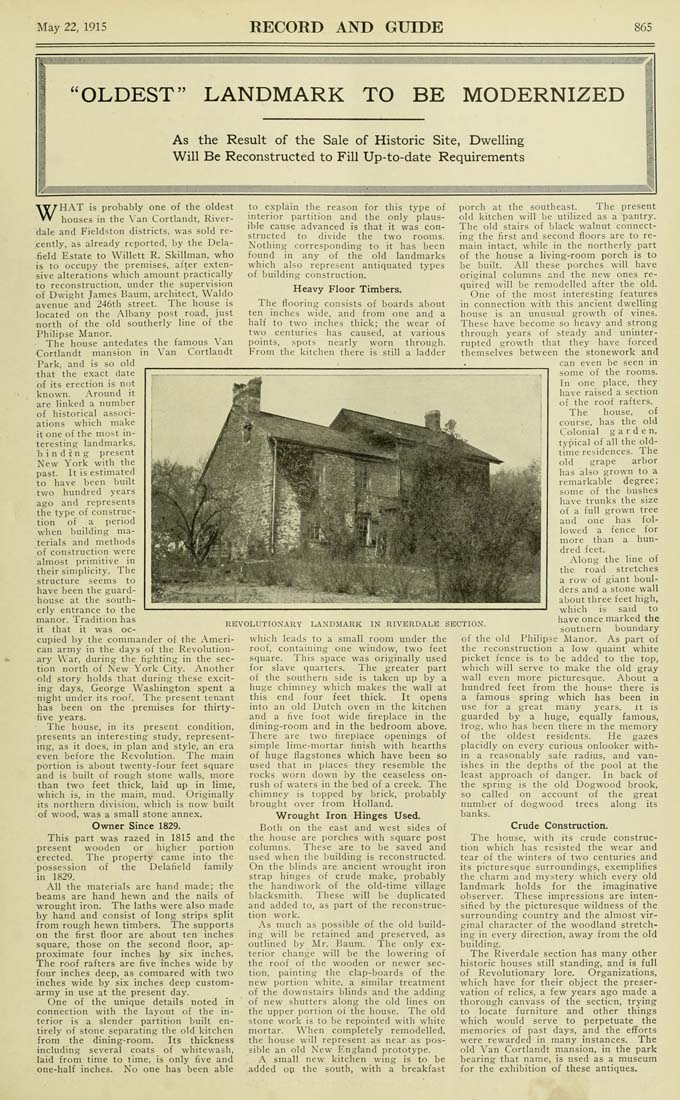
May 22, 1915 RECORD AND GUIDE 865 "OLDEST" LANDMARK TO BE MODERNIZED As the Result of the Sale of Historic Site, DweUing Will Be Reconstructed to Fill Up-to-date Requirements jiiiim iiiiiiill^^ ■illiiiliW^^^^^^^^^ WHAT is probably one of the oldest houses in the Van Cortiandt, River¬ dale and Fieldston districts, was sold re¬ cently, as already reported, by the Dela¬ field Estate to Willett R. Skillman, who is to occupy the premises, after exten¬ sive alterations which amount practically to reconstruction, under the supervision of Dwight James Baum, architect, Waldo avenue and 246th street. The house is located on the Albany post road, just north of the old southerly line of the Philipse Manor. The house antedates the famous Van Cortiandt mansion in Van Cortiandt Park, and is so old that the exact date of its erection is not known. Around it are linked a number of historical associ¬ ations which make it one of the most in¬ teresting landmarks, bind i'n g present New York with the past. It is estimated to have been built two hundred years ago and represents the type of construc¬ tion of a period when building ma¬ terials and methods of construction were almost primitive in their simplicity. The structure seems to have been the guard¬ house at the south¬ erly entrance to the manor. Tradition has it that it was oc¬ cupied by the commander of the Ameri¬ can army in the days of the Revolution¬ ary War. during the fighting in the sec¬ tion north of New York City. Another old story holds that during these excit¬ ing days, George Washington spent a night under its roof. The present tenant has been on the premises for thirty- five years. The house, in its present condition, presents an interesting study, represent¬ ing, as it does, in plan and style, an era even before the Revolution. The main portion is about twenty-four feet square and is built of rough stone walls, more than two feet thick, laid up in lime, which is, in the main, mud. Originally its northern division, which is now built of wood, was a small stone annex. Owner Since 1829. This part was razed in 1815 and the present wooden or higher portion erected. The property came into the possession of the Delafield family in 1829. All the materials are hand made; the beams are hand hewn and the nails of wrought iron. The laths were also made by hand and consist of long strips split from rough hewn timbers. The supports on the first floor are about ten inches square, those on the second floor, ap¬ proximate four inches by six inches. The roof rafters are five inches wide by four inches deep, as comoared with two inches wide by six inches deep custom- army in use at the present day. One of the unique details noted in connection with the laj'out of the in¬ terior is a slender partition built en¬ tirely of stone separating the old kitchen from the dining-room. Its thickness including several coats of whitewash, laid from time to time, is only five and one-half inches. No one has been able to explain the reason for this type of interior partition and the only plaus¬ ible cause advanced is that it was con¬ structed to divide the two rooms. Nothing corresponding to it has been found in any of the old landmarks which also represent antiquated types of building construction. Heavy Floor Timbers. The flooring consists of boards about ten inches wide, and from one and a half to two inches thick; the wear of two centuries has caused, at various points, spots nearly worn through. From the kitchen there is still a ladder REVOLUTIONARY LANDMARK IN RIVERDALE SECTION. which leads to a small room under the roof, containing one window, two feet square. This space was originally used for slave quarters. The greater part of the southern side is taken up by a huge chimney which makes the wall at this end four feet thick. It opens into an old Dutch oven ni the kitchen and a five foot wide fireplace in the dining-room and in the bedroom above. There are two fireplace openings of simple lime-mortar finish with hearths of huge flagstones which have been so used that in places they resemble the rocks worn down by the ceaseless on¬ rush of waters in the bed of a creek. The chimney is topped by brick, probably brought over from Holland. Wrought Iron Hinges Used. Botli on the east and west sides of the house are porches with square post columns. These are to be saved and used when the building is reconstructed. On the blinds are ancient wrought iron strap hinges of crude make, probably the handiwork of the old-time village blacksmith. These will be duplicated and added to, as part of the reconstruc¬ tion work. As much as possible of the old build¬ ing will be retained and preserved, as outlined by Mr. Baum. The only ex¬ terior change will be the lowering of the roof of the wooden or newer sec¬ tion, painting the clap-boards of the new portion white, a similar treatment of the downstairs blinds and the adding of new shutters along the old lines on the upper portion oi the house. The old stone work is to be repointed with white mortar. When completely remodelled, the house will represent as near as pos¬ sible an old New England prototype. A small new kitchen wing is to be added on the south, with a breakfast porch at the southeast. The present old kitchen will be utilized as a pantry. The old stairs of black walnut connect¬ ing the first and second floors are to re¬ main intact, while in the northerly part of the house a living-room porch is to be built. All these porches will have original columns and the new ones re¬ quired will be remodelled after the old. One of the most interesting features in connection with this ancient dwelling house is an unusual growth of vines. These have become so heavy and strong through years of steady and uninter¬ rupted growth that they have forced themselves between the stonework and can even be seen in some of the rooms. In one place, they have raised a section of the roof rafters. The house, of course, has the old Colonial garden, typical of all the old- time residences. The old grape arbor has also grown to a remarkable degree; some of the bushes have trunks the size of a full grown tree and one has fol¬ lowed a fence for more than a hun¬ dred feet. Along the line of the road stretches a row of giant boul¬ ders and a stone wall about three feet high, which is said to have once marked the soutnern boundary of the old Philipse Manor. As part of the reconstruction a low quaint white picket fence is to be added to the top, which will serve to make the old gray wall even more picturesque. About a hundred feet from the house there is a famous spring which has been in use for a great many years. It is guarded by a huge, equally famous, irog, who has been there in the memory of the oldest residents. He gazes placidly on every curious onlooker with¬ in a reasonably safe radius, and van¬ ishes in the depths of the pool at the least approach of danger. In back of the spring is the old Dogwood brook, so called on account of the great number of dogwood trees along its banks. Crude Construction. The house, with its crude construc¬ tion which has resisted the wear and tear of the winters of two centuries and its picturesque surroundings, exemplifies the charm and mystery which every old landmark holds for the imaginative observer. These impressions are inten¬ sified by the picturesque wildness of the surrounding country and the almost vir¬ ginal character of the woodland stretch¬ ing in every direction, away from the old building. The Riverdale section has many other historic houses still standing, and is full of Revolutionary lore. Organizations, which have for their object the preser¬ vation of relics, a few years ago made a thorough canvass of the section, trying to locate furniture and other things which would serve to perpetuate the memories of past days, and the efforts were rewarded in many instances. The old Van Cortiandt mansion, in the park bearing that name, is used as a museum for the exhibition of these antiques.