
Columbia University Libraries Digital Collections: The Real Estate Record
Use your browser's Print function to print these pages.
Real estate record and builders' guide: [v. 97, no. 2497: Articles]: January 22, 1916
Text version:
Please note: this text may be incomplete. For more information about this OCR, view About OCR text.
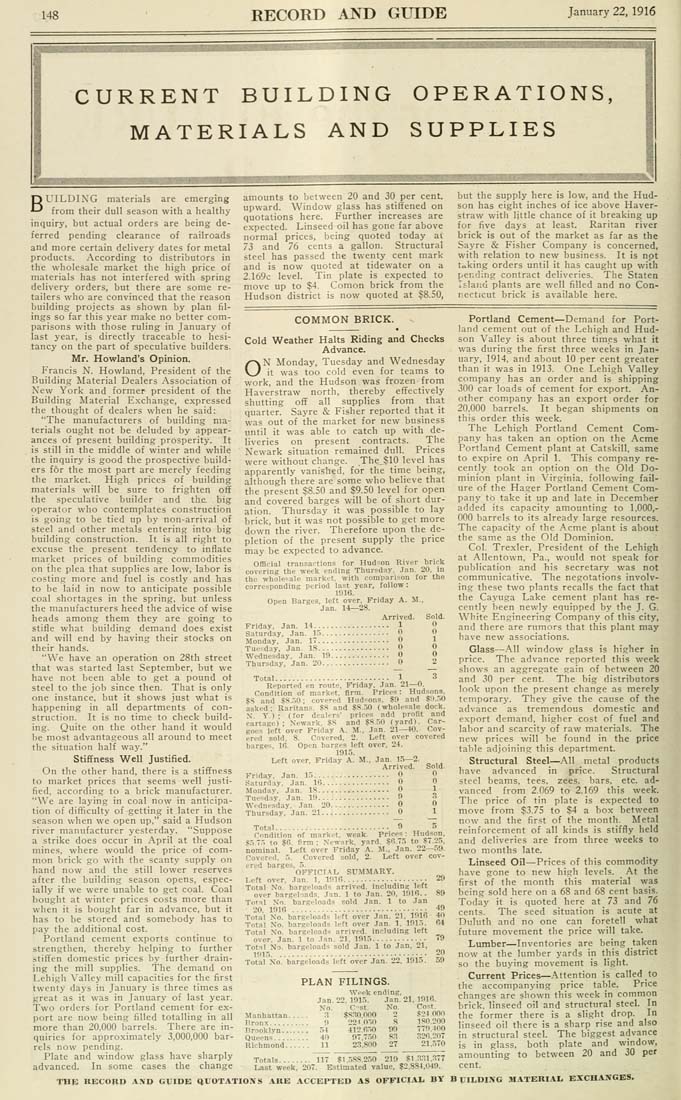
148 RECORD AND GUIDE January 22, 1916 CURRENT BUILDING OPERATIONS, MATERIALS AND SUPPLIES DUILDING materials are emerging *-' from their dull season with a healthy inquiry, but actual orders are being de¬ ferred pending clearance of railroads and more certain delivery dates for metal products. According to distributors in the wholesale market the high price of materials has not interfered with spring delivery orders, but there are some re¬ tailers who are convinced that the reason building projects as shown by plan fil¬ ings so far this year make no better com¬ parisons with those ruling in January of last year, is directly traceable to hesi¬ tancy on the part of speculative builders. Mr. Howland's Opinion. Francis N. Howland, President of the Building Material Dealers .-Association of New York and former president of the Building Material Exchange, expressed the thought of dealers when he said: "The manufacturers of building ma¬ terials ought not be deluded by appear¬ ances of present building prosperity. It is still in the middle of winter and while the inquiry is good the prospective build¬ ers for the most part are merely feeding the market. High prices of building materials will be sure to frighten off the speculative builder and the big operator who contemplates construction is going to be tied up by non-arrival of steel and other metals entering into big building construction. It is all right to excuse the present tendency to inflate market prices of building commodities on the plea that supplies are low, labor is costing more and fuel is costly and has to be laid in now to anticipate possible coal shortages in the spring, but unless the manufacturers heed the advice of wise heads among them they are going to stifle what building demand does exist and will end by having their stocks on their hands. "We have an operation on 28th street that was started last September, but we have not been able to get a pound ot steel to the job since then. That is only one instance, but it shows just what is happening in all departments of con¬ struction. It is no time to check build¬ ing. Quite on the other hand it would be most advantageous all around to meet the situation half way." Stiffness Well Justified, On the other hand, there is a stiffness to market prices that seems well justi¬ fied, according to a brick manufacturer. "We are laying in coal now in anticipa¬ tion of difficulty of getting it later in the season when we open up," said a Hudson river manufacturer yesterday. "Suppose a strike does occur in April at the coal mines, where would the price of com¬ mon brick go with the scanty supply on hand now and the still lower reserves after the building season opens, espec¬ ially if we were unable to get coal. Coal bought at winter prices costs more than when it is bought far in advance, but it has to be stored and somebody has to pay the additional cost. Portland cement exports continue to strengthen, thereby helping to further stiffen domestic prices by further drain¬ ing the mill supplies. The demand on Lehigh Valley mill capacities for the first twenty days in January is three times as great as it was in January of last year. Two orders for Portland cement for ex¬ port are now being filled totalling in all more than 20,000 barrels. There are in¬ quiries for appro.ximately 3,000,000 bar¬ rels now pending. Plate and window glass have sharply advanced. In some cases the change amounts to between 20 and 30 per cent, upward. Window glass has stiffened on quotations here. Further increases are expected. Linseed oil has gone far above normal prices, being quoted today av 73 and 76 cents a gallon. Structural steel has passed the twenty cent mark and is now quoted at tidewater on a 2.169c level. Tin plate is expected to move up to $4. Comon brick from the Hudson district is now quoted at $8.50, but the supply here is low, and the Hud¬ son has eight inches of ice above Haver¬ straw with little chance of it breaking up for five days at least. Raritan river brick is out of the market as far as the Sayre & Fisher Company is concerned, with relation to new business. It is not tcxking orders until it has caught up with pending contract deliveries. The Staten Island plants are well filled and no Con¬ necticut brick is available here. COMMON BRICK. Ot, Cold Weather Halts Riding and Checks Advance. ^N Monday, Tuesday and Wednesday _ was too cold even for teams to work, and the Hudson was frozen from Haverstraw north, thereby effectively shutting off all supplies from that quarter. Sayre & Fisher reported that it was out of the market for new business until it was able to catch up with de¬ liveries on present contracts. The Newark situation remained dull. Prices were without change. TheJlO level has apparently vanished, for the time being, although there are some who believe that the present $8.50 and $9.50 level for open and covered barges will be of short dur¬ ation. Thursday it was possible to lay brick, but it was not possible to get more down the river. Therefore upon the de¬ pletion of the present supply the price may be expected to advance. Official transactions tor Hudson River brick covering the week ending Thursday, Jan. 20, in the wholesale market, with comparison for the corresponding period last year, follow: 1916. Open Barges, left over. Friday A. M., Jan. Ii—28. Arrived. Sold. Friday, Jan. 14.................. 1 0 Saturday, Jan. 15................ 0 0 Monday, Jan. 17................. 0 1 Tue=day, Jan. IS................. 0 0 Wednesday. Jan. 19.............. 0 0 Thursday, Jan. 20................ 0 2 Total........................... 1 3 Reported en route, Friday, Jan. 21—0. Condition of market, firm. Prices: Hudsons. $S and $S..JO; covered Hud=ons. $9 and $!)..)0 asked; Raritans. .?.S and $8.50 (wholesale dock. X Y); (for dealers' prices add profit and cartage); Newark, .$8 and $S..50 fyard). Car¬ goes left over Friday -A.. M., Jan. 21—JO. Cov¬ ered sold, 8. Covered. 2. Left over covered barges, 16. Open barges left over, 24. 1915. Left over, Friday A. M., Jan. 15—2. Friday, Jan. 15..... Saturday, Jan. 16... Monday, Jan. IS.... Tuesday. Jan. 19.... Wfdiipsday, Jan. 20. Thursday, Jan. 21... ived. Sold 0 n 0 n 0 M 9 .3 0 0 0 1 Total........................... 9 5 Condition of market, weak. Prices: Hudson, S.'i 75 to $6. firm; Newark, yard. $6.75 to $7.2.i, nominal. Left over Friday A. M., Jan. 22—f>9. Covered. 5. Covered sold, 2. Lett over cov¬ ered barges, 5. OFFICIAL SUMMARY. Left over, Jan. 1, 1916.................... 29 Total No. bargeloads arrived, including left over bargelnads. Jan. 1 to Jan. 20, 1916.. 89 Tntil No. bargeloads sold Jan. 1 to Jan 20, 1916 ................................ 49 Total No. bargeloads left over Jan. 21. 1916 40 Total No. bargeloads left over Jan. 1. 1915. 64 Total No. bargeloads arrived, including left over. Jan. 1 to Jan. 21, 1915............. 79 Totnl No. bargeloads sold Jan. 1 to Jan, 21, 1915.................................... Total No. bargeloads left over Jan. 22, 191o. 20 59 PLAN FILINGS. WppU. ending. Jan. 22. 1^15. Jan. 21, IHlfi. Ko. Manhattan..... 3 Bronx.......... 0 Brooklyn....... o4 Queens......... 40 Richmond...... 11 Totals........llT $1,588,250 210 -SI .?.?.1."T7 Last week, 207. Estimated value, $2.SS4.(.V10. C-st. No. Cost. $sso.ooo o S24 noo 22J 0"0 8 180,200 41''.fi50 W 779.400 97,750 8.3 326.207 2.3.800 27 21.570 THB RECORD AXD GUIDE QUOTATIONS ARE ACCEPTED AS OFFICIAI. BY Portland Cement—Demand for Port¬ land cement out of the Lehigh and Hud¬ son Valley is about three times what it was during the first three weeks in Jan¬ uary, 1914, and about 10 per cent greater than it was in 1913. One Lehigh Valley company has an order and is shipping 300 car loads of cement for export. An¬ other company has an export order for 20.000 barrels. It began shipments on this order this week. The Lehigh Portland Cement Com¬ pany has taken an option on the Acme Portland Cement plant at Catskill, same to expire on April 1. This company re¬ cently took an option on the Old Do¬ minion plant in Virginia, following fail¬ ure of the Hager Portland Cement Com- panj' to take it up and late in December added its capacity amounting to 1.000,- 000 barrels to its already large resources. The capacity of the Acme plant is about the same as the Old Dominion. Col. Trexler, President of the Lehigh at Allentown, Pa., would not speak for publication and his secretary was not communicative. The negotations involv¬ ing these two plants recalls the fact that the Cayuga Lake cement plant has re¬ cently been newly equipped by the J. G. White Engineering Company of this city, and there are rumors that this plant may have new associations. Glass—."Ml window glass is higher in price. The advance reported this week shows an aggregate sain of between 20 and 30 per cent. The big distributors look upon the present change as merely temporary. They give the cause of the advance as tremendous domestic and export demand, higher cost of fuel and labor and scarcity of raw materials. The new prices will be found in the price talile adjoining this department. Structural Steel—All metal products have advanced in price. Structural steel beams, tees, zees, bars, etc. ad¬ vanced from 2.069 to 2.169 this week. The price of tin plate is expected to move from $3.75 to $4 a box between now and the first of the month. Metal reinforcement of all kinds is stiffly held and deliveries are from three weeks to two months late. Linseed Oil—Prices of this commodity have gone to new high levels. At the first of the month this material was being sold here on a 68 and 68 cent basis. Today it is quoted here at 73 and 76 cents. The seed situation is acute at Duluth and no one can foretell what future movement the price will take. Lumber—Inventories are being taken now at the lumber yards in this district so the buying movement is light. Current Prices—Attention is called to the accompanying price table. Price changes are shown this week in common brick, linseed oil and structural steel. In the former there is a slight drop. In linseed oil there is a sharp rise and also in structural steel. The biggest advance is in glass, both plate and window, amounting to between 20 and 30 per cent. BpiLDING MATERIAIj EXCHANGES.