
Columbia University Libraries Digital Collections: The Real Estate Record
Use your browser's Print function to print these pages.
Real estate record and builders' guide: [v. 97, no. 2503: Articles]: March 4, 1916
Text version:
Please note: this text may be incomplete. For more information about this OCR, view About OCR text.
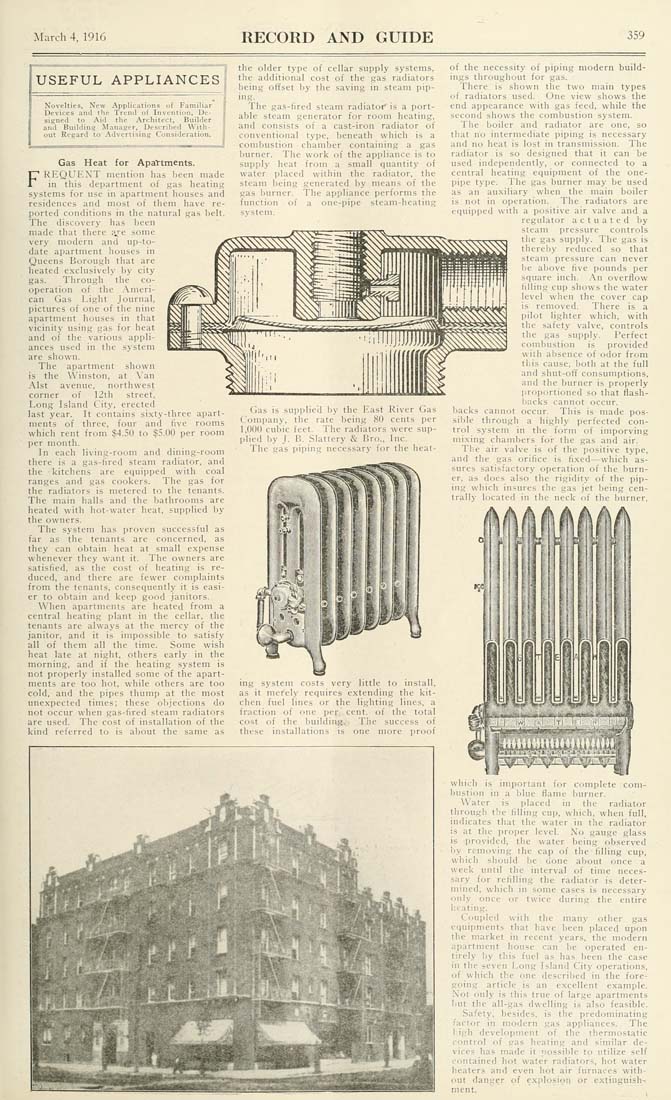
March 4, 1916 RECORD AND GUIDE 359 USEFUL APPLIANCES Novelties, New Applications of Familiar Devices and the Trend of Invention, De¬ signed to Aid tlie Architect, Builder and Building Manager, Described With¬ out Regard to Advertising Consideration. Gas Heat for Apartments. FREQUENT mention has been made in this department of gas heating systems for use in apartment houses and residences and most of them have re¬ ported conditions in the natural gas belt. The discovery has been made that there ?.fe some very modern and up-to- date apartment houses in Queens Borough that are heated exclusively by city gas. Through the co¬ operation of the .Ameri¬ can Gas Light Journal, pictures of one of the nine apartment houses in that vicinity using gas for heat and of the various appli¬ ances used in the system are shown. The apartment shown is the Winston, at \'an Alst avenue, northwest corner of 12th street. Long Island City, erected last year. It contains sixty-three apart¬ ments of three, four and five rooms which rent from $4.50 to $5.00 per room per month. In each living-room and dining-room there is a gas-fired steam radiator, and the kitchens are equiiiped with coal ranges and gas cookers. The gas for the radiators is metered to the tenants. The main halls and the bathrooms are heated with hot-water heat, supplied by the owners. The system has proven successful as far as the tenants are concerned, as they can obtain heat at small expense whenever they want it. The owners are satisfied, as the cost of heating is re¬ duced, and there are fewer complaints from the tenants, consequently it is easi¬ er to obtain and keep good janitors. When apartments are heated from a central heating plant in the cellar, the tenants are always at the mercy of the janitor, and it is impossible to satisfy all of them all the time. Some wish heat late at night, others early in the morning, and if the heating system is not properly installed some of the apart¬ ments are too hot, while others are too cold, and the pipes thump at the most unexpected times; these objections do not occur when gas-fired steam radiators are used. The cost of installation of the kind referred to is about the same as the older type of cellar supply systems, the additional cost of the gas radiators being offset by the saving in steam pip¬ ing. The gas-fired steam radiator' is a port¬ able steam generator for room heating, and consists of a cast-iron radiator of conventional type, beneath which is a comliusticjn chamber containing a gas burner. The work of the appliance is to supply heat from a small quantity of water placed within the radiator, the steam being generated by means of the gas liurncr. The appliance performs the function of a one-pipe steam-heating system. Gas is supplied by the East River Gas Company, the rate being 80 cents per 1.0(1(1 cubic feet. The radiators were sup¬ plied by J. B. Slattery & Bro., Inc. The gas piping necessary for the heat¬ ing system costs very little to install, as it merely requires e.xtending the kit¬ chen fuel lines or the lighting lines, a fraction of one per cent, of the total cost of the building. The success of tliese installations is one more proof of the necessity of piping modern build¬ ings throughout for gas. There is shown the two main types of radiators used. One view shows the end appearance with gas feed, while the second shows the combustion system. The boiler and radiator are one, so that no intermediate piping is necessary and no heat is lost in transmission. The radiator is so designed that it can be used independently, or connected to a central heating equipment of the one- pipe type. The gas burner may be used as an auxiliary when the main boiler is not in operation. The radiators are equipped with a positive air valve and a regulator actuated by steam pressure controls the gas supply. The gas is thereby reduced so that steam pressure can never be above five pounds per square inch. An overflow lining,cup shows the water level when the cover cap is removed. There is a pilot lighter which, with the safety valve, controls x\\NN\\\v<4 the gas supply. Perfect S^J^^^vw combustion is provided with absence of odor from this cause, both at the full and shut-off consumptions, and the burner is properly proportioned so that flash- hacks cannot occur. backs cannot occur. This is made pos¬ sible through a highly perfected con¬ trol system in the form of imporving mixing chambers for the gas and air. Tlie air valve is of the positive type, and the gas orifice is fixed—which as¬ sures satisfactory operation of the burn¬ er, as docs also the rigidity of the pip¬ ing which insures the gas jet being cen¬ trally located in the neck nf the burner. which is important for complete com¬ bustion in a blue flame burner. Water is placed in the radiator through the filling cup, wliich. when full, indicates that the water in the radiator is at the proper level. No gauge glass is provided, the water being observed by removing the cap of the filling cup, which should be done aliout once a week until tlie interval of time neces¬ sary for refilling the radiator is deter¬ mined, which in some cases is necessary only once or twice during the entire heating. Coupled willi the many other gas equipments that have been placed upon the market in recent years, the modern apartment house can be operated en¬ tirely by this fuel as has been the case in the seven Long Island City operations, of which the one described in the fore¬ going article is an excellent example. X'ot only is this true of large apartments liut the all-gas dwelling is also feasible. Safety, besides, is the predominating factor in modern gas appliances. The 1 igh development of the thermostatic control of gas heating and similar de¬ vices has made it possible to utilize self contained hot water radiators, hot water heaters and even hot air furnaces with¬ out dan.ger of explosion or extinguish¬ ment,