
Columbia University Libraries Digital Collections: The Real Estate Record
Use your browser's Print function to print these pages.
Real estate record and builders' guide: [v. 97, no. 2515: Articles]: May 27, 1916
Text version:
Please note: this text may be incomplete. For more information about this OCR, view About OCR text.
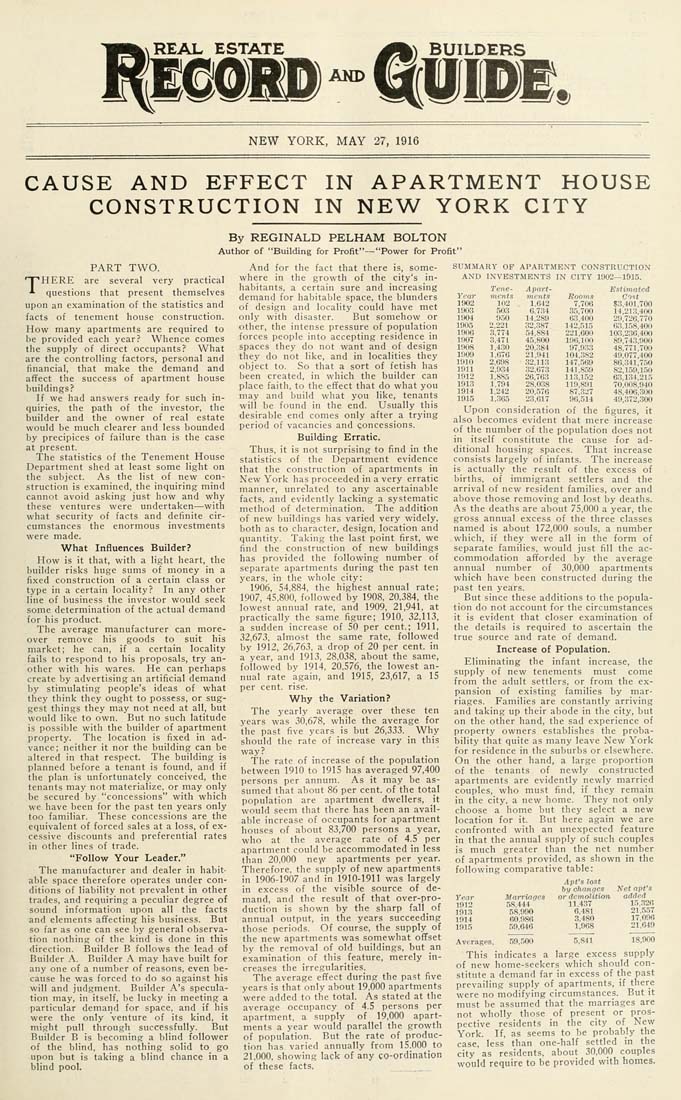
REAL ESTATE AND NEW YORK, MAY 27, 1916 CAUSE AND EFFECT IN APARTMENT HOUSE CONSTRUCTION IN NEW YORK CITY By REGINALD PELHAM BOLTON Author of "Building for Profit"—"Power for Profit" PART TWO. THERE are several very practical questions that present themselves upon an examination of the statistics and facts of tenement house construction. How many apartments are required to be provided each year? Whence comes the supply of direct occupants? What are the controlling factors, personal and financial, that make the demand and affect the success of apartment house buildings? If we had answers ready for such in¬ quiries, the path of the investor, the builder and the owner of real estate would be much clearer and less bounded by precipices of failure than is the case at present. The statistics of the Tenement House Department shed at least some light on the subject. As the list of new con¬ struction is examined, the inquiring mind cannot avoid asking just how and why these ventures were undertaken—with what security of facts and definite cir¬ cumstances the enormous investments were made. What Influences Builder? How is it that, with a light heart, the builder risks huge sums of money in a fixed construction of a certain class or type in a certain locality? In any other line of business the investor would seek some determination of the actual demand for his product. The average manufacturer can more¬ over remove his goods to suit his market; he can, if a certain locality fails to respond to his proposals, try an¬ other with his wares. He can perhaps create by advertising an artificial demand by stimulating people's ideas of what they think they ought to possess, or sug¬ gest things they may not need at all, but would like to own. But no such latitude is possible with the builder of apartment property. The location is fixed in ad¬ vance; neither it nor the building can be altered in that respect. The building is planned before a tenant is found, and if the plan is unfortunately conceived, the tenants may not materialize, or may only be secured by "concessions" with which we have been for the past ten years only too familiar. These concessions are the equivalent of forced sales at a loss, of ex¬ cessive discounts and preferential rates in other lines of trade. "Follow Your Leader." The manufacturer and dealer in habit¬ able space therefore operates under con¬ ditions of liability not prevalent in other trades, and requiring a peculiar degree of sound information upon all the facts and elements affecting his business. But so far as one can see by general observa¬ tion nothing of the kind is done in this direction. Builder B follows the lead of Builder A. Builder A may have built for any one of a number of reasons, even be¬ cause he was forced to do so against his will and judgment. Builder A's specula¬ tion inay, in itself, be lucky in meeting a particular dematid for space, and if his were the only venture of its kind, it might pull through successfully. But Builder B is becoming a blind follower of the blind, has nothing solid to go upon but is taking a blind chance in a blind pool. And for the fact that there is, some¬ where in the growth of the city's in¬ habitants, a certain sure and increasing demand for habitable space, the blunders of design and locality could have met only with disaster. But somehow or other, the intense pressure of population forces people into accepting residence in spaces they do not want and of design they do not like, and in localities they object to. So that a sort of fetish has been created, in which the builder can place faith, to the efifect that do what you may and build what you like, tenants will be found in the end. Usually this desirable end comes only after a trying period of vacancies and concessions. Building Erratic. Thus, it is not surprising to find in the statistics of the Department evidence that the construction of apartments in New York has proceeded in a very erratic manner, unrelated to any ascertainable facts, and evidently lacking a systernatic method of determination. The addition of new buildings has varied very widely, both as to character, design, location and quantity. Taking the last point first, we find the construction of new buildings has provided the following number of separate apartments during the past ten years, in the whole city: 1906, 54,884, the highest annual rate; 1907, 45,800, followed by 1908, 20,384, the lowest annual rate, and 1909, 21,941, at practically the same fi,gure; 1910, 32,113, a sudden increase of 50 per cent.; 1911, 32,673, almost the same rate, followed by 1912, 26,763, a drop of 20 per cent, in a year, and 1913, 28,038, about the same, followed by 1914, 20,576, the lowest an¬ nual rate again, and 1915, 23,617, a 15 per cent. rise. Why the Variation? The yearly average over these ten years was 30,678, while the average for the past five years is but 26,333. Why should the rate of increase vary in this way? The rate of increase of the population between 1910 to 1915 has averaged 97,400 persons per annum. As it may be as¬ sumed that about 86 per cent, of the total population are apartment dwellers, it would seem that there has been an avail¬ able increase of occupants for apartment houses of about 83,700 persons a year, who at the average rate of 4.5 per apartment could be accommodated in less than 20,000 new apartments per year. Therefore, the supply of new apartments in 1906-1907 and in 1910-1911 was largely in excess of the visible source of de¬ mand, and the result of that over-pro¬ duction is shown by the sharp fall of annual output, in the years succeeding those periods. Of course, the supply of the new apartments was somewhat ofTset by the removal of old buildings, but an examination of this feature, merely in¬ creases the irregularities. The average effect during the past five years is that only about 19,000 apartments were added to the total. As stated at the average occupancy of 4.5 persons per apartment, a supply of 19,000 apart¬ ments a year would parallel the growth of population. But the rate of produc¬ tion has varied annually from 15.000 to 21.000, showing lack of any co-ordination of these facts. SUMMARY OF APARTMENT CONSTRUCTION AND INVESTMENTS IN CITY 1902—1915. Tene- Apart- Year ments ments 1902 102 1.042 1903 .503 0.734 1904 9.50 14,289 Estimated Booms Co'it 7,706 ?3,401,700 35,700 14,213,400 63,400 29,726,770 1905 2,221 32,387 142,515 63.158,400 1006 3,774 54,884 221,600 103,236,400 1907 3,471 45.800 190,KK1 89,743,900 1908 1,4,30 20,384 97,9.33 48.771,700 1909 1,076 21,941 104,.3S2 49,077,400 1910 2,698 32,113 147,.569 86,341,750 1911 2,934 32,673 141,859 82,159,150 1912 1,885 26,763 113,152 63,134,213 1913 1.794 28,038 119,891 70,008,940 1914 1,242 20,576 87,327 48,406,300 1915 1,365 23,617 96,514 49,372,300 Upon consideration of the figures, it also becomes evident that mere increase of the number of the population does not in itself constitute the cause for ad¬ ditional housing spaces. That increase consists largely of infants. The increase is actually the result of the excess of births, of immigrant settlers and the arrival of new resident families, over and above those removing and lost by deaths. .A.S the deaths are about 75,000 a year, the gross annual e.xcess of the three classes named is about 172,000 souls, a nuinber which, if they were all in the form of separate families, would just fill the ac¬ commodation afforded by the average annual number of 30,000 apartinents which have been constructed during the past ten years. But since these additions to the popula¬ tion do not account for the circumstances it is evident that closer e.xamination of the details is required to ascertain the true source and rate of demand. Increase of Population. Eliminating the infant increase, the supply of new tenements must come from the adult settlers, or from the ex¬ pansion of existing families by mar¬ riages. Families are constantly arriving and taking up their abode in the city, but on the other hand, the sad experience of property owners establishes the proba¬ bility that quite as many leave New York for residence in the suburbs or elsewhere. On the other hand, a large proportion of the tenants of newly constructed apartments are evidently newly married couples, who must find, if they remain in the city, a new home. They not only choose a home but they select a new location for it. But here again we are confronted witli an unexpected feature in that the annual supply of such couples is much greater than the net number of apartments provided, as shown in the following comparative table: Apt's lost 6,1/ changes Net apt's Year Marriages or demolition added 1912 ,5.8.444 11.4.37 15,326 1913 58.990 6,481 21.537 1914 60,986 3,480 17,096 1915 59,646 1,968 21,649 Averages, 59,500 5,841 18,900 This indicates a large excess supply of new home-seekers which should con¬ stitute a demand far in excess of the past prevailing supply of apartments, if there were no modifying circumstances. But it must be assumed that the marriages are not wholly those of present or pros¬ pective residents in the city of New York, If, as seems to be probably the case, less than one-half settled in the city as residents, about 30,000 couples would require to be provided with homes.