
Columbia University Libraries Digital Collections: The Real Estate Record
Use your browser's Print function to print these pages.
Real estate record and builders' guide: [v. 98, no. 2538: Articles]: November 4, 1916
Text version:
Please note: this text may be incomplete. For more information about this OCR, view About OCR text.
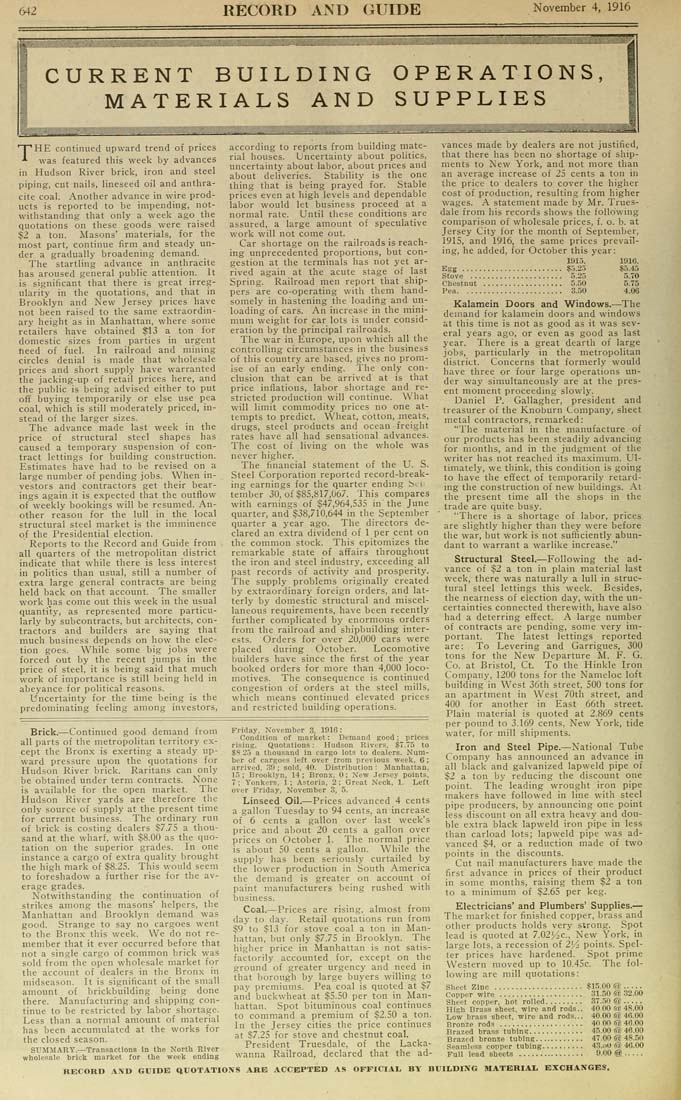
642 RECORD AND GUIDE November 4, 1916 iiiiiiiiiiiiiMiliiiiiiiiiiiiiiiiiiiii Jiiiiiiiiiiiiiiiiiiiiiiiiiiiiiiiiiiiiiiiiiiiiiiiiiiiniiiiiiiiiiiii I CURRENT BUILDING OPERATIONS, I MATERIALS AND SUPPLIES 1 Hiiiiini IIIIIIII THE continued upward trend of prices was featured this week by advances in Hudson River brick, iron and steel piping, cut nails, lineseed oil and anthra¬ cite coal. .Another advance in wire prod¬ ucts is reported to be impending, not¬ withstanding that only a week ago the quotations on these goods were raised $2 a ton. Alasons' materials, for the most part, continue firm and steady un¬ der a gradually broadening demand. The startling advance in anthracite has aroused general public attention. It is significant that there is great irreg¬ ularity in the quotations, and that in Brooklyn and New Jersey prices have not been raised to the same extraordin¬ ary height as in Manhattan, where some retailers have obtained ?13 a ton for domestic sizes from parties in urgent need of fuel. In railroad and mining circles denial is made that wholesale prices and short supply have warranted the jacking-up of retail prices here, and the public is being advised either to put off buying temporarily or else use pea coal, which is still moderately priced, in¬ stead of the larger sizes. The advance made last week in the price of structural steel shapes has caused a temporary suspension of con¬ tract lettings for building construction. Estimates have had to be revised on a large number of pending jobs. When in¬ vestors and contractors get their bear¬ ings again it is expected that the outflow of weekly bookings will be resumed. An¬ other reason for the lull in the local structural steel market is the imminence of the Presidential election. Reports to the Record and Guide from all quarters of the metropolitan district indicate that while there is less interest in politics than usual, still a number of extra large general contracts are being held back on that account. The smaller work has come out this week in the usual quantity, as represented more particu¬ larly by subcontracts, but architects, con¬ tractors and builders are saying that much business depends on how the elec¬ tion goes. While some big jobs were forced out by the recent jumps in the price of steel, it is being said that much work of importance is still being held in abeyance for political reasons. Uncertainty for the time being is the predominating feeling among investors, according to reports from building mate¬ rial houses. Lncertainty about politics, uncertainty about labor, about prices and about deliveries. Stability is the one thing that is being prayed for. Stable prices even at high levels and dependable labor would let business proceed at a normal rate. Until tliese conditions are assured, a large amount of speculative work will not come out. Car shortage on the railroads is reach¬ ing unprecedented proportions, but con¬ gestion at the terminals has not yet ar¬ rived again at the acute stage of last Spring. Railroad men report that ship¬ pers are co-operating with them hand¬ somely in hastening the loading and un¬ loading of cars. An increase in the mini¬ mum weight for car lots is under consid¬ eration by the principal railroads. The war in Europe, upon which all the controlling circumstances in the business of this country are based, gives no prom¬ ise of an early ending. The only con¬ clusion that can be arrived at is that price inflations, labor shortage and re¬ stricted production will continue. What will limit commodity prices no one at¬ tempts to predict. Wheat, cotton, jneats, drugs, steel products and ocean freight rates have all had sensational advances. The cost of living on tlie whole was never higher. The financial statement of the U. S. Steel Corporation reported record-break¬ ing earnings for the quarter endin.g bci tember 30,"of $8S,817,U67. This compares with earnings of $47,964,535 in the June quarter, and $38,710,644 in the September quarter a year ago. The directors de¬ clared an extra dividend of 1 per cent on the common stock. This epitomizes the remarkable state of affairs throughout the iron and steel industry, exceeding all past records of activity and prosperity. The supply problems originally created by extraordinary foreign orders, and lat¬ terly b}' domestic structural and miscel¬ laneous requirements, have been recently further complicated by enormous orders from the railroad and shipbuilding inter¬ ests. Orders for over 20,000 cars were placed during October. Locomotive builders have since the first of the year booked orders for more than 4,000 loco¬ motives. The consequence is continued congestion of orders at the steel mills, which means continued elevated prices and restricted building operations. Brick.—Continued good demand from all parts of tlie metropolitan territory ex¬ cept the Bron.x is exerting a steady up¬ ward pressure upon the quotations for Hudson River brick. Raritans can only be obtained under term contracts. None is availal)le for the open market. The Hudson River yards are therefore the only source of supply at the present time for current business. The ordinary run of brick is costing dealers $7.75 a thou¬ sand at the wharf, with $8.00 as the quo¬ tation on the superior grades. In one instance a cargo of extra quality brought the high mark of $8.25. This would seem to foreshadow a further rise for the av¬ erage grades. Notwithstanding the continuation of strikes among the masons' helpers, the Manhattan and Brooklyn demand was good. Strange to say no cargoes went to the Bronx this week. We do not re¬ member that it ever occurred before that not a single cargo of common brick was sold from the open wholesale market for the account of dealers in the Bronx in midseason. It is significant of the small amount of brickbuilding being done there. Manufacturing and shipping con¬ tinue to be restricted by labor shortage. Less than a normal amount of material has been accumulated at the works for the closed season. SUMMARY.—Transactions In the North River Friday, November 3, 1916: Condition ot marltet: Demand good; prices rising. Quotations: Hudson Rivers, $7.75 to $8 2.5 a thousand in cargo lots to dealers. Num¬ ber of cargoes left over from previous week, 6 : arrived, 30 ; sold, 40. Distribution : Manhattan, I.T; Brooklyn, 14; Bronx, 0; New Jersey points. 7 ; Yonkers, 1; Astoria, 2 ; Great Neck, 1. Left over Friday, November 3, 5. Linseed Oil.—Prices advanced 4 cents a gallon Tuesday to 94 cents, an increase of 6 cents a gallon over last week's price and about 20 cents a gallon over prices on October 1. The normal price is about 50 cents a gallon. While the supply has been seriously curtailed by the lower production in South America the demand is greater on account of paint manufacturers being rushed with business. Coal.—Prices are rising, almost from day to day. Retail quotations run from $9 to $13 for stove coal a ton in Man¬ hattan, but only $7.75 in Brooklyn. The higher price in Manhattan is not satis¬ factorily accounted for, except on the ground of greater urgency and need in that borough by large buyers willing to pay premiums. Pea coal is quoted at $7 and buckwheat at $5.50 per ton in Man¬ hattan. Spot bituminous coal continues to command a premium of $2.50 a ton. In the Jersey cities the price continues at $7.25 for stove and chestnut coal. President Truesdale, of the Lacka¬ wanna Railroad, declared that the ad¬ vances made by dealers are not justified, that there has been no shortage of ship¬ ments to New York, and not more than an average increase of 25 cents a ton in the price to dealers to cover the higher cost of production, resulting from higher wages. A statement made by Mr. Trues¬ dale from his records shows the following comparison of wholesale prices, f. o. b. at Jersey City for the month of September, 1915, and 1916, the same prices prevail¬ ing, he added, for October this year: 1915. 1916. Egg ........................ $5.2.5 $5.45 Stove ...................... 5.25 5.70 Chestnut ................... 5.50 5.75 Pea........................ 3.50 4.08 Kalamein Doors and Windows.—The demand for kalamein doors and windows at this time is not as good as it was sev¬ eral years ago, or even as good as last year. There is a great dearth of large jobs, particularly in the metropolitan district. Concerns that formerly would have three or four large operations un¬ der way simultaneously are at the pres¬ ent moment proceeding slowly. Daniel P. Gallagher, president and treasurer of the Knoburn Company, sheet metal contractors, remarked: "The material in the manufacture of our products has been steadily advancing for months, and in the judgment of the writer has not reached its maximum. Ul¬ timately, we think, this condition is going to have the effect of temporarily retard¬ ing the construction of new buildings. .At the present time all the shops in the trade are quite busy. "There is a shortage of labor, prices are slightly higher than they were before the war, but work is not sufficiently abun¬ dant to warrant a warlike increase." Structural Steel.—Following the ad¬ vance of $2 a ton in plain material last week, there was naturally a lull in struc¬ tural steel lettings this week. Besides, the nearness of election day, with the un¬ certainties connected therewith, have also had a deterring effect. A large number of contracts are pending, some very im¬ portant. The latest lettings reported are: To Levering and Garrigues, 300 tons for the New Departure M. F. G. Co. at Bristol, Ct. To the Hinkle Iron Company, 1200 tons for the Nameloc loft building in West 36th street, 500 tons for an apartment in West 70th street, and 400 for another in East 66th street. Plain material is quoted at 2.869 cents per pound to 3.169 cents, New York, tide water, for mill shipments. Iron and Steel Pipe.—National Tube Company has announced an advance iii all black and galvanized lapweld pipe of $2 a ton by reducing the discount one point. The leading wrought iron pipe makers have followed in line with steel pipe producers, by announcing one point less discount on all extra heavy and dou¬ ble extra black lapweld iron pipe in less than carload lots; lapweld pipe was ad¬ vanced $4, or a reduction made of two points in the discounts. Cut nail manufacturers have made the first advance in prices of their product in some months, raising them $2 a ton to a minimum of $2.65 per keg. Electricians' and Plumbers' Supplies.— The market for finished copper, brass and other products holds very strong. Spot lead is quoted at 7.02^c., New York, in large lots, a recession of 2'/2 points. Spel¬ ter prices have hardened. Spot prime Western moved up to 10.45c. The fol¬ lowing are mill quotations: Sheet Zinc ..................... $15.00 (fj!..... Copper wire .................... •31..50 (9 .32.00 Sheet copper, hot rolled......... 37..50 @..... High Brass sheet, wire and rods.. 4000 roi 48.00 Low brass sheet, wire and rods... 40.00 0i 46.00 Bronze rods .................... 40 00 ffi) 46.00 Brazed brass tubln?............. 45.00 (ai 46.00 Brazed bronze tubing............ 47.00 @ 4S..50 Seamless copper tubing.......... 43.ii0 (iTi 46.00 Full lead sheets ................ 9.00 @..... wholesale brick market for the week ending RBCORD AND GUIDB QUOTATIONS ARE ACCEPTED AS OPFICIAI. BY BUILDING MATERIAI. EXCHANGES