
Columbia University Libraries Digital Collections: The Real Estate Record
Use your browser's Print function to print these pages.
Real estate record and builders' guide: [Appendix]
Text version:
Please note: this text may be incomplete. For more information about this OCR, view About OCR text.
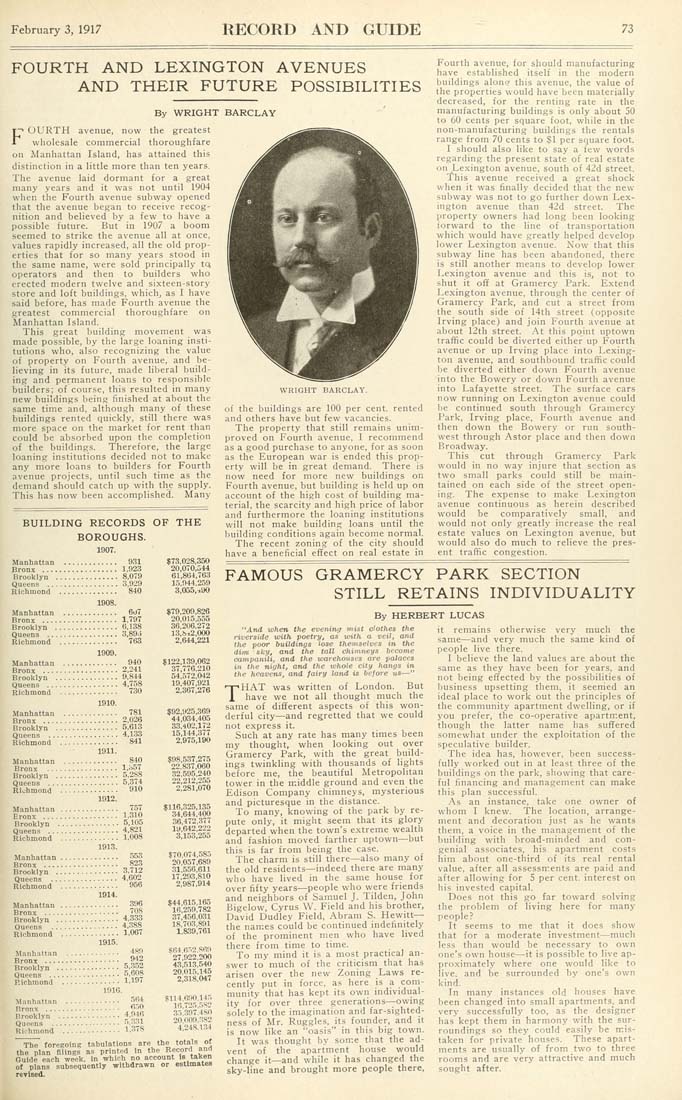
February 3, 1917 RECORD AND GUIDE 73 FOURTH AND LEXINGTON AVENUES AND THEIR FUTURE POSSIBILITIES By WRIGHT BARCLAY F-> OURTH avenue, now the greatest wholesale commercial thoroughfare on Manhattan Island, has attained this distinction in a little more than ten years. The avenue laid dormant for a great many years and it was not until 1904 when the Fourth avenue subway opened that the avenue began to receive recog¬ nition and believed by a few to have a possible future. But in 1907 a boom seemed to strike the avenue all at once, values rapidly increased, all the old prop¬ erties that for so many years stood in the same name, were sold principally tQ operators and then to builders who erected modern twelve and sixteen-story store and loft buildings, whichj as I have said before, has made Fourth avenue the greatest commercial thoroughfare on Manhattan Island. This great building movement was made possible, by the large loaning insti¬ tutions who, also recognizing the value of property on Fourth avenue, and be¬ lieving in its future, made liberal build¬ ing and permanent loans to responsible builders; of course, this resulted in many new buildings being finished at about the same time and, although many of these buildings rented quickly, still there was more space on the market for rent than could be absorbed upon the completion of the buildings. Therefore, the large loaning institutions decided not to make any more loans to builders for Fourth avenue projects, until such time as the demand should catch up with the supply. This has now been accomplished. Many BUILDING RECORDS OF THE BOROUGHS. 1907. Manhattan ............. 931 $73,028,350 pronx .................. 1,923 20.070,544 Brooklyn ............... 8,079 61,804,763 Queens .................3,929 15,944,259 Richmond .............. 840 3,055,^90 1908. Manhattan ............. 6o7 $79,209,826 Bronx .................. 1.797 20,015.,5.55 Brooklyn ............... 6,138 36,206.272 Queens ................. 3,89o 13,M2,000 Richmond .............. 763 2,644,221 1909. Manhattan ............. 940 $122,139,062 Bronx ..................2,241 37,776.210 Brooklyn ............... 9,844 54,572,042 Queens .................4,758 IS.^I.O^J Richmond .............. 730 2,36i,2i6 1910. Manhattan ............. 781 $92,92.5,369 Bronx ..................2.026 "■OS^.^Oo Brooklyn ............... 5,613 33,402,1x2 Queens ............4,133 15,144,3ii R?ohmond.............. 841 2,975,190 1911. ^-r- ......::•■::; i,?l? ll.iS ^u:±°--:-::::::;::::i;i?t illtli Rkhmond .::.::::...... 910 2,281,070 1912. Manhattan .............. 757 $116,325,135 Bronx ....... 1,310 34,644,400 Brooklyn ........... 5.105 36,472.377 Queens...............4,821 19,642,222 Richmond .............. 1.008 3,153,25o 1913. Manhattan.............. 553 570,074,585 Bronx ................. 823 20.0o7,6S9 Brooklyn ...........3,712 31.556,611 Queens ........ .....4,602 17,293,810 Richmond ••.-............. 956 2,987,914 1914. ^r^o-r'^"........:::::: foi 'l6;i» —"■ ••••■•••■•;;:;: l:li ?l;Si Richmond ■•.■.•.v.......... 1,067 1,839,761 1915. B^onx ........... 942 27,922,200 B ooklyn •.■:::::::::....: 5,352 ^•513.540 Queens .................5,608 ^SlS'Jlf Richmond ..............L197 2,iilS,m' 1916. -?:^-^- ........::;;: ^f^ *^1^;S5 S° •■•••■■•;::;::: 5II? ^^ yueens................. . ^ 248,134 Richmond .............. l.,oii-> i._i-, The foregoing tabulations are the totals of the plan filings as printed in the Record and Guide each week, in -which no account Ib taken ot plans subsequently -withdrawn or estimates revised. WRIGHT BARCLAY. of the buildings are 100 per cent, rented and others have but few vacancies. The property that still remains unim¬ proved on Fourth avenue. I recommend as a good purchase to anyone, for as soon as the European war is ended this prop¬ erty will be in great demand. There is now need for more new buildings on Fourth avenue, but building is held up on account of the high cost of building ma¬ terial, the scarcity and high price of labor and furthermore the loaning institutions will not make building loans until the building conditions again become normal. The recent zoning of the city should have a beneficial effect on real estate in Fourth avenue, for should manufacturing have established itself in the modern buildings alone this avenue, the value of the properties would have been materially decreased, for the renting rate in the manufacturing buildings is only about 50 to 60 cents per square foot, while in the non-manufacturing buildings the rentals range from 70 cents to $1 per square foot. I should also like to say a few words regarding the present state of real estate on Le.xington avenue, south of 42d street. This avenue received a great shock when it was finally decided that the new- subway was not to go further down Lex¬ ington avenue than 42d street. The property owners had long been looking forward to the line of transportation which would have greatly helped develop lower Le.xington avenue. Now that this subway line has been abandoned, there is still another means to develop lower Lexington avenue and this is, not to shut it off at Gramercy Park. Extend Lexington avenue, through the center of Gramercy Park, and cut a street from the south side of 14th street (opposite Irving place) and join Fourth avenue at about 12th street. At this point uptown traffic could be diverted either up Fourth avenue or up Irving place into Lexing¬ ton avenue, and southbound traffic could be diverted either down Fourth avenue into the Bowery or down Fourth avenue into Lafayette street. The surface cars now running on Lexington avenue could he continued south through Gramercy Park, Irving place. Fourth avenue and then down the Bowery or run south¬ west through Astor place and then down Broadway. This cut through Gramercy Park would in no way injure that section as two small parks could still be main¬ tained on each side of the street open¬ ing. The expense to make Lexington avenue continuous as herein described would be comparatively small, and would not only greatly increase the real estate values on Lexington avenue, but would also do much to relieve the pres¬ ent traffic congestion. FAMOUS GRAMERCY PARK SECTION STILL RETAINS INDIVIDUALITY By HERBERT LUCAS "And when the evening mist clothes the riverside with poetry, as with a veil, and the poor buildings lose themselves in the dint sky, and the tall chimneys become campanili, and the warehouses are palaces in the night, a-nd the wliole city hangs in the heavens, and fairy land is before us—" THAT was written of London. But have we not all thought much the same of different aspects of this won¬ derful city—and regretted that we could not e.xpress it. Such at any rate has many times been my thought, when looking out over Gramercy Park, with the great build¬ ings twinkling with thousands of lights before me, the beautiful Metropolitan tower in the m.iddle ground and even the Edison Company chimneys, mysterious and picturesque in the distance. To many, knowing of the park by re¬ pute only, it might seem that its glory departed when the town's extreme wealth and fashion moved farther uptown—but this is far from being the case. Tlie charm is still there—also many of the old residents—indeed there are many who have lived in the same house for over fifty years—people who were friends and neighbors of Samuel J. Tilden, John Bigelow, Cyrus W. Field and his brother, David Dudley Field, Abram S. Hewitt— the names could be continued indefinitely of the prominent men who have lived there from time to time. To my mind it is a most practical an¬ swer to much of the criticism that has arisen over the new Zoning Laws re¬ cently put in force, as here is a com¬ munity that has kept its own individual¬ ity for over three generations--owing solely to the imagination and far-sighted¬ ness of Mr. Ruggles, its founder, and it is now like an "oasis" in this big town. It was thought by som.e that the ad¬ vent of the apartment house would change it—and while it has changed the sky-line and brought more people there. it remains otherwise very much the same—and very much the same kind of people live there. I believe the land values are about the same as they have been for years, and not being effected by the possibilities of Ijusiness upsetting them, it seemed an ideal place to work out the principles of the community apartment dwelling, or if you prefer, the co-operative apartir.ent, though the latter name has suffered somewhat under the exploitation of the speculative builder. The idea has, however, been success¬ fully worked out in at least three of the buildings on the park, showing that care¬ ful financing and management can make this plan successful. As an instance, take one owner of whom I knew. The location, arrange¬ ment and decoration just as he wants them, a voice in the management of the building with broad-minded and con¬ genial associates, his apartment costs him about one-third of its real rental value, after all assessm.ents are paid and after allowing for 5 per cent, interest on his invested capital. Does not this go far toward solving the problem of living here for many people? It seems to me that it does show that for a moderate investment—much less than would be necessary to own one's own house—it is possible to live ap¬ proximately where one would like to live, and be surrounded by one's own kind. In many instances old houses have been changed into small apartments, and very successfully too, as the designer has kept them in harmony with the sur¬ roundings so they could easily be m.is- taken for private houses. These apart¬ ments are usually of from two to three rooms and are very attractive and much sought after.