
Columbia University Libraries Digital Collections: The Real Estate Record
Use your browser's Print function to print these pages.
Real estate record and builders' guide: [Appendix]
Text version:
Please note: this text may be incomplete. For more information about this OCR, view About OCR text.
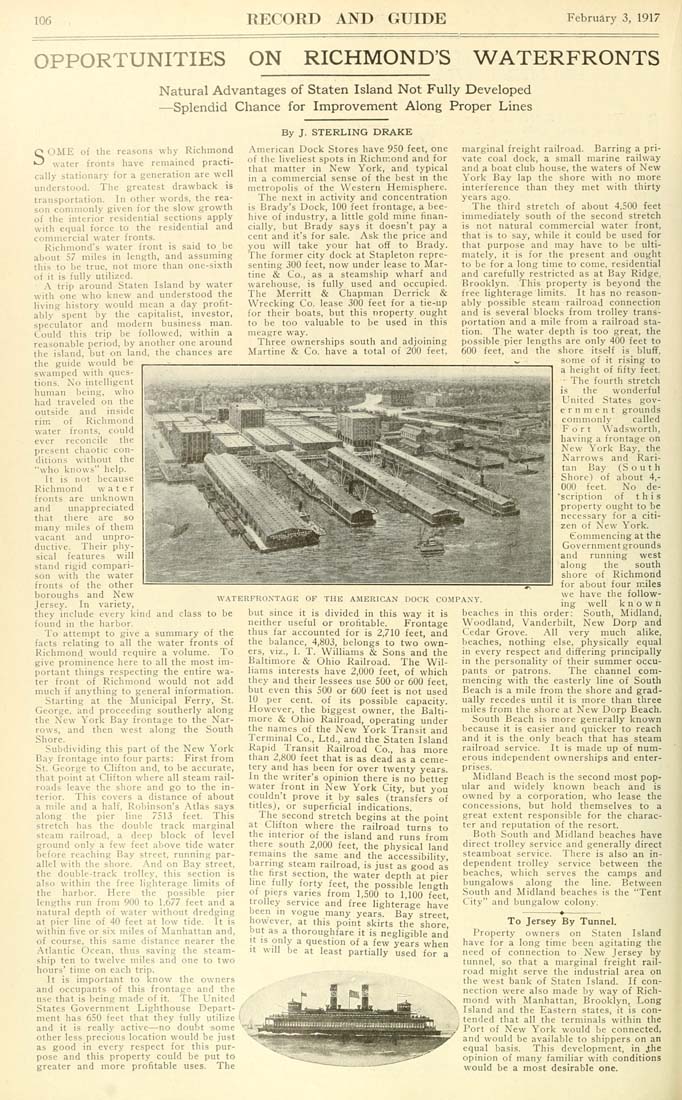
106 RECORD AND GUIDE February 3, 1917 OPPORTUNITIES ON RICHMOND'S WATERFRONTS Natural Advantages of Staten Island Not Fully Developed —Splendid Chance for Improvement Along Proper Lines SOME of the reasons why Richmond water fronts have remained practi¬ cally stationary for a generation are well understood. The greatest drawback is transportation. In other words, the rea¬ son commonly given for the slow growth of the interior residential sections apply with equal force to the residential and commercial water fronts. Richmond's water front is said to be about 57 miles in length, and assuming this to be true, not more than one-sixth of it is fully utilized. A trip around Staten Island by water with one who knew and understood the living history would mean a day profit¬ ably spent by the capitalist, investor, speculator and modern business man. Could this trip be followed, within a reasonable period, by another one around the island, "but on land, the chances are the guide would be swamped with ques¬ tions. No intelligent human being, who had traveled on the outside and inside rim. of Richmond water fronts, could ever reconcile the present chaotic con¬ ditions without the "who knows" help. It is not because Richmond water fronts are unknown and unappreciated that there are so many miles of them vacant and unpro¬ ductive. Their pliy¬ sical features will stand rigid compari¬ son with the water fronts of the other boroughs and New Jersey. In variety, they include every kind and class to be found in the harbor. To attempt to give a summary of the facts relating to all the water fronts of Richmond would require a volume. To give prominence here to all the most im¬ portant things respecting the entire wa¬ ter front of Richmond would not add much if anything to general information. Starting at the Municipal Ferry, St. George, and proceeding southerly along the New York Bay frontage to the Nar¬ rows, and then west along the South Shore. Subdividing this part of the New York Bay frontage into four parts: First from St. George to Clifton and, to be accurate, that point at Clifton where all steam rail¬ roads leave the shore and go to the in¬ terior. This covers a distance of about a mile and a half, Robinson's .Atlas says along the pier line 7513 feet. This stretch has the double track marginal steam railroad, a deep block of level ground only a few feet above tide water before reaching Bay street, running par¬ allel with the shore. And on Bay street, the double-track trolley, this section is also within tlie free lighterage limits of the harbor. Here the possible pier lengths run from 900 to 1,677 feet and a natural depth of water without dredging at pier line of 40 feet at low tide. It is within five or six miles of Manhattan and, of course, this same distance nearer the Atlantic Ocean, thus saving the steam¬ ship ten to twelve miles and one to two hours' time on each trip. It is iniportant to know the owners and occupants of this frontage and the use that is being made of it. The United States Government Lighthouse Depart¬ ment has 650 feet that they fully utilize and it is really active—no doubt some other less precious location would be just as good in every respect for this pur¬ pose and this property could be put to greater and more profitable uses. The By J. STERLING DRAKE American Dock Stores have 950 feet, one of tlic liveliest spots in Richmond and for that matter in New York, and typical in a commercial sense of the best in the metropolis of the Western Hemisphere. The next in activity and concentration is Brady's Dock, 100 feet frontage, a bee¬ hive of industry, a little gold mine finan¬ cially, but Brady says it doesn't pay a cent and it's for sale. Ask the price and you will take your hat off to Brady. The former city dock at Stapleton repre¬ senting 300 feet, now under lease to Mar¬ tine & Co., as a steamship wharf and warehouse, is fully used and occupied. The Merritt & Chapman Derrick & Wrecking Co. lease 300 feet for a tie-up for their boats, but this nroperty ought to be too valuable to be used in this meagre way. Three ownerships south and adjoining Martine & Co. have a total of 200 feet, \\ AIEKKKO.N I Al,E OF IHE Ai\lEHlt:„-\.N liuiK L 0.\1I'.\.N i but since it is divided in this way it is neither useful or Drofitable. Frontage thus far accounted for is 2,710 feet, and the balance, 4,803, belongs to two own¬ ers, viz., I. T. Williams & Sons and the Baltimore & Ohio Railroad. The Wil¬ liams interests have 2,000 feet, of which they and their lessees use 500 or 600 feet, but even this 500 or 600 feet is not used 10 per cent, of its possible capacity. However, the biggest owner, the Balti¬ more & Ohio Railroad, operating under the names of the New York Transit and Terminal Co., Ltd., and the Staten Island Rapid Transit Railroad Co., has more than 2,800 feet that is as dead as a ceme¬ tery and has been for over twenty years. In the writer's opinion there is no better water front in New York City, but you couldn't prove it by sales (transfers of titles), or superficial indications. The second stretch begins at the point at Clifton where the railroad turns to the interior of the island and runs from there south 2,000 feet, the physical land remains the same and the accessibility, barring steam railroad, is just as good as the hrst section, the water depth at pier hue fully forty feet, the possible length of piers varies from 1,500 to 1,100 feet, trolley service and free lighterage have been in vogue many years. Bay street however, at this point skirts the shore, but as a thoroughfare it is negligible and it IS only a question of a few years when It will be at least partially used for a marginal freight railroad. Barring a pri¬ vate coal dock, a small marine railway and .a boat club house, the waters of New York Bay lap the shore with no more interference than they met with thirty years ago. The third stretch of about 4,500 feet immediately south of the second stretch is not natural commercial water front, that is to say, while it could be used for that purpose and may have to be ulti¬ mately, it is for the present and ought to be for a long time to come, residential and carefully restricted as at Bay Ridge, Brooklyn. This property is beyond the free lighterage limits. It has no reason¬ ably possible steam railroad connection and is several blocks from trolley trans¬ portation and a mile from a railroad sta¬ tion. The water depth is too great, the possible pier lengths are only 400 feet to 600 feet, and the shore itself is bluff, some of it rising to a height of fifty feet. • The fourth stretch is the wonderful United States gov- ernment grounds commonly called Fort \Vadsworth, having a frontage on New York Bay, the Narrows and Rari¬ tan Bay (South .^^hore) of about 4,- nno feet. No de- >iription of this property ought to be iiicessary for a citi¬ zen of New York. Commencing at the Government grounds and running west along the south shore of Richmond for about four m.iles we have the follow¬ ing well known beaches in this order: South, Midland, Woodland, Vanderbilt, New Dorp and Cedar Grove. All very much alike, lieaches, nothing else, physically equal in every respect and differing principally in the personality of their summer occu¬ pants or patrons. The channel com¬ mencing with the easterly line of South Beach is a mile from the shore and grad¬ ually recedes until it is more than three miles from the shore at New Dorp Beach. South Beach is more generally known because it is easier and quicker to reach and it is the only beach that has steam railroad service. It is made up of num¬ erous independent ownerships and enter¬ prises. Midland Beach is the second most pop¬ ular and widely known beach and is owned by a corporation, who lease the concessions, but hold themselves to a great e.xtent responsible for the charac¬ ter and reputation of the resort. Both South and Midland beaches have direct trolley service and generally direct steamboat service. There is also an in¬ dependent trolley service between the beaches, which serves the camps and bungalows along the line. Between South and Midland beaches is the "Tent City" and bungalow colony. To Jersey By Tunnel. Property owners on Staten Island have for a long time been agitating the need of connection to New Jersey by tunnel, so that a marginal freight rail¬ road might serve the industrial area on the west bank of Staten Island. If con¬ nection were also made by way of Rich¬ mond with Manhattan, Brooklyn, Long Island and the Eastern states, it is con¬ tended that all the terminals within the y Port of New York would be connected, and would be available to shippers on an equal basis. This development, in .the opinion of many familiar with conditions would be a most desirable one.