
Columbia University Libraries Digital Collections: The Real Estate Record
Use your browser's Print function to print these pages.
Real estate record and builders' guide: [Appendix]
Text version:
Please note: this text may be incomplete. For more information about this OCR, view About OCR text.
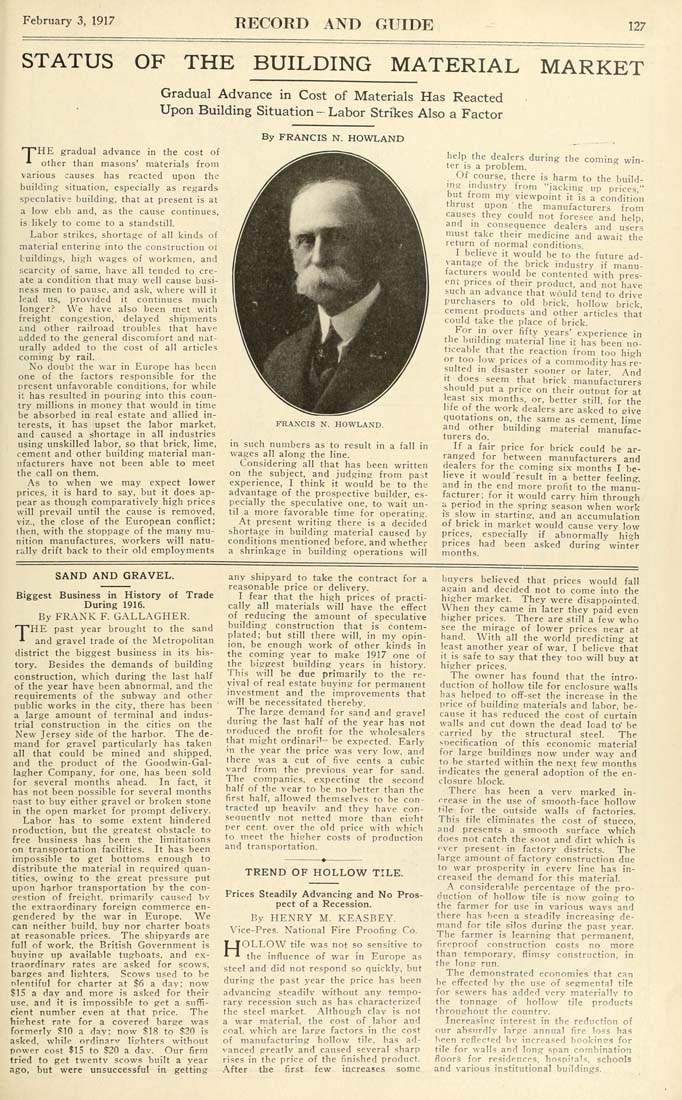
February 3, 1917 RECORD AND GUIDE 127 STATUS OF THE BUILDING MATERIAL MARKET Gradual Advance in Cost of Materials Has Reacted Upon Building Situation- Labor Strikes Also a Factor By FRANCIS N. HOWLAND "T'HE gradual advance in the cost of •*■ other than masons' materials from various causes has reacted upon the building situation, especially as regards speculative building, that at present is at a low ebb and, as the cause continues, is likely to come to a standstill. Labor strikes, shortage of all kinds of material entering into the construction ot Luildings, high wages of workmen, and scarcity of same, have all tended to cre¬ ate a condition that may well cause busi¬ ness men to pause, and ask, where will it lead us, provided it continues much longer? We have also been met with freight congestion, delayed shipments and other railroad troubles that have added to the general discomfort and nat- urallv added to the cost of all articles coming by rail. No doubt the war in Europe has been one of the factors responsible for the present unfavorable conditions, for while il has resulted in pouring into this coun¬ try millions in money that would in time be absorbed in real estate and allied in¬ terests, it has upset the labor market, and caused a shortage in all industries using unskilled labor, so that brick, lime, cement and other building material man¬ ufacturers have not been able to meet the call on them. .\s to when we may expect lower prices, it is hard to say. but it does ap¬ pear as though comparatively high prices will prevail until the cause is removed, viz., the close of the European conflict; (hen, with the stoppage of the many mu¬ nition manufactures, workers will natu¬ rally drift back to their old employments FRANCIS N. HOWLAND. in such numbers as to result in a fall in wages all along the line. Considering all that has been written on the subject, and judging from past e.xperience, I think it would be to the advantage of the prospective builder, es¬ pecially the speculative one, to wait un¬ til a more favorable time for operating. At present writing there is a decided shortage in building material caused by conditions mentioned before, and whether a shrinkage in building operations will help the dealers during the coming win¬ ter IS a problem. Of course, there is harm to the build¬ ine industry from "jacking up prices" l)ut from my viewpoint it is a condition thrust upon ' the manufacturers from causes they could not foresee and help, and in consequence dealers and users must take their medicine and await the return of normal conditions. I believe it would be to the future ad¬ vantage of the brick industry if manu¬ facturers would be contented with pres¬ ent prices of their product, and not have such an advance that would tend to drive purchasers to old brick, hollow brick, cement products and other articles that could take the place of brick. , For in over fifty years' experience in the buildmg material line it has been no¬ ticeable that the reaction from too high or too low prices of a commodity has re¬ sulted in disaster sooner or later ■^nd It does seem that brick manufacturers should put a price on their output for at east SIX months, or, better still, for the life of the work dealers are asked to give quotations on, the same as cement lime and other building material manufac¬ turers do. If a fair price for brick could be ar¬ ranged for between manufacturers and dealers for the coming six months I be- Iieve_ it would 'result in a better feeling, and in the end more profit to the manu¬ facturer: for it would carry him through a period in the spring season when work is slow in starting, and an accumulation of brick in market would cause very low prices, especially if abnormally high prices had been asked during winter nionths. SAND AND GRAVEL. Biggest Business in History of Trade During 1916. By FRANK F. GALLAGHER. nPHE past year brought to the sand *- and gravel trade of the Metropolitan district the biggest business in its his¬ tory. Besides the demands of building construction, which during the last half of the year have been abnormal, and the requirements of the subway and other public works in the city, there has been a large amount of terminal and indus¬ trial construction in the cities on the New Jersey side of the harbor. The de¬ mand for gravel particularly has taken all that could be mined and shipped, and the product of the Goodwin-Gal¬ lagher Company, for one, has been sold for several months ahead. In fact, it has not been possible for several months nast to buy either gravel or broken stone in the open market for prompt delivery. Labor has to some extent hindered production, but the greatest obstacle to free business has been the limitations on transportation facilities. It has been impossible to get bottoms enough to distribute the material in required quan¬ tities, owing to the great pressure put upon hgrbor transportation by the con¬ gestion of freight, primarily caused bv the extraordinary foreign commerce en¬ gendered by the war in Europe. We can neither build, buy nor charter boats at reasonable prices. The shipyards are full of work, the British Government is buyine up available tugboats, and e.x- traordinarv rates are asked for scows, barges and lighters. Scows used to be plentiful for charter at $6 a dav; now $15 a dav and more is asked for their use, and it is impossible to get a suffi¬ cient number even at that price. The hiehest rate for a covered barge was formerly SIO a dav; now .fl8 to $20 is asked, while nrdinarv lighters without power cost $15 to $20 a dav. Our firm tried to get twentv scows built a year ago, but were unsuccessful in gettin.g any shipyard to take the contract for a reasonable price or delivery. I fear that the high prices of practi¬ cally all inaterials will have the effect of reducing the amount of speculative building construction that is contem¬ plated; but still there will, in my opin¬ ion, be enough work of other kinds in the coming year to make 1917 one of the biggest building years in history. Tliis will be due primarily to the re¬ vival of real estate buying for permanent investment and the improvements that will be necessitated thereby. The large demand for sand and gravel during the last half of the year has not produced the nrofit for the wholesalers that might ordinari'" be expected. Early in the year the price was very low, and Ihere was a cut of five cents a cubic vard from the previous year for sand. The companies, expecting the second half of the vear to be no better than the first half, allowed themselves to be con¬ tracted up heavilv and they have con- seauentlv not netted more than eisht per cent, over the old price with which to meet the higher costs of production and transportation. TREND OF HOLLOW TILE. Prices Steadily Advancing and No Pros¬ pect of a Recession. By HENRY M. KEASBEY. Vice-Pres. National Fire Proofing Co. flOLLOW tile was not so sensitive to ■*■ * the influence of war in Europe as steel and did not respond so quickly, but during the past year the price has been advancing steadilv without any tempo¬ rary recession such as has characterized the steel market. Although clav is not a war material, the cost of labor and coal, which are laree factors in the cost of manufacturing hollow tile, has ad- ^'anced greatlv and caused several sharp rises in the price of the finished product. After the first few iacreases sorae buyers believed that prices would fall again and decided not to come into the higher market. They were disappointed. When they came in later they paid even higher prices. There are still a few who see the mirage of lower prices near at hand. With all the world predicting at least another year of war, I believe that it is safe to say that they too will buy at higher prices. The owner has found that the intro¬ duction of hollow tile for enclosure walls has helped to off-set the increase in the price of buildine materials and labor, be¬ cause it has reduced the cost of curtain walls and cut down the dead load to' be carried by the structural steel. The soecification of this economic material for large buildings now under way and to be started within the next few months indicates the general adoption of the en¬ closure block. There has been a verv marked in¬ crease in the use of smooth-face hollow tile for the outside walls of factories. This tile eliminates the cost of stucco, and presents a smooth surface which does not catch the soot and dirt which is r-ver present in factory districts. The large amount of factory construction due lo war prosperity in everv line has in¬ creased the demand for this material. A considerable percentage of the pro¬ duction of hollow tile is now going to the farmer for use in various wavs and there has been a steadilv increasing de¬ mand for tile silos during the past year. The farmer is learning that permanent, fireproof construction costs no more than temporary, flimsy construction, in the lone run. The demonstrated economies that can be effected by the use of segmental tile for sewers has added very materiallv to the tonnage of hollow tile products Ihrouehout the countrv. Increasing interest in the reduction of our absurdly large annual fire loss has been reflected bv increased bookings for tile for walls and long span combination floors for residences, hospitals, schools and various institutional buildings.