
Columbia University Libraries Digital Collections: The Real Estate Record
Use your browser's Print function to print these pages.
Real estate record and builders' guide: [v. 100, no. 2577: Articles]: August 4, 1917
Text version:
Please note: this text may be incomplete. For more information about this OCR, view About OCR text.
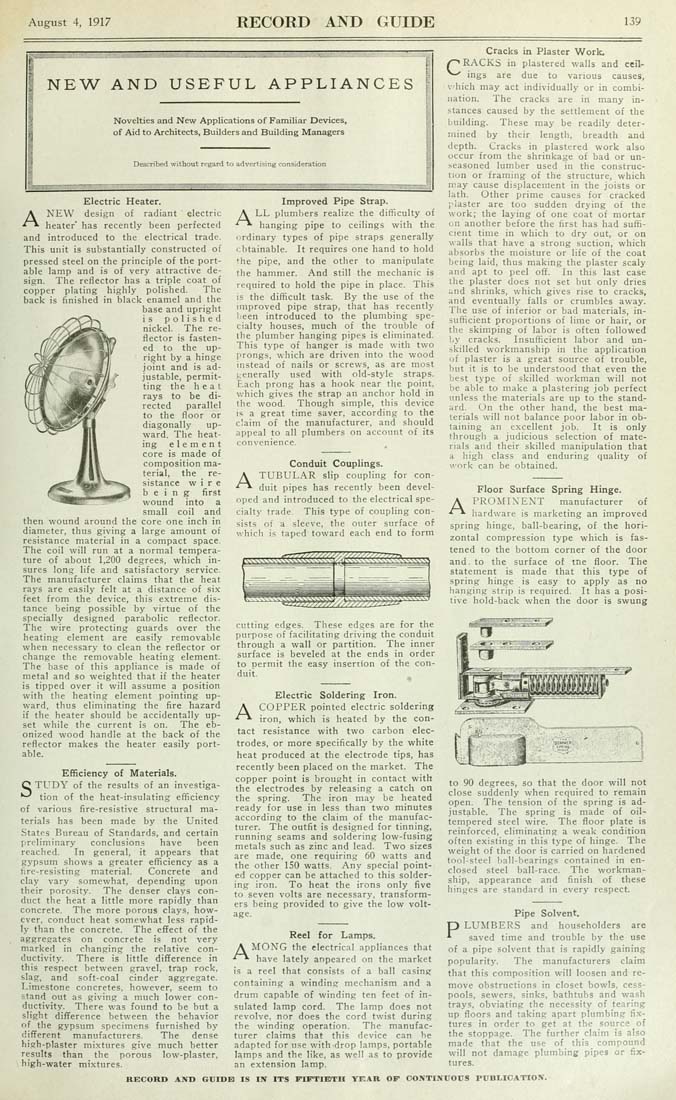
August 4, 1917 RECORD AND GUIDE 139 s!ii[iiiimiiimmi!"i:;i",ii[i[;''ii:;;r ''!■'": ■"'■:'" ylfi-r■-l-[^|;ll;(l;;!.||f^^il^ll|ll!M^^:|JFm;sNmt!(!■;■;|:l^l^^^1l.■|^l..:l;."i,li:m "ji::'":,■,[':■■:■',:'il i^icn.,;''■ ■■' ■ ■ ' ■. i 1 NE"W 1 AND USEFUL APPLIANCES 1 Novelties and New Applications of Familiar Devices, 1 of Aid to Architects, Builders and Building Managers 1 Described without regard to advertising consideration 1 iiiiiiiiiiiiHiiiiiiiiiiiiiiiiiiiiiaiiuiiitiiiiiiiByMyMiiiiiininiHiiiiiMP Electric Heater. A heater* has recently been perfected and introduced to the electrical trade. This unit is substantially constructed of pressed steel on the principle of the port¬ able lamp and is of very attractive de¬ sign. The reflector has a triple coat of copper plating highly polished. The back is finished in black enamel and the base and upright is polished nickel. The re¬ flector is fasten¬ ed to the up¬ right by a hinge joint and is ad¬ justable, permit¬ ting the heat rays to be di¬ rected parallel to the floor or diagonally up¬ ward. The heat¬ ing element core is made of composition ma¬ terial, the re¬ sistance wire being first wound into a small coil and then wound around the core one inch in diameter, thus giving a large amount of resistance material in a compact space. The coil will run at a normal tempera¬ ture of about 1,200 degrees, which in¬ sures long life and satisfactory service. The manufacturer claims that the heat rays are easily felt at a distance of six feet from the device, this extreme dis¬ tance being possible by virtue of the specially designed parabolic reflector. The wire protecting guards over the heating element are easily removable when necessary to clean the reflector or change the removable heating element. The base of this appliance is made of metal and so weighted that if the heater is tipped over it will assume a position with the heating element pointing up¬ ward, thus eliminating the fire hazard if the heater should be accidentally up¬ set while the current is on. The eb- onized wood handle at the back of the reflector makes the heater easily port¬ able. Efficiency of Materials. C TUDY of the results of an investiga- *^ tion of the heat-insulating efficiency of various fire-resistive structural ma¬ terials has been made by the United States Bureau of Standards, and certain preliminary conclusions have been reached. In general, it appears that gypsum shows a greater efficiency as a fire-resisting material. Concrete and clay vary somewhat, depending upon their porosity. The denser clays con¬ duct the heat a little more rapidly than concrete. The more porous clays, how¬ ever, conduct heat somewhat less rapid¬ ly than the concrete. The effect of the aggregates on concrete is not very marked in changing the relative con¬ ductivity. There is little difference in this respect between gravel, trap rock, slag, and soft-coal cinder aggregate. Limestone concretes, however, seem to stand out as giving a much lower con¬ ductivity. There was found to be but a slight difference between the behavior of the gypsum specimens furnished by different manufacturers. The dense high-plaster mixtures give much better results than the porous low-plaster, high-water mixtures. Improved Pipe Strap. A LL plumbers realize the difficulty of •'* hanging pipe to ceilings with the ordinary types of pipe straps generally obtainable. It requires one hand to hold the pipe, and the other to manipulate the hammer. And still the mechanic is required to hold the pipe in place. This is the difficult task. By the use of the improved pipe strap, that has recently Iieen introduced to the plumbing spe¬ cialty houses, much of the trouble of the plumber hanging pipes is eliminated. This type of hanger is made with two itrongs, which are driven into the wood instead of nails or screws, as are most e^enerally used with old-style straps. Each prong has a hook near the point, v/hich gives the strap an anchor hold in the wood. Though simple, this device IS a great time saver, according to the claim of the manufacturer, and should appeal to all plumbers on account of its convenience. Conduit Couplings. A TUBULAR slip coupling for con¬ duit pipes has recently been devel¬ oped and introduced to the electrical spe¬ cialty trade. This type of coupling con¬ sists of a sleeve, the outer surface of which is taped toward each end to form cutting edges. These edges are for the purpose of facilitating driving the conduit through a wall or partition. The inner surface is beveled at the ends in order to permit the easy insertion of the con¬ duit. Electric Soldering Iron. A COPPER pointed electric soldering ** iron, which is heated by the con¬ tact resistance with two carbon elec¬ trodes, or more specifically by the white heat produced at the electrode tips, has recently been placed on the market. The copper point is brought in contact with the electrodes by releasing a catch on the spring. The iron may be heated ready for use in less than two minutes according to the claim of the manufac¬ turer. The outfit is designed for tinning, running seams and soldering low-fusing metals such as zinc and lead. Two sizes are made, one requiring 60 watts and the other 150 watts. Any special point¬ ed copper can be attached to this solder¬ ing iron. To heat the irons only five to seven volts are necessary, transform¬ ers being provided to give the low volt¬ age. Cracks in Plaster Work. ^ RACKS in plastered walls and ceil- ^^ ings are due to various causes, \'hich may act individually or in combi¬ nation. The cracks are in many in¬ stances caused by the settlement of the building. These may be readily deter¬ mined by their length, breadth and depth. Cracks in plastered work also occur from the shrinkage of bad or un¬ seasoned lumber used in the construc¬ tion or framing of the structure, which may cause displacement in the joists or lath. Other prime causes for cracked I'iaster are too sudden drying of the work; the laying of one coat of mortar on another before the first has had suffi¬ cient time in which to dry out, or on walls that have a strong suction, which absorbs the moisture or life of the coat being laid, thus making the plaster scaly and apt to peel off. In this last case the plaster does not set but only dries and shrinks, which gives rise to cracks, and eventually falls or crumbles away. The use of inferior or bad materials, in¬ sufficient proportions of lime or hair, or the skimping of labor is often followed l^y cracks. Insufficient labor and un¬ skilled workmanship in the application of plaster is a great source of trouble, but it is to be understood that even the best type of skilled workman will not be able to make a plastering job perfect unless the materials are up to the stand¬ ard. On the other hand, the best ma¬ terials will not balance poor labor in ob¬ taining an excellent job. It is only through a judicious selection of mate¬ rials and their skilled manipulation that a high class and enduring quality of work can be obtained. of Floor Surface Spring Hinge. A PROMINENT manufacturer ^~* hardware is marketing an improved spring hinge, ball-bearing, of the hori¬ zontal compression type which is fas¬ tened to the bottom corner of the door and. to the surface of tne floor. The statement is made that this type of spring hinge is easy to apply as no hanging strip is required. It has a posi¬ tive hold-back when the door is swung to 90 degrees, so that the door will not close suddenly when required to remain open. The tension of the spring is ad¬ justable. The spring is made of oil- tempered steel wire. The floor plate is reinforced, eliminating a weak condition often existing in this type of hinge. The weight of the door is carried on hardened tool-steel ball-bearings contained in en¬ closed steel ball-race. The workman¬ ship, appearance and finish of these hinges are standard in every respect. Reel for Lamps. A MONG the electrical appliances that ■**■ have lately anpeared on the market is a reel that consists of a ball casing containing a winding mechanism and a drum capable of winding ten feet of in¬ sulated lamp cord. The lamp does not revolve, nor does the cord twist during the winding operation. The manufac¬ turer claims that this device can be adapted for use with drop lamps, portable lamps and the like, as well as to provide an extension lamp. RECORD AND GUIDE IS IN ITS FIFTIEJTH YEAR OF CONTINUOUS PUBLICATION, Pipe Solvent. P LUMBERS and householders are ^ saved time and trouble by the use of a pipe solvent that is rapidly gaining popularity. The manufacturers claim that this composition will loosen and re¬ move obstructions in closet bowls, cess¬ pools, sewers, sinks, bathtubs and wash trays, obviating the necessity of tearing up floors and taking apart plumbing fix¬ tures in order to get at the source of the stoppage. The further claim is also made that the use of this^ compound will not damage plumbing pipes or fix¬ tures.