
Columbia University Libraries Digital Collections: The Real Estate Record
Use your browser's Print function to print these pages.
Real estate record and builders' guide: [v. 100, no. 2582: Articles]: September 8, 1917
Text version:
Please note: this text may be incomplete. For more information about this OCR, view About OCR text.
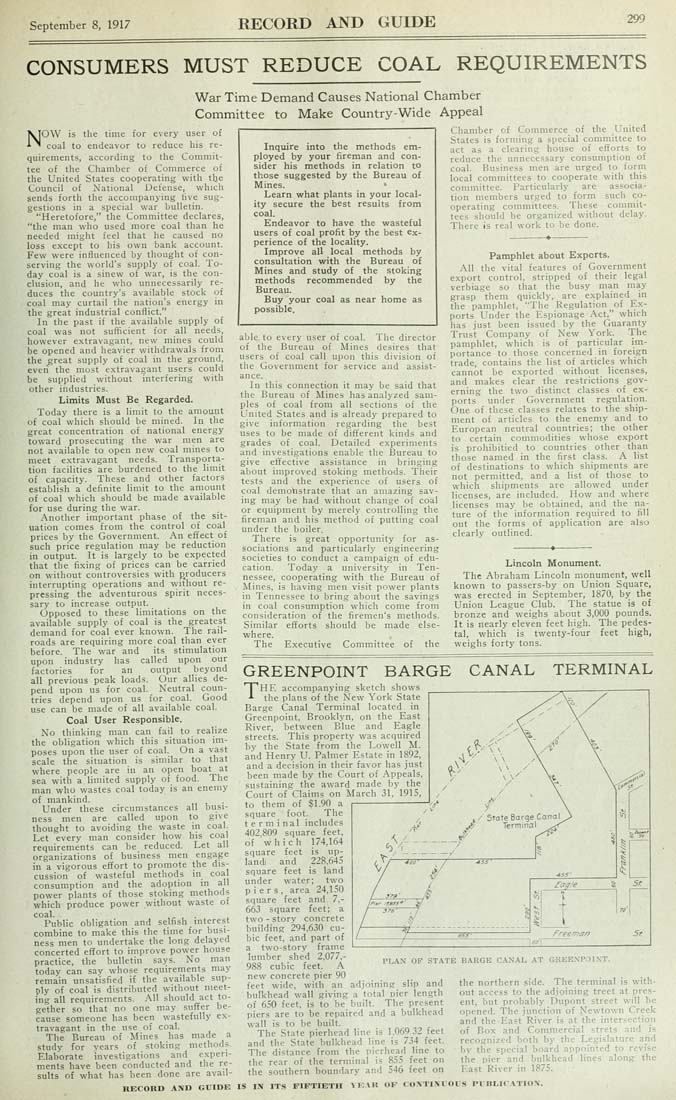
September 8, 1917 RECORD AND GUIDE 299 CONSUMERS MUST REDUCE COAL REQUIREMENTS War Time Demand Causes National Chamber Committee to Make Country-Wide Appeal NOW is the time for every user of coal to endeavor to reduce his re¬ quirements, according to the Commit¬ tee of the Chamber of Commerce of the United States cooperating with the Council of National Defense, which sends forth the accompanying five sug¬ gestions in a special war bulletin. "Heretofore," the Committee declares, "the man who used more coal than he needed might feel that he caused no loss except to his own bank account. Few were influenced by thought of con¬ serving the world's supply of coal. To¬ day coal is a sinew of war, is the con¬ clusion, and he who unnecessarily re¬ duces the country's available stock of coal may curtail the nation's energy in the great industrial conflict." In the past if the available supply of coal was not sufficient for all needs, however extravagant, new mines could be opened and heavier withdrawals from the great supply of coal in the ground, even the most extravagant users could be supplied without interfering with other industries. Limits Must Be Regarded. Today there is a limit to the amount of coal which should be mined. In the great concentration of national energy toward prosecuting the war men are not available to open new coal mines to meet extravagant needs. Transporta¬ tion facilities are burdened to the limit of capacity. These and other factors establish a definite limit to the amount of coal which should be made available for use during the war. Another important phase of the sit¬ uation comes from the control of coal prices by the Government. An effect of such price regulation may be reduction in output. It is largely to be expected that the fixing of prices can be carried on without controversies with p^roducers interrupting operations and without re¬ pressing the adventurous spirit neces¬ sary to increase output. Opposed to these limitations on the available supply of coal is the greatest demand for coal ever known. The rail¬ roads are requiring more coal than ever before. The war and its stimulation upon industry has called upon our factories for an output beyond all previous peak loads. Our allies de¬ pend upon us for coal. Neutral coun¬ tries depend upon us for coal. Good use can be made of all available coal. Coal User Responsible. No thinking man can fail to realize the obligation which this situation im¬ poses upon the user of coal. On a vast scale the situation is similar to that where people are in an open boat at sea with a limited supply of food. The man who wastes coal today is an enemy of mankind. Under these circumstances all busi¬ ness men are called upon to give thought to avoiding the waste in coal. Let every man consider how his coa requirements can be reduced. Let all organizations of business men engage in a vigorous effort to promote the dis¬ cussion of wasteful methods in_ coal consumption and the adoption in all power plants of those stoking methods which produce power without waste ot coal. ,^ , . Public obligation and selfish interest combine to make this the time for busi¬ ness men to undertake the long delayed concerted effort to improve power house practice, the bulletin says. No man today can say whose requirements may remain unsatisfied if the available sup¬ ply of coal is distributed without meet¬ ing all requirements. All should act to¬ gether so that no one may suffer be¬ cause someone has been wastefully ex¬ travagant in the use of coal. The Bureau of Mines has made a study for years of stoking methods. Elaborate investigations and experi¬ ments have been conducted and the re¬ sults of what has been done are avail- RECORD AND GUIDE Inquire into the methods em¬ ployed by your fireman and con¬ sider his methods in relation to those suggested by the Bureau of Mines, » Learn what plants in your local¬ ity secure the best results from coal. Endeavor to have the wasteful users of coal profit by the best ex¬ perience of the locality. Improve all local methods by consultation with the Bureau of Mines and study of the stoking methods recommended by the Bureau, Buy your coal as near home as possible. Chamber of Commerce of the _United States is forming a special committee to act as a clearing house of efforts to reduce the unnecessary consumption of coal. Business men are urged to form local committees to cooperate with this committee. Particularly are associa¬ tion members urged to form such co¬ operating committees. These commit¬ tees should be organized without delay. There is real work to be done. able to every user of coal. The director of the Bureau of Mines desires that users of coal call upon this division of the Government for service and assist¬ ance. In this connection it may be said that thc Bureau of Mines has analyzed sam¬ ples of coal from all sections of the United States and is already prepared to give information regarding the best uses to be made of different kinds and grades of coal. Detailed experiments and investigations enable the Bureau to give effective assistance in bringing about improved stoking methods. Their tests and the experience of users of coal demohstrate that an amazing sav¬ ing may be had without change of coal or equipment by merely controlling the fireman and his method of putting coal under the boiler. There is great opportunity for as¬ sociations and particularly engineering societies to conduct a campaign of edu¬ cation. Today a university in Ten¬ nessee, cooperating with the Bureau of Mines, is having men visit power plants in Tennessee to bring about the savings in coal consumption which come from consideration of the firemen's methods. Similar efforts should be made else¬ where. The Executive Committee of the Pamphlet about Exports. AU the vital features of Government export control, stripped of their legal verbiage so that the busy man may grasp them quickly, are explained in the pamphlet, "The Regulation of Ex¬ ports Under the Espionage Act," which has just been issued by the Guaranty Trust Company of New York. The pamphlet, which is of particular im¬ portance to those concerned in foreign trade, contains the list of articles which cannot be exported without licenses, and makes clear the restrictions gov¬ erning the tw^o distinct classes of ex¬ ports under Government regulation. One of these classes relates to the ship¬ ment of articles to the enemy and to European neutral countries; the other to certain commodities whose export is prohibitied to countries other than those named in the first class. A list of destinations to which shipments are not permitted, and a list of those to which shipments are allowed under licenses, are included. How and where licenses may be obtained, and the na¬ ture of the information required to fill out the forms of application are also clearly outlined. Lincoln Monument. The Abraham Lincoln monument, well known to passers-by on Union Square, was erected in September, 1870, by the Union League Club. The statue is of bronze and weighs about 3,000 pounds. It is nearly eleven feet high. The pedes¬ tal, which is twenty-four feet high, weighs forty tons. GREENPOINT BARGE CANAL TERMINAL THE accompanying sketch shows the plans of the New York State Barge Canal Terminal located in Greenpoint, Brooklyn, on the East River, between Blue and Eagle streets. This property was acquired by the State from the Lowell M. and Henry U. Palmer Estate in 1892, and a decision in their favor has just been made by the Court of Appeals, sustaining the award made by the Court of Claims on March 31, 1915, to them of $1.90 a square foot. The termi nal includes 402.809 square feet, of which 174,164 square feet is up¬ land) and 228,645 square feet is land under water; two piers, area 24,150 square feet and 7,- 663 square feet; a two - storv concrete building 294.630 cu¬ bic feet, and part of a two-story frame lumber shed 2,077.- 988 cubic feet. A new concrete pier 90 feet wide, with an adjoining: slip and bulkhead wall giving a total pier length PLAN OF STATE BARGE CANAL AT GREENPOINT. of 650 feet, is to be built. The present piers are to be repaired and a bulkhead wall is to be built. The State pierhead line is 1.069.32 feet and the State bulkhead line is 734 feet. The distance from the pierhead line to the rear of the terminal is 855 feet on the southern boundary and 546 feet on IS IN ITS FIFTIETH YEAR OF CONTINUOUS PUBLICATION. the northern side. The terminal is with¬ out access to the adjoining treet at pres¬ ent, but probably Dupont street will be opened. The junction of Newtown Creek and the East River is at the intersection of Box and Commercial strets and is recognized both by the Legislature and by the special board appointed to revise the pier and bulkhead lines along the East River in 1875.