
Columbia University Libraries Digital Collections: The Real Estate Record
Use your browser's Print function to print these pages.
Real estate record and builders' guide: [v. 100, no. 2585: Articles]: September 29, 1917
Text version:
Please note: this text may be incomplete. For more information about this OCR, view About OCR text.
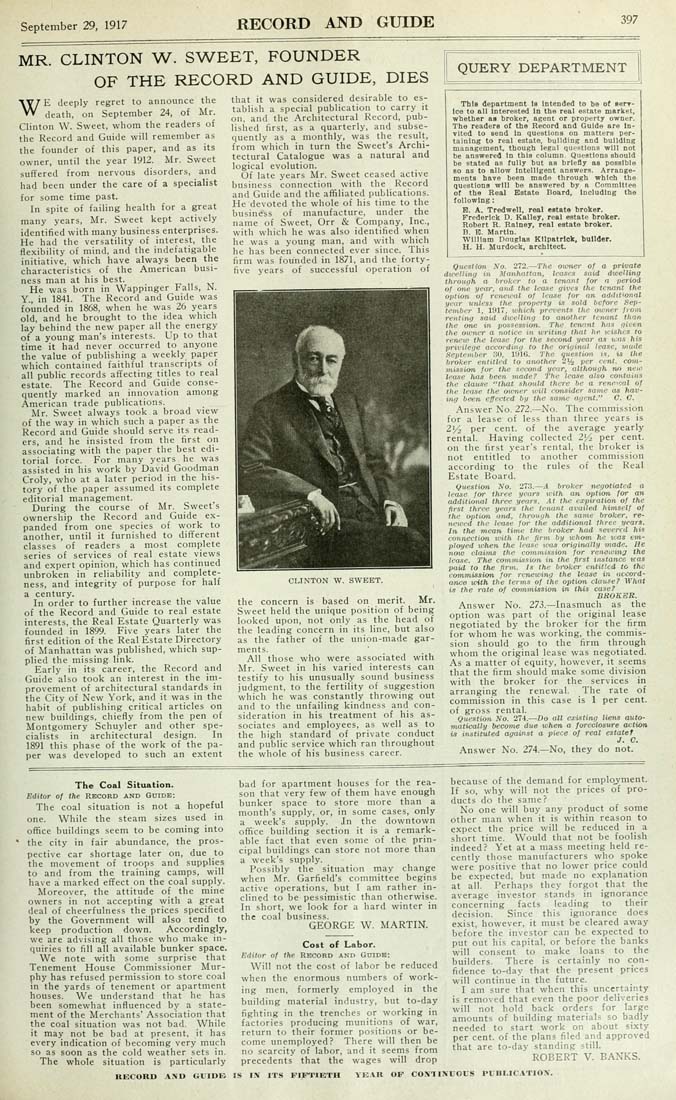
September 29, 1917 RECORD AND GUIDE 397 MR. CLINTON V/. SWEET, FOUNDER OF THE RECORD AND GUIDE, DIES WE deeply regret to announce the death, on September 24, of Mr. Clinton W. Sweet, whom the readers of the Record and Guide will remember as the founder of this paper, and as its owner, until the year 1912. Mr. Sweet suffered from nervous disorders, and had been under the care of a specialist for some time past. In spite of failing health for a great many years, Mr. Sweet kept actively identified with many business enterprises. He had the versatility of interest, the flexibility of mind, and the indefatigable initiative, which have always been the characteristics of the American busi¬ ness man at his best. He was born in Wappinger Falls, N. Y., in 1841. The Record and Guide was founded in 1868, when he was 26 years old, and he brought to the idea which lay behind the new paper all the energy of a young man's interests. Up to that time it had never occurred to anyone the value of publishing a weekly paper which contained faithful transcripts of all public records affecting titles to real estate. The Record and Guide conse¬ quently marked an innovation among American trade publications. Mr. Sweet always took a broad view of the way in which such a paper as the Record and Guide should serve its read¬ ers, and he insisted from the first on associating with the paper the best edi¬ torial force. For many years he was assisted in his work by David Goodman Croly, who at a later period in the his¬ tory of the paper assumed its complete editorial management. During the course of Mr. Sweets ownership the Record and Guide ex¬ panded from one species of work to another, until it furnished to different classes of readers a most complete series of services of real estate views and expert opinion, which has continued unbroken in reliability and complete¬ ness, and integrity of purpose for half a century. In order to further increase the value of the Record and Guide to real estate interests, the Real Estate Quarterly was founded in 1899. Five years later the first edition of the Real Estate Directory of Manhattan was published, which sup¬ plied the missing link. Early in its career, the Record and Guide also took an interest in the iiii- provement of architectural standards in the City of New York, and it was in the habit of publishing critical articles on new buildings, chiefly from the pen of Montgomery Schuyler and other spe¬ cialists in architectural design. In 1891 this phase of the work of the pa¬ per was developed to such an extent that it was considered desirable to es¬ tablish a special publication to carry it on. and the Architectural Record, pub¬ lished first, as a quarterly, and subse¬ quently as a monthly, was the result, from which in turn the Sweet's Archi¬ tectural Catalogue was a natural and logical evolution. Of late years Mr. Sweet ceased active business connection with the Record and Guide and the affiliated publications. He devoted the whole of his time to the business of manufacture, under the name of Sweet, Orr & Company, Inc., with which he was also identified when he was a young man, and with which he has been connected ever since. This firm was founded in 1871, and the forty- five vears of successful operation of CLINTON W. SWEET. the concern is based on merit. Mr. Sweet held the unique position of being looked upon, not only as the head of the leading concern in its line, but also as the father of the union-made gar¬ ments. All those who were associated with Mr. Sweet in his varied interests^ can testify to his unusually sound business judgment, to the fertility of suggestion which he was constantly throwing out and to the unfailing kindness and con¬ sideration in his treatment of his as¬ sociates and employees, as well as to the high standard of private conduct and public service which ran throughout the whole of his business career. The Coal Situation. Editor of the Record and Guide: The coal situation is not a hopeful one. While the steam sizes used in office buildings seem to be coming into the city in fair abundance, the pros¬ pective car shortage later on, due to the movement of troops and supplies to and from the training camps, will have a marked effect on the coal supply. Moreover, the attitude of the mine owners in not accepting with a great deal of cheerfulness the prices specified by the Government will also teiid to keep production down. Accordingly, we are advising all those who make in¬ quiries to fill all available bunker space. We note with some surprise that Tenement House Commissioner Mur¬ phy has refused permission to store coal in the yards of tenement or apartment houses. We understand that he has been somewhat influenced by a state¬ ment of the Merchants* Association that the coal situation was not bad. While it may not be bad at present, it has every indication of becoming very much so as soon as the cold weather sets in. The whole situation is particularly QUERY DEPARTMENT This department !a Intended to be of eerr- Ice to all Interested In the real estate market, whether as broker, agent or property owner. The readers of the Record and Guide are In¬ vited to send In questions on matters per¬ taining to real estate, building and building management, though legal questions will not be answered In thia column. Questions should be stated as fully but aa briefly as possible so as to allow Intelligent answers. Arrange¬ ments have been made through which the questions will be answered by a Committee of the Real Estate Board, Including the following: B. A. Tredwell, real estate broker. Frederick D. Kalley, real estate broker. Robert R. Ralney, real estate broker. B. E. Martin. William Douglas Kllpatrlclt. builder. H. H. Murdock. architect. Question No. 272.—The owner of a private dwelling in Matihattan, leases said dwelling through a broker to a tenant for a period of oiie year, and the lease gives the tenant the option of renewal of lease for an additional year unless the property is sold before Sep¬ tember 1, 1917, which prevents the owner from renting said dwelling to another tena7it than the one in possession. The tenant has given the owner a notice in writing that he v:ishcs to renew tlie lease for the second year as 2cas his privilege according to the original lease, made September 30. 1916. The question is. is the broker entitled to anotlier 2^2 per cent, com¬ mission for the second year, although no new lease has beeji made? The lease also contains the clause "that should there be a renewal of the lease the onmer will consider same as hav¬ ing been effected by the same agent." C. C. Answer No. 272.—No. The commission for a lease of less than three years is 11/2 per cent, of the average yearly rental. Having collected 2>1 per cent, on the first year's rental, the broker is not entitled to another comniission according to the rules of the Real Estate Board. Question No. 273.—A broker negotiated a lease for three years with an option for an additional three years. At tJu; expiratioti of the first three years the tenant availed himself of the option and, through the same broker, re¬ newed the lease for the additional three years. In the mean time the broker had severed his connection xoith the firm by whom he w.as em¬ ployed when the lease was origi^uzlly made. Re now claims the commission for renewing the lease. The commission in the first instance was paid to the firm. Is the broker entitled to the commission for renewing the lease in accord- ance with the terms of the option clause? What is the rate of commission in this case? BROKER. Answer No. 273.—Inasmuch as the option was part of the original lease negotiated by the broker for the firm for whom he was working, the commis¬ sion should go to the firm through whom the original lease was negotiated. As a matter of equity, however, it seems that the firm should make some division wMth the broker for the services in arranging the renewal. The rate of commission in this case is 1 per cent, of gross rental. Question No. 274.—Do all existing liens auto¬ matically become due when a foreclosure action is instituted against a piece of real estate? J. C. Answer No. 274.—No, they do not. bad for apartment houses for the rea¬ son that very few of them have enough bunker space to store more than a month's supply, or, in some cases, only a week's supply. In the downtown office building section it is a remark¬ able fact that even some of the prin¬ cipal buildings can store not more than a week's supply. Possibly the situation may change when Mr. Garfield's committee begins active operations, but I am rather jn- clined to be pessimistic than otherwise. In short, we look for a hard winter in the coal business. GEORGE W. MARTIN. RECORD AND GUIDB IS IN ITS FIFTIETH Cost of Labor. Editor of the Record and Guide: Will not the cost of labor be reduced when the enormous numbers of work¬ ing men, formerly employed in the building material industry, but to-day fighting in the trenches or working in factories producing munitions of war, return to their former positions or be¬ come unemployed? There will then be no scarcity of labor, and it seems from precedents that the wages will drop YEAR OF CONTINUOUS because of the demand for emplo^^ment. If so, why will not the prices of pro¬ ducts do the same? No one will buy any product of some other man when it is within reason to expect the price will be reduced in a short time. Would that not be foolish indeed? Yet at a mass meeting held re¬ cently those manufacturers who spoke were positive that no lower price could be expected, but made no explanation at all. Perhaps they forgot that the average investor stands in ignorance concerning facts leading to their decision. Since this ignorance does exist, however, it must be cleared away before the investor can be expected to put out his capital, or before the banks will consent to make loans to the builders. There is certainly no con¬ fidence to-day that the present prices will continue in the future. I am sure that when this uncertainty is removed that even the poor deliveries will not hold back orders for large amounts of building materials so badly needed to start work on about sixty per cent, of the plans filed and approved that are to-day standing still. ROBERT V. BANKS. PUBLICATION.