
Columbia University Libraries Digital Collections: The Real Estate Record
Use your browser's Print function to print these pages.
Real estate record and builders' guide: [v. 101, no. 2600: Articles]: January 12, 1918
Text version:
Please note: this text may be incomplete. For more information about this OCR, view About OCR text.
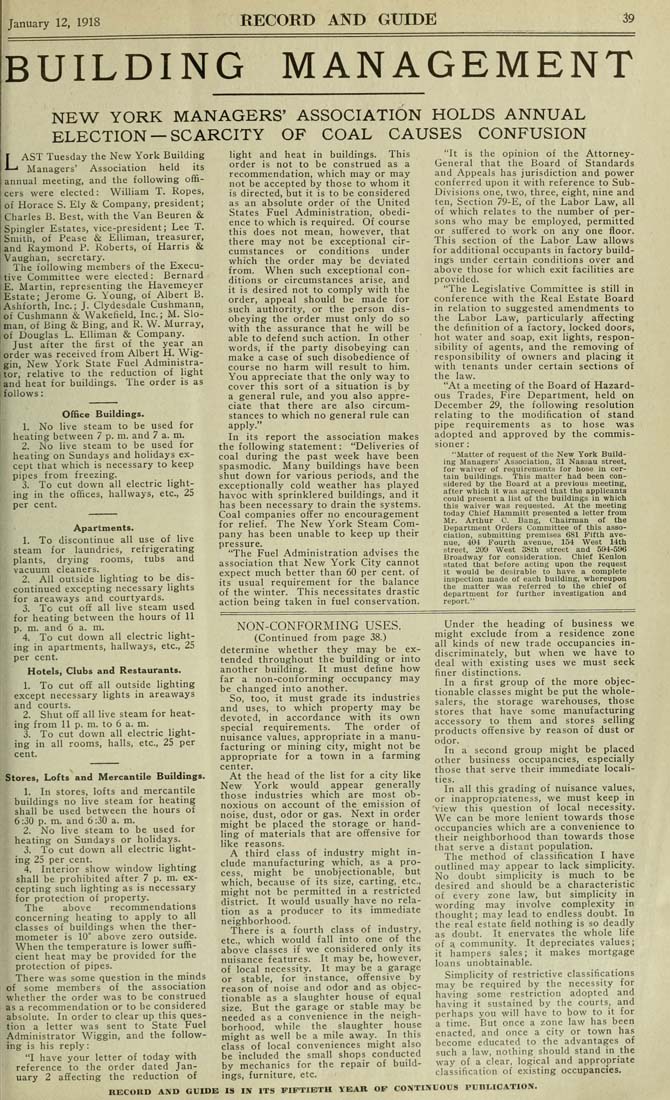
January 12, 1918 RECORD AND GUIDE 39 BUILDING MANAGEMENT NEW YORK MANAGERS' ASSOCIATION HOLDS ANNUAL ELECTION —SCARCITY OF COAL CAUSES CONFUSION LAST Tuesday the New York Building Managers' Association held its annual meeting, and the following offi¬ cers were elected: William T. Ropes, of Horace S. Ely & Company, president; Charles B. Best, with the Van Beuren & Spingler Estates, vice-president; Lee T. Smith, of Pease & Elliman, treasurer, and Raymond P. Roberts, of Harris & Vaughan, secretary. The following members of the Execu- , tive Committee were elected: Bernard IE. Martin, representing the Havemeyer [Estate; Jerome G. Young, of Albert B. I Ashforth, Inc.; J. Clydesdale Cushmann, of Cushmann & V/akefield, Inc.; M. Slo- ■ man, of Bing & Bing, and R. W. Murray, iof Douglas L. Elliman & Company. ' Just after the first of the year an ' order was received from Albert H. Wig- gin, New York State Fuel Administra- , tor, relative to the reduction of light and heat for buildings. The order is as \ follows; Office Buildings. 1. No live steam to be used for heating between 7 p. m. and 7 a. m. 2. No live steam to be used for heating on Sundays and holidays ex¬ cept that which is necessary to keep pipes from freezing. 3. To cut down all electric light¬ ing in the offices, hallways, etc., 25 per cent. Apartments. 1. To discontinue all use of live steam for laundries, refrigerating plants, drying rooms, tubs and vacuum cleaners. 2. All outside lighting to be dis¬ continued excepting necessary lights for areaways and courtyards. 3. To cut off all live steam used for heating between the hours of U p. m. and 6 a. m. 4. To cut down all electric light¬ ing in apartments, hallways, etc., 25 per cent. Hotels, Clubs and Restaurants. 1. To cut off all outside lighting except necessary lights in areaways and courts. 2. Shut off all live steam for heat¬ ing from 11 p. m. to 6 a. m. 3. To cut down all electric light¬ ing in all rooms, halls, etc., 25 per cent. Stores, Lofts and Mercantile Buildings. 1. In stores, Iofts and mercantile buildings no live steam for heating shall be used between the hours of 6:30 p. m. and 6:30 a. m. 2. No live steam to be used for heating on Sundays or holidays. 3. To cut down all electric light¬ ing 25 per cent. 4. Interior show window lighting shall be prohibited after 7 p. m. ex¬ cepting such lighting as is necessary for protection of property. The above recommendations concerning heating to apply to all classes of buildings when the ther¬ mometer is 10° above zero outside. When the temperature is lower suffi¬ cient heat may be provided for the protection of pipes. light and heat in buildings. This order is not to be construed as a recommendation, which may or may not be accepted by those to whom it is directed, but it is to be considered as an absolute order of the United States Fuel Administration, obedi¬ ence to which is required. Of course this does not mean, however, that there may not be exceptional cir¬ cumstances or conditions under which the order may be deviated from. When such exceptional con¬ ditions or circumstances arise, and it is desired not to comply with the order, appeal should be made for such authority, or the person dis¬ obeying the order must only do so with the assurance that he will be able to defend such action. In other words, if the party disobeying can make a case of such disobedience of course no harm will result to him. You appreciate that the only way to cover this sort of a situation is by a general rule, and you also appre¬ ciate that there are also circum¬ stances to which no general rule can apply." In its report the association makes the following statement: "Deliveries of coal during the past week have been spasmodic. Many buildings have been shut down for various periods, and the exceptionally cold weather has played havoc with sprinklered buildings, and it has been necessary to drain the systems. Coal companies offer no encouragement for relief. The New York Steam Com¬ pany has been unable to keep up their pressure. "The Fuel Administration advises the association that New York City cannot expect much better than 60 per cent, of its usual requirement for the balance of the winter. This necessitates drastic action being taken in fuel conservation. "It is the opinion of the Attorney- General that the Board of Standards and Appeals has jurisdiction and power conferred upon it with reference to Sub- Divisions one, two, three, eight, nine and ten. Section 79-E, of the Labor Law, all of which relates to the number of per¬ sons who may be employed, permitted or suffered to work on any one floor. This section of the Labor Law allows for additional occupants in factory build¬ ings under certain conditions over and above those for which exit facilities are provided. "The Legislative Committee is still in conference with the Real Estate Board in relation to suggested amendments to the Labor Law, particularly affecting the definition of a factory, locked doors, hot water and soap, exit lights, respon¬ sibility of agents, and the removing of responsibility of owners and placing it with tenants under certain sections of the law. "At a meeting of the Board of Hazard¬ ous Trades, Fire Department, held on December 29, the following resolution relating to the modification of stand pipe requirements as to hose was adopted and approved by the commis¬ sioner : "Matter of request of the New York Build¬ ing Managers' Association, 31 Nassau street, for waiver of requirements for hose in cer¬ tain buildings. This matter had been con¬ sidered by the Board at a previous meeting, after which it was agreed that tbe applicants could present a list of the buildings in which this waiver was requested. At the meeting today Chief Hammitt presented a letter from Mr. Arthur C. Bang, Chairman of the Department Orders Committee of this asso¬ ciation, submitting premises 681 Fifth ave¬ nue, 404 Fourth avenue, 154 West 14th street, 209 West SSth street and 594-596 Broadway for consideration. Chief Kenlon .stated that before acting upon the request it would be desirable to have a complete inspection made of each building, whereupon the matter was referred to the chief of department for further investigation and report." NON-CONFORMING USES. (Continued from page 38.) determine whether they may be ex¬ tended throughout the building or into another building. It must define how ^^^^^ distinctions. Under the heading of business we might exclude from a residence zone all kinds of new trade occupancies in¬ discriminately, but when we have to deal with existing uses we must seek far a non-conforming occupancy may be changed into another. So, too, it must grade its industries and uses, to which property may be devoted, in accordance with its own special requirements. The order of nuisance values, appropriate in a manu¬ facturing or mining city, might not be appropriate for a town in a farming center. At the head of the list for a city like New York would appear generally those industries which are most ob¬ noxious on account of the emission of noise, dust, odor or gas. Next in order might be placed the storage or hand¬ ling of materials that are offensive for like reasons. A third class of industry might in¬ clude manufacturing which, as a pro- In a first group of the more objec¬ tionable classes might be put the whole¬ salers, the storage warehouses, those stores that have some manufacturing accessory to them and stores selling products offensive by reason of dust or odor. In a second group might be placed other business occupancies, especially those that serve their immediate locali¬ ties. In all this grading of nuisance values, or inappropriateness, we must keep^ in view this question of local necessity. We can be more lenient towards those occupancies which are a convenience to their neighborhood than towards those that serve a distant population. The method of classification I have outlined may appear to lack simplicity. ce^ss,^ might be^^ V,",°^^!f^'°r.^,^!^^ J^,"^ No doubt simplicity is much to be __.i „ .*.r. ^,,« ^o^ ,t,^ «^ desired and should be a characteristic of every zone law, but simplicity in wording may involve complexity in thought; may lead to endless doubt. In the real estate field nothing is so deadly as doubt. It enervates the whole life of a community. It depreciates values; it hampers sales; it makes mortgage loans unobtainable. Simplicity of restrictive classifications may be required by the necessity for having some restriction adopted and which, because of its size, carting,_etc might not be permitted in a restricted district. It would usuallyhave no rela¬ tion as a producer to its immediate neighborhood. There is a fourth class of industry, etc., which would fall into one of the above classes if we considered only its nuisance features. It may be, however, of local necessity. It may be a garage There was some question in the minds or stable, for instance, offensive by of some members of the association reason of noise and odor and as objec- . . , ^ ^„,. whether the order was to be construed tionable as a slaughter house of equal having some restriction acoptea ana as a recommendation or to be considered si^e. But the garage or stable may be havmg it sustained by the cou/^s^"^ absolute. In order to clear up this ques- needed as a convenience in the neigh- perhaps you will have to bow to ^^ ^^^ tion a letter was sent to State Fuel borhood, while the slaughter house a time But once a zone law has been Administrator Wiggin, and the follow¬ ing is his reply: "I have your letter of today with reference to the order dated Jan¬ uary 2 affecting the reduction of might as well be a mile away. In this enacted, and once a city or town has da!s of local conveniences might also become educated to the advantages of be included the small shops conducted such a law nothing should stand in the by mechanics for the repair of build- way of a clear, lofl^al^and appropriate ings, furniture, etc. issification of existing occupancies. RECORD AND GUIDE IS IN ITS FIFTIETH YEAR OF CONTINUOUS PUBLICATION.