
Columbia University Libraries Digital Collections: The Real Estate Record
Use your browser's Print function to print these pages.
Real estate record and builders' guide: [v. 101, no. 2606: Articles]: February 23, 1918
Text version:
Please note: this text may be incomplete. For more information about this OCR, view About OCR text.
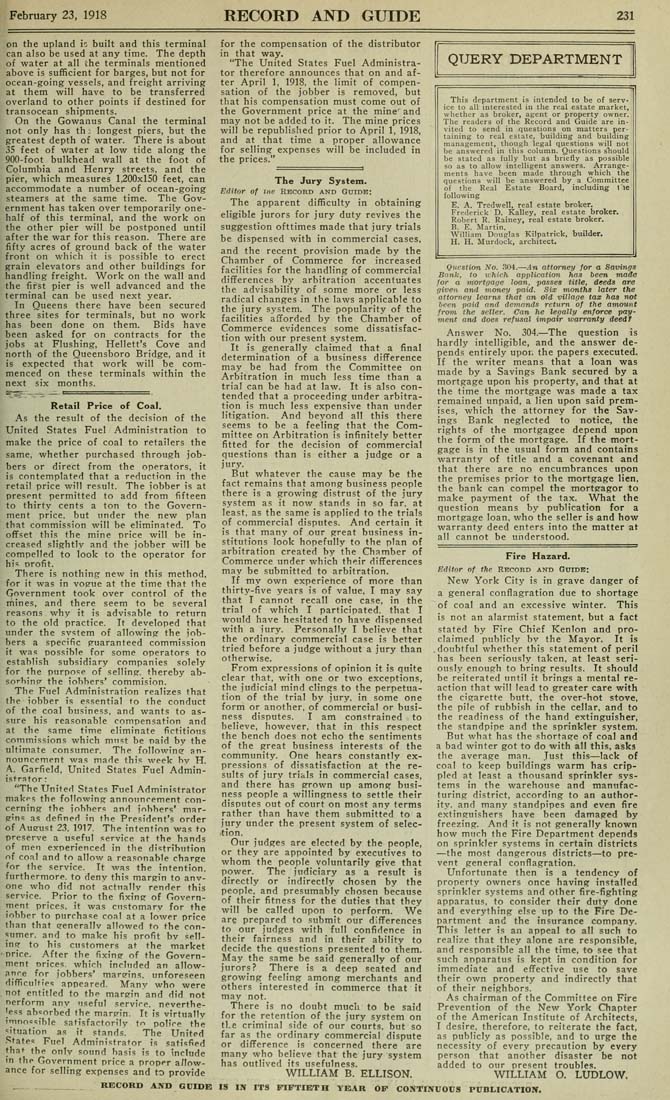
February 23, 1918 RECORD AND GUIDE 231 on the upland h built and this terminal can also be used at any time. The depth of water at all the terminals mentioned above is sufficient for barges, but not for ocean-going vessels, and freight arriving at them will have to be transferred overland to other points if destined for transocean shipments. On the Gowanus Canal the terminal not only has th: longest piers, but the greatest depth of water. There is about 35 feet of water at low tide along the 900-foot^ bulkhead wall at the foot of Columbia and Henry streets, and the pier, which measures 1,200x150 feet, can accommodate a number of ocean-going steamers at the same time. The Gov¬ ernment has taken over temporarily one- half of this terminal, and the work on the other pier will be postponed until after the war for this reason. There are fifty acres of ground back of the water front on which it is possible to erect grain elevators and other buildings for handling freight. Work on the wall and the first pier is well advanced and the terminal can be used next year. In Queens there have been secured three sites for terminals, but no work has been done on them. Bids have been asked for on contracts for the jobs at Flushing, Hellett's Cove and north of the Queensboro Bridge, and it is expected that work will be com¬ menced on these terminals within the next six months. for the compensation of the distributor in that way. "The United States Fuel Administra¬ tor therefore announces that on and af¬ ter April 1, 1918. the limit of compen¬ sation of the jobber is removed, but that his compensation must come out of the Government price at the mine' and may not be added to it. The mine prices will be republished prior to April 1, 1918, and at that time a proper allowance for selling expenses will be included in the prices." QUERY DEPARTMENT Retail Price of Coal. As the result of the decision of the United States Fuel Administration to make the price of coal to retailers the same, whether purchased through job¬ bers or direct from the operators, it is contemplated that a reduction in the retail price will result. The jobber is at present permitted to add from fifteen to thirty cents a ton to the Govern¬ ment price, but under the new plan that commission will be eliminated. To offset this the mine price will be in¬ creased slightly and the jobber will be compelled to look to the operator for hi"^ orofit. There is nothing new in this method, for it was in vo?ue at the time that the Government took over control of the mines, and there seem to be several reasons why it is advisable to return to the old practice. Tt developed that under the svstem of allowing- the job¬ bers a specific guaranteed commission it was possible for some operators to establish subsidiary companies solely for the purpose of selling, thereby ab- sorhine' the jobbers' commision. The Fuel Administration realizes that the iobber is essential to the conduct of the coal business, and wants to as¬ sure his reasonable compensation and at the same time eliminate fictitious commissions which mnst be naid by the ultimate consumer. The following an¬ nouncement was made this week bv H. A. Garfield, United States Fuel Admin¬ istrator : "The United States Fuel Administrator mak^s the following announcement con¬ cerning the iohbers and jobbers* mar¬ gins as defined in the President's order of Aueust 23. 1917. The intention was to preserve a useful service at the hands of men experienced in the di<;tribution of coal and to allow a reasonable charge for the service. Tt was the intention, furthermore, to deny this margin to anv- one who did not actnallv render this service. Prior to the fixing of Govern¬ ment prices, it was customary for the iobber to purchase coal at a lower price than that generally allowed to the con- Mimer. and to make his profit bv sell¬ ing to his customers at the market nrice. After tbe fixing of the Govern¬ ment prices. whJrh included an allow- 3rire for jobbers' margins, unforeseen difficulties appeared. Many who were not entitled to the margin and did not Perform any useful service, neverthe¬ less absorbed the margin. It is virtually impossible satisfactorily to police the <:ituation as it stands. The United State<: Fuel Administrator is satisfied that the onlv sound basis is to include in the Government price a proper a/low- ance for selling expenses and to provide _________________RECORD AND GUIDB The Jury System. Editor of me Record and Guide: The apparent difficulty in obtaining eligible jurors for jury duty revives the suggestion ofttimes made that jury trials be dispensed with in commercial cases, and the recent provision made by the Chamber of Commerce for increased facilities for the handling of commercial differences by arbitration accentuates the advisability of some more or less radical changes in the laws applicable to the jury system. The popularity of the facilities afforded by the Chamber of Commerce evidences some dissatisfac¬ tion with our present system. It is generally claimed that a final determination of a business difference may be had from the Committee on Arbitration in much less time than a trial can be had at law. It is also con¬ tended that a proceeding under arbitra¬ tion is much less expensive than under litigation. And beyond all this there seems to be a feeling that the Com¬ mittee on Arbitration is infinitely better fitted for the decision of commercial questions than is either a judge or a jury. But whatever the cause may be the fact remains that among business people there is a growing distrust of the jury system as it now stands in so far. at least, as the same is applied to the trials of commercial disputes. And certain it is that many of our great business in¬ stitutions look hopefully to the plan of arbitration created by the Chamber of Commerce under which their differences may be submitted to arbitration. If my own experience of more than thirty-five years is of value, I may say that T cannot recall one case, in the trial of which I participated, that I would have hesitated to have dispensed with a jury. Personally I believe that the ordinary commercial case is better tried before a judge without a jury than otherwise. From expressions of opinion it is quite clear that, with one or two exceptions, the judicial mind clings to the perpetua¬ tion of the trial by jury, in some one form or another, of commercial or busi- nes^s disputes. I am constrained to believe, however, that in this respect the bench does not echo the sentiments of the great business interests of the community. One hears constantly ex¬ pressions of dissatisfaction at the re¬ sults of Jury trials in commercial cases, and there has grown up among busi¬ ness people a willingness to settle their disputes out of court on most any terms rather than have them submitted to a jury under the present system of selec¬ tion. Our Judges are elected by the people, or they are appointed by executives to whom the people voluntarily give that power. The Judiciary as a result is directly or indirectly chosen by the people, and presumably chosen because of their fitness for the duties that they will be called upon to perform. We are prepared to submit our differences to our judges with full confidence in their fairness and in their ability to decide the questions presented to them. May the same be said generally of our Jurors? There is a deep seated and growing feeling among merchants and others interested in commerce that it may not. There is no doubt much to be said for the retention of the Jury system on the criminal side of our courts, but so far as the ordinary commercial dispute or difference is concerned there are many who believe that the jury system has outlived its usefulness. WILLIAM B. ELLISON. This department is intended to be of serv¬ ice to all interested in the real estate market, whether as broker, agent or property owner. The readers of the Record and Guide are in¬ vited to send in questions on matters per¬ taining to real estate, building and builaing management, though legal questions will not be answered in this column. Questions should be stated as fully but as briefly as possible so as to allow intelligent answers. Arrange¬ ments have been made through which the questions will be answered by a Committee of the Real Estate Board, including lie following E. A. Tredwell, real estate broker. Frederick D. Kalley, real estate broker. Robert R. Rainey, real estate broker. B. E. Martin. William Douglas Kilpatrick, builder. H. H. Murdock, architect. Question No. 304.—An attorney for a Savings Bmik. to which application has been made for a mortgage loan, passes title, deeds are given and money paid. Six months later the attorney learns that an old village tax has not been paid and demands return of the amount from the seller. Can he leaally enforce pay¬ ment and does refusal impair warranty deedt Answer No. 304.—The question is hardly intelligible, and the answer de¬ pends entirely upon the papers executed. If the writer means that a loan was made by a Savings Bank secured by a mortgage upon his property, and that at the time the mortgage was made a tax remained unpaid, a lien upon said prem¬ ises, which the attorney for the Sav¬ ings Bank neglected to notice, the rights of the mortgagee depend upon the form of the mortgage. If the mort¬ gage is in the usual form and contains warranty of title and a covenant and that there are no encumbrances upon the premises prior to the mortgage lien, the bank can compel the mortgagor to make payment of the tax. What the question means by publication for a mortgage loan, who the seller is and how warranty deed enters into the matter at all cannot be understood. Fire Hazard. Editor of the Record and Guide: New York City is in grave danger of a general conflagration due to shortage of coal and an excessive winter. This is not an alarmist statement, but a fact stated by Fire Chief Kenlon and pro¬ claimed publicly bv the Mayor. It is .doubtful whether this statement of peril has been seriously taken, at least seri¬ ously enough to bring results. It should be reiterated until it brings a mental re¬ action that will lead to greater care with the cigarette butt, the over-hot stove, the pile of rubbish in the cellar, and to the readiness of the hand extinguisher, the standpipe and the sprinkler system. But what has the shortage of coal and a bad winter got to do with all this, asks the average man. Just this—lack of coal to keep buildings warm has crip¬ pled at least a thousand sprinkler sys¬ tems in the warehouse and mantifac- turing district, according to an author¬ ity, and many standpipes and even fire extinguishers have been damaged by freezing. And it is not generally known how much the Fire Department depends on sprinkler systems in certain districts —the most dangerous districts—to pre¬ vent general conflagration. Unfortunate then is a tendency of property owners once having installed sprinkler systems and other fire-fighting apparatus, to consider their duty done and everything else up to the Fire De¬ partment and the insurance company. This letter is an appeal to all such to realize that they alone are responsible, and responsible all the time, to see that such apparatus is kept in condition for immediate and effective use to save their own property and indirectly that of their neighbors. As chairman of the Committee on Fire Prevention of the New York Chapter of the American Institute of Architects, I desire, therefore, to reiterate the fact. as publicly as possible, and to urge the necessity of every precaution by every person that another disaster be not added to our present troubles. WILLIAM O. LUDLOW. IS IN ITS FIFTIETH YGAR OF CONTINUOUS PUBLICATION.