
Columbia University Libraries Digital Collections: The Real Estate Record
Use your browser's Print function to print these pages.
Real estate record and builders' guide: v. 102, no. 1 [2625]: [Articles]: July 6, 1918
Text version:
Please note: this text may be incomplete. For more information about this OCR, view About OCR text.
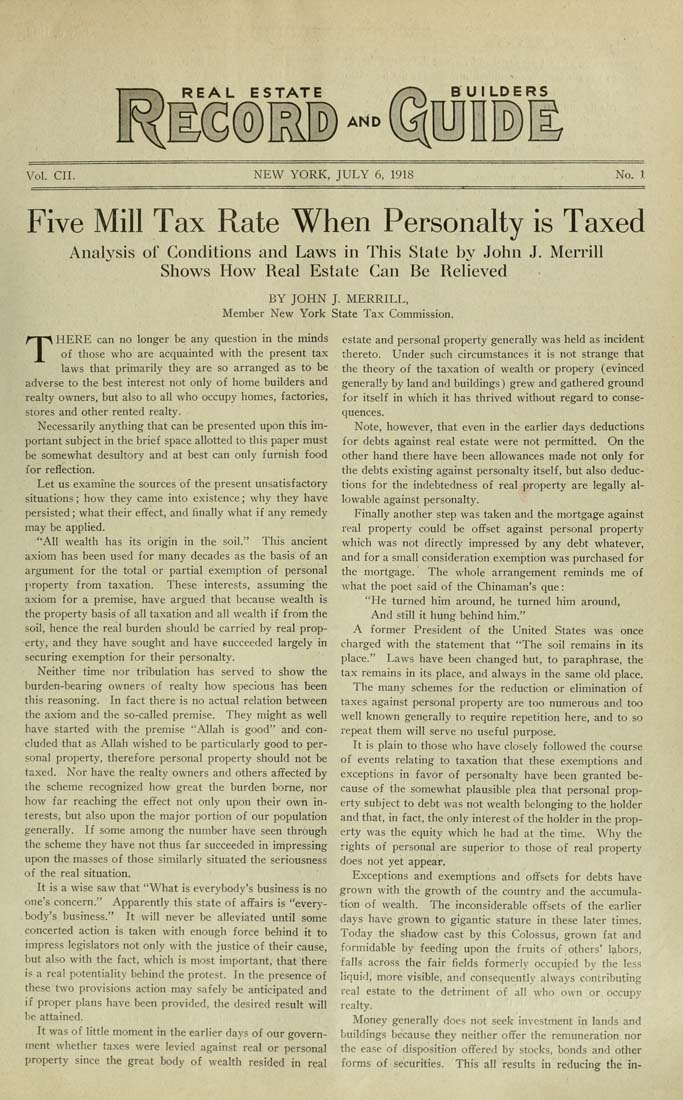
AND B U I LD E R S m]\m Vol. CII. NEW YORK, JULY 6, 1918 No. .1, Five MiU Tax Rate When Personalty is Taxed Analysis of Gonditions and Laws in This State by John J. Merrill Shows How Real Estate Can Be Reheved BY JOHN J. MERRILL, Member New York State Tax Commission. THERE can no longer be any question in the minds of those who are acquainted with the present tax laws that primarily they are so arranged as to be adverse to the best interest not only of home builders and reaUy owners, but also to all who occupy homes, factories, stores and otlier rented realty. Necessarily anything that can be presented upon this im- portant subject in the brief space allotted to this paper must be somewhat desultory and at best can only furnish food for reflection. Let us examine the sources of the present unsatisfactory situations; how they came into e.xistence; why they have persisted; what their efĩect, and finally what if any remedy may be applied. "All weahh has its origin in the soil." This ancient axiom has been used for many decades as the basis of an argument for the total or partial exemption of personal property from taxation. These interests, assuming the axiom for a premise, have argued that because wealth is the property basis of all taxation and all wealth if from the soil, hence the real burden should be carried by real prop- erty, and they have sought and have succeeded largely in securing exemption for their personalty. Neither time nor tribulation has served to show the burden-bearing owners of realty how specious has been this reasoning. In fact there is no actual relation between the axiom and the so-called premise. They might as well have started with the premise "Allah is good" and con- cluded that as Allah wished to be particularly good to per- sonal property, therefore personal property should not be taxed. Nor have the realty owners and others afifected by the scheme recognized how great the burden borne, nor how far reaching the efĩfect not only upon their own in- terests, but also upon the major portion of our population generally. If some among the nuniber have seen through the scheme they have not thus far succeeded in impressing upon the masses of those similarly situated the seriousness of the real situation. It is a wise saw that "What is everybody's business is no one's concern." Apparently this state of afîairs is "every- body's business." It will never be alleviated until some concerted action is taken with enough force behind it to impress legislators not only with the justice of their cause, but also with the fact, which is most important, that there is a real potentiality behind the protest. In the presence of these two provisions action may safely be anticipated and if proper plans have been providcd, the desired result will be attained. It was of little moment in the earlier days of our govern- inent whether taxes were levied against real or personal property since the great body of wealth resided in real cstate and personal property generally was held as incident diereto. Under such circumstances it is not strange that the theory of the taxation of wealth or propery (evinced generally by land and buildings) grew and gathered ground for itself in which it has thrived without regard to conse- quences. Note, however, that even in the earlier days deductions íor debts against real estate were not permitted. On the other hand there have been allowances made not only for the debts existing against personalty itself, but also deduc- tions for the indebtedness of real property are legally al- lowable against personalty. Finally another step was taken and the mortgage against real property could be ofifset against personal property which was not directly impressed by any debt whatever, and for a small consideration exemption was purchased for the mortgage. The whole arrangement reminds me of what the poet said of the Chinaman's que: "He turned him around, he turned him around, And still it hung behind him." A former President of the United States was once charged with the statement that "The soil remains in its place." Laws have been changed but, to paraphrase, the tax remains in its place, and always in the same old place. The many schemes for the reduction or elimination of taxes against personal property are too numerous and too well known generally to require repetition here, and to so repeat them will serve no useful purpose. It is plain to those who have closely followed the course of events relating to taxation that these exemptions and exceptions in favor of personalty have been granted be- cause of the somewhat plausible plea that personal prop- erty subject to debt was not wealth belonging to the holder and that, in fact, the only interest of the holder in the prop- erty was the equity whicli he had at the time. Wliy the rights of personal are superior to Ihose of real property does not yet appear. E.xceptions and exemptions and offsets for debts have grown with the growth of the country and the accumula- tion of wealth. The inconsiderable offsets of the earlier days have grown to gigantic stature in these later times. Today the shadow cast by this Colossus, grown fat and formidable by feeding upon the fruits of others' labors, falls across the fair fĩelds formerly occupied by the less liquid, more visible, and consequently always contributing real estate to the detriment of all who own or occupy realty. Money generally does not seek investment in lands and buildings because they neither offer the remuneration nor the ease of disposition offered by stocks, bonds and other forms of securitíes. This all results in reducing tíie in-