
Columbia University Libraries Digital Collections: The Real Estate Record
Use your browser's Print function to print these pages.
Real estate record and builders' guide: v. 102, no. 2 [2626]: [Articles]: July 13, 1918
Text version:
Please note: this text may be incomplete. For more information about this OCR, view About OCR text.
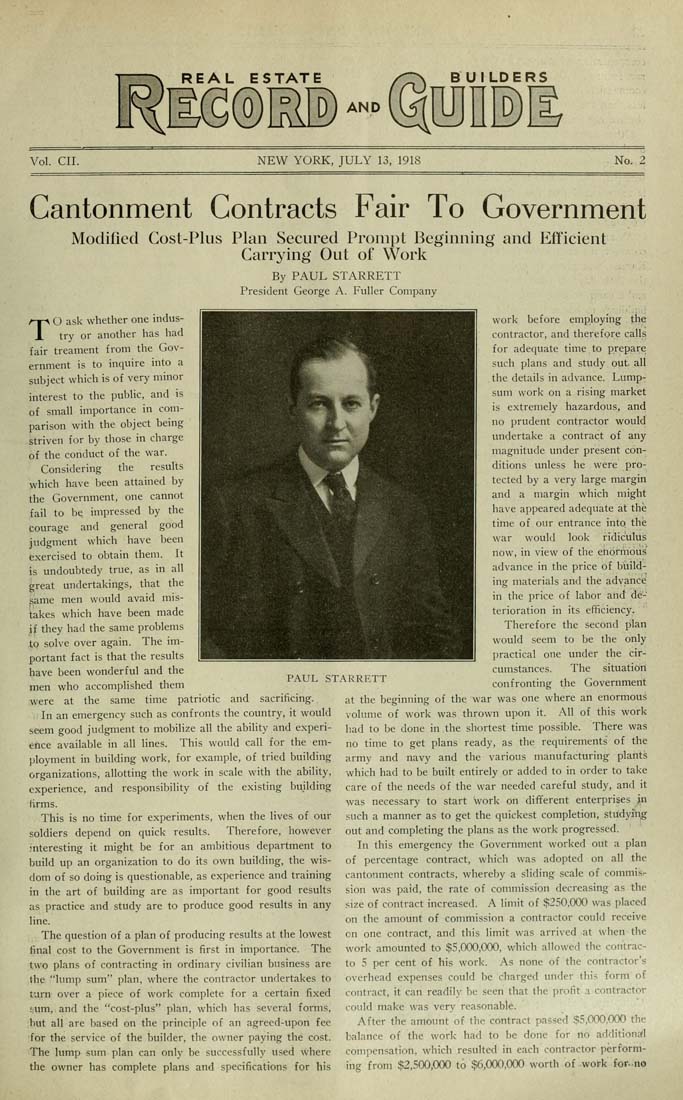
REAL ESTATE AND BUILDERS m® Vol. CII. NEW YORK, JULY 13, 1918 No. 2 Cantonment Contracts Fair To Government Modified Gost-Plus Plan Secured Prompt Beginning and Efficient Garrying Out of Work By PAUL STARRETT President George A. Fuller Company TO ask whether one indiis- try or another has had fair treament from the Gov- ernment is to inquire into a subject which is of very minor interest to the pubhc, and is of small importance in com- parison with the object being striven for by those in charge of the conduct of the war. Considering the results which have been attained by the Government, one cannot fail to be impressed by the courage and general good judgment which have been exercised to obtain them. It is undoubtedy true, as in all great undertakings, that the pame men would avaid inis- takes which have been made if they had the same problems to solve over again. The im- portant fact is that the results have been wonderful and the men who accomphshed them were at the same time patriotic and sacrificing. In an emergency such as confronts the country, it would seem good judgment to mobiHze all the abihty and e.xperi- ence available in all lines. This would call for the em- PAUL STARRETT work before employíng the contractor, and therefore calls for adequate time to prepare such plans and study out all the details in advance. Lump- sum work on a rising market is e-xtremely hazardous, and no prudent contractor would undertake a contract of any niagnitude under present con- ditions unless he were pro- tected by a very large margin and a margin which niight have appeared adequate at thé time of our entrance intq the war would look ridiculus now, in view of the enorriious advance in the price of build- ing materials and the advance in the price of labor and de'- terioration in its efíiciency. Therefore the second plan would seem to be the only practical one under the cir- cumstances. The situation confronting the Government at the beginning of the war was one where an enormous volume of work was thrown upon it. All of this work had to be done in the shortest time possible. There was no time to get plans ready, as the requirements" of the ployment in building work, for example, of tried building army and navy and the various manufacturing plants organizations, allotting the work in scale with the ability, which had to be built entirely or added to in order to take experience, and responsibility of the existing building care of the needs of the war needed careful study, and it (-;i-ms. was necessary to start Work on difYerent enterprises j.n such a manner as to get the quickest completion, studyíng out and completing the plans as the work progressed. In this emergency the Government worked out a plan of percentage contract, which was adopted on all the cantonnient contracts, whereby a sliding scale of commisr sion was paid, the rate of commission decreasing as the size of contract increased. A limit of $2.S0.00O was placed 011 the amount of commission a contractor could receive on one contract, and this limit was arrived at when the work amounted to $5,000,000, which allowed the cotitrac- to 5 per cent of his work. .A.s none of the contractor's overhead expenses could be charged under this form of contract, it can readily be seen that thc profit a contractor could make was very reasonable. After the amount of the contract paásed $5,000,000 thc balance of the vvork had to he donc for no additionrfl compensation, which resulted in each contractor pêrform- ing from $2,500,000 to $6,000,000 worth of work for..no This is no time for experiments, when the lives of our soldiers depend on quick results. Therefore, however jnteresting it might be for an ambitious department to build up an organization to do its own building, the wis- clom of so doing is questionable, as experience and training in the art of building are as important for good results as practice and study are to produce good results in any line. The question of a plan of producing results at the lowest final cost to the Government is first in importance. The two plans of contracting in ordinary civilian business are the "lump suni" plan, where the contractor undertakes to turn over a piece of work complete for a certain fixed -sum, and the "cost-plus" plan, which has several forms, but ali are based on the principle of an agreed-upon fee for the service of the builder, the owner paying the cost. The lump sum plan can only be successfully used where the owner has complete plans and specifications for his