
Columbia University Libraries Digital Collections: The Real Estate Record
Use your browser's Print function to print these pages.
Real estate record and builders' guide: v. 102, no. 3 [2627]: [Articles]: July 20, 1918
Text version:
Please note: this text may be incomplete. For more information about this OCR, view About OCR text.
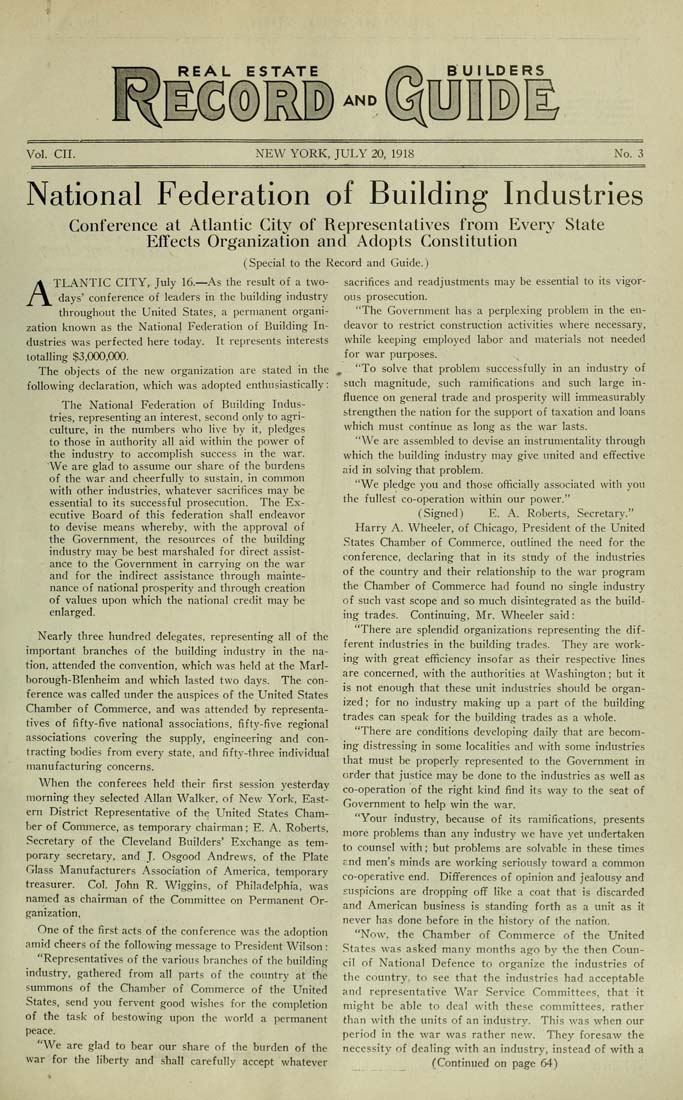
^--^ REAL E5TATE l^E@(ô)IâE) ÁND B UILDERS mm Vol. CII. NEW YORK, JULY 20, 1918 No. 3 National Federation of Building Industries Conference at Atlantic Gity of Representatives from Every State Effects Organization and Adopts Constitution (Special to the Record and Guide.) ATLANTIC CITY, July 16.—As the result of a two- days' conference of leaders in the Iniilding iiidustry throughout the United States, a pernianent organi- zation known as the National Federation of Building In- dustries was perfected here today. It represents interests lotalling $3,000,000. The objects of the new organization are stated in the following declaration, which was adopted enthusiastically: The National Federation of Building Indus- tries, representing an interest, second only to agri- culture, in the numbers who live by it, pledges to those in authority all aid within the power of the industry to accomplish success in the war. 'We are glad to assume our share of the burdens of the war and cheerfully to sustain, in common with other industries, whatever sacrifices may be essential to its successful prosecution. The Ex- ecutive Board of this federation shall endeavor to devise means whereby, with the approval of the Government, the resources of the building industry may be best marshaled for direct assist- ance to the Government in carrying on the war and for the indirect assistance through mainte- nance of national prosperity and through creation of values upon which the national credit may be enlarged. Nearly three hundred delegates, representing all of the important branches of the building industry in the na- tĩon, attended the convention, which was held at the Marl- horough-Blenheim and which lasted two days. The con- ference was called under the auspices of the United States Chamber of Commerce, and was attended by representa- tives of fifty-fîve national associations, fifty-five regĩonal associations covering the supply, engineering and con- tracting bodies from every state, and fifty-three individual manufacturing concerns. When the conferees held their first session yesterday mornîng they selected Allan Walker, of New York, East- ern District Representative of the United States Cham- ber of Commerce, as temporary chairman; E. A. Roberts, Secretary of the Cleveland Builders' Exchange as tem- porary secretary, and J. Osgood Andrews, of the Plate Glass Manufacturers Association of America, temporary treasurer. Col. John R. Wiggins, of Philadelphia, was named as chairman of the Committee on Permanent Or- ganizatîon, One of the first acts of the conference was the adoption amid cheers of the following message to President Wilson : "Representatives of the varioiis branches of the building industry, gathered from all parts of the country at the summons of the Chamber of Commerce of the United States, send you fervent good wishes for the completion of the task of bestowing upon the world a permanent peace. "We are glad to bear our share of the burden of the war for the liberty and shall carefully accept whatever sacrifices and readjustments may be essential to its vigor- ous prosecution. "The Government has a perplexing problem in the en- deavor to restrict construction activities where necessary, vvhile keeping employed labor and materials not needed for war purposes. ^ "To solve that problem successfully in an industry of such magnitude, such ramifications and such large in- fluence on general trade and prosperity will immeasurably strengthen the nation for the support of taxation and loans which must continue as long as the war lasts. "We are assembled to devise an instrumentality through which the building industry may give iinited aiid efifective aid in solving that problem. "We pledge you and those officially associated with yon the fullest co-operation within our power." (Signed) E. A. Roberts, Secretary." Harry A. Wheeler, of Chicago, President of the United States Chainber of Commerce, outlined the need for the conference, declaring that in its study of the industries of the country and their relationship to the war program the Chamber of Commerce had found no single industry of such vast scope and so much disintegrated as the build- ing trades. Continuing, Mr. Wheeler said: "There are splendid organizations representing the dif- ferent industries in the building trades. They are work- ing with great efficiency insofar as their respective lines are concerned, with the authorities at Washington; but it is not enough that these unit industries should be organ- ized; for no industry making up a part of the building trades can speak for the building trades as a whole. "There are conditions developing daily that are becom- ing distressing in some localities and with some industries that must be properly represented to the Government in order that justice may be done to the industries as well as co-operation of the right kind find its way to the seat of Government to help win the war. "Your industry, because of its ramificatĩons, presents niore problems than any industry we have yet undertaken to counsel with; but problems are solvable in these times rnd men's minds are working seriously toward a common co-operative end. Diflferenccs of opinion and jealousy and .íuspicions are dropping ofF like a coat that is discarded and American business is standing forth as a unit as it never has done before in the history of the nation. "Now. the Chamber of Commerce of the United States was asked many months ago by the then Coun- cil of National Defence to organize the industries of the country, to see that the industries had acceptable and representative War Service Committees, that it might be able to dcal with these committees, rather than with the units of an industry. This was when our period in the war was rather new. They foresaw the necessity of dealing with an industry, instead of with a (Continued on page 64)