
Columbia University Libraries Digital Collections: The Real Estate Record
Use your browser's Print function to print these pages.
Real estate record and builders' guide: v. 102, no. 7 [2631]: [Articles]: August 17, 1918
Text version:
Please note: this text may be incomplete. For more information about this OCR, view About OCR text.
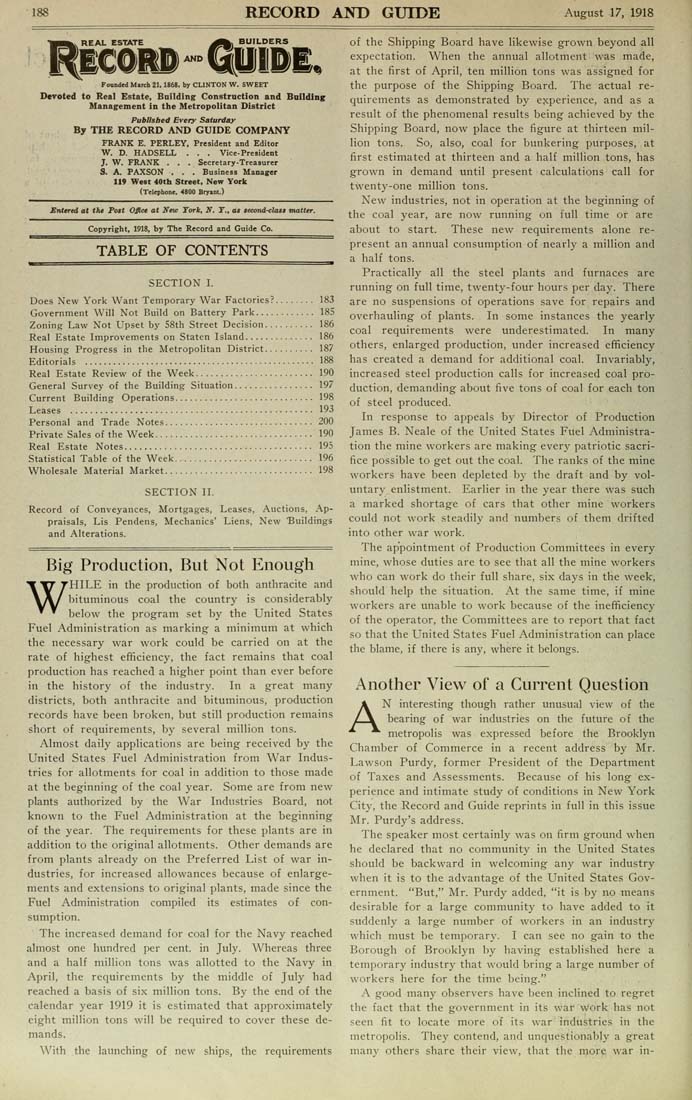
188 RECORD AND GUIDE August 17, 1918 AND 6, BUILDERS illil Pounded Marcb 21. 1868, by CLINTON W. SWEET Dcroted to Real Estate, Bnilding Constrnction and Bnilding Management in tlie Metropolitan District Publlsbed Every Saturday By THE RECORD AND GUIDE COMPANY FRANK E. PERLEY, President and Editor W. D. HADSELL . . . Vice-President J. W. FRANK . . . Secretary-Treasurer S. A. PAXSON . . . Business Manager 119 West 40th Street, New York (TclqiboDe. 4800 Bryant.) Entered at the Pott OMce at New Tork. N. T., at lecond-claii matter. Copyright, 1918, by The Record and Guide Co. TABLE OF CONTENTS SECTION L Does New York Want Temporary War Factories?........ 183 Government Will Not Build on Battery Park............ 185 Zoning Law Not Upset by 58th Street Decision.......... 186 Real Estate Improvements on Staten Island.............. 186 Housing Progress in the Metropolitan District.......... 187 Editorials ................................................. 188 Real Estate Review of the Week........................ 190 General Survey of the Building Situation................ 197 Current Building Operations............................ 198 Leases ................................................. 193 Personal and Trade Notes.............................. 200 Private Sales of the Week................................ 190 Real Estate Notes...................................... 195 Statistical Table of the Week............................ 196 Wholesale Material Market.............................. 198 SECTION II. Record of Conveyances, Mortgages, Leases, Auctions, Ap- praisals, Lis Pendens, Mechanics' Liens, New 'Buildings and Alterations. Big Production, But Not Enough WHILE in the production of both anthracite and bituminous coal the country is considerably below the program set by the United States Fuel Administration as marking a minimum at which the necessary war work could be carried on at the rate of highest effĩciency, the fact remains that coal production has reached a higher point than ever before in the history of the industry. In a great many districts, both anthracite and bituminous, production records have been broken, but still production remains short of requirements, by several million tons. Almost daily applications are being received by the United States Fuel Administration from War Indus- tries for allotments for coal in addition to those made at the beginning of the coal year. Some are from new plants authorized by the War Industries Board, not known to the Fuel Administration at the beginning of the year. The requirements for these plants are in addition to the original allotments. Other demands are from plants already on the Preferred List of war in- dustries, for increased allowances because of enlarge- ments and extensions to original plants, made since the Fuel Administration compiled its estimates of con- sumption. The increased demand for coal for the Navy reached almost one hundred per cent. in July. Whereas three and a half million tons was allotted to the Navy in April, the requirements by the middle of July had reached a basis of six million tons. By the end of the calendar year 1919 it is estimated that approximately eight million tons will be required to cover these de- mands. With the launching of new ships, the requirements of the Shipping Board have likewise grown beyond all expectation. When the annual allotment was made, at the first of April, ten million tons was assigned for the purpose of the Shipping Board. The actual re- quirements as demonstrated by ejcperience, and as a result of the phenomenal results being achieved by the Shipping Board, now place the figure at thirteen mil- lion tons. So, also, coal for bunkering purposes, at first estimated at thirteen and a half million tons, has grown in demand until present calculations call for twenty-one million tons. New industries, not in operation at the beginning of the coal year, are now running on full time or are about to start. These new requirements alone re- present an annual consumption of nearly a million and a half tons. Practically all the steel plants and furnaces are running on full time, twenty-four hours per day. There are no suspensions of operations save for repairs and overhauling of plants. In some instances the yearly coal requirements were underestimated. In many others, enlarged production, under increased effĩciency has created a demand for additional coal. Invariably, increased steel production calls for increased coal pro- duction, demanding about five tons of coal for each ton of steel produced. In response to ajij^eals by Director of Production James B. Neale of the United States Fuel Administra- tion the mine workers are making every patriotic sacri- fice possible to get out the coal. The ranks of the mine workers have been depleted by the draft and by vol- untary enlistment. Earlier in the year there was such a marked shortage of cars that other mine workers could not work steadily and numbers of them drifted into other war work. The appointment of Production Committees in every mine, whose dtities are to see that all the mine workers who can work do their full share, six days in the week, should help the situation. At the same time, if mine workers are unable to work because of the inefficiency of the operator, the Committees are to report that fact so that the United States Fuel Administration can place the blame, if there is any, where it belongs. Another View of a Current Question AN interesting though rather unusual view of the bearing of war industries on the future of the metropolis was expressed before the Brooklyn Chamber of Commerce in a recent address by Mr. Lawson Purdy, former President of the Department of Taxes and Assessments. Because of his long ex- perience and intimate study of conditions in New York City, the Record and Guide reprints in full in this issue Mr. Purdy's address. The speaker most certainly was on firm grotind when he declared that no community in the United States should be backward in welcoming any war industry when it is to the advantage of the United States Gov- ernment. "But," Mr. Purdy added, "it is by no means desirable for a large community to have added to it suddenly a large number of workers in an industry which must be temporary. I can see no gain to the Borough of Brooklyn by having established here a temporary industry that would bring a large number of workers here for the time being." A good many observers have been inclined to regret the fact that the government in its war work has not seen fit to locate more of its war indtistries in the metropolis. They contend, and unquestionably a great many others share their view, that the more war in-