
Columbia University Libraries Digital Collections: The Real Estate Record
Use your browser's Print function to print these pages.
Real estate record and builders' guide: v. 102, no. 9 [2633]: [Articles]: August 31, 1918
Text version:
Please note: this text may be incomplete. For more information about this OCR, view About OCR text.
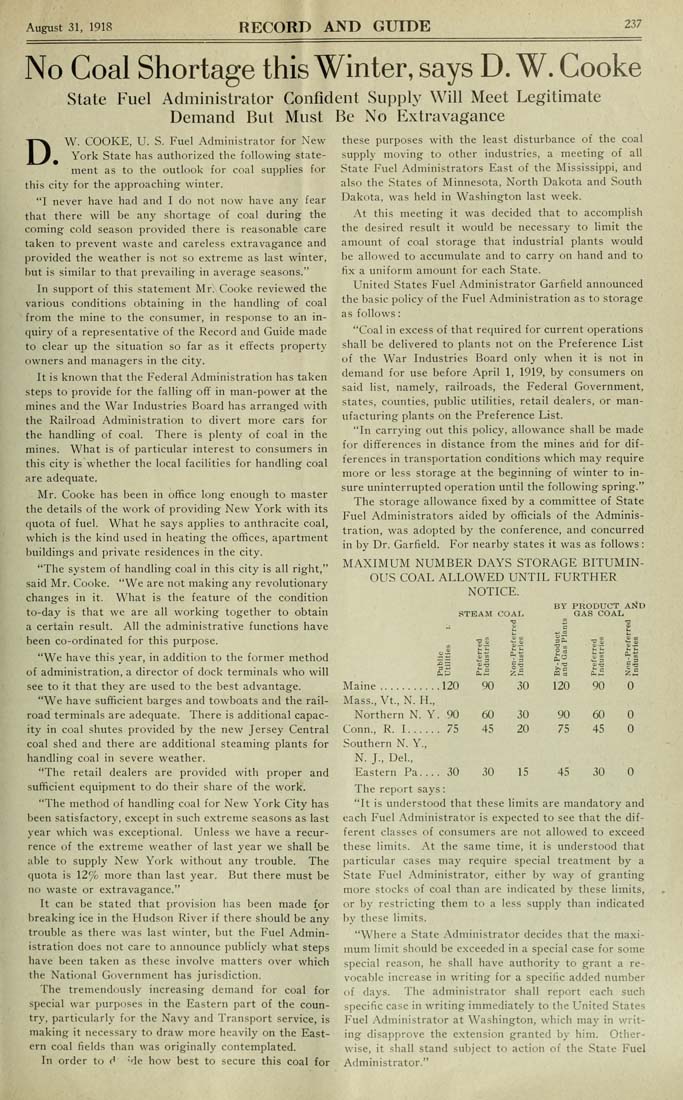
August 31, 1918 RECORD AND GUIDE 237 No Coal Shortage this Winter, says D. W. Cooke State Fuel Administrator Confid Demand But Must DW. COOKE, U. S. Fuel Administrator for New York State has authorized the following state- ment as to the outlook for coal supplies for this city for the approaching winter. "I never have had and I do not now have any fear that there will be any shortage of coal during the coming cold season provided there is reasonable care taken to prevent waste and careless extravagance and provided the weather is not so extreme as last winter, but is similar to that prevailing in average seasons." In support of this statement Mr. Cooke reviewed the various conditions obtaining in the handling of coal froni the mine to the consunier, in response to an in- quiry of a representative of the Record and Guide made to clear up the situation so far as it effects property owners aiid managers in the city. It is known that the Federal Administration has taken steps to provide for the falling off in man-power at the mines and the War Industries Board has arranged with the Railroad Administration to divert more cars for the handling of coal. There is plenty of coal in the mines. What is of particular interest to consumers in this city is whether the local facilities for handling coal are adequate. Mr. Cooke has been in ofifice long enough to master the details of the work of providing New York with its quota of fuel. What he says applies to anthracite coal, which is the kind used in heating the offices, apartment buildings and private residences in the city. "The system of handling coal in tliis city is all right," said Mr. Cooke. "We are not making any revolutionary changes in it. What is the feature of the condition to-day is that we are all working together to obtain a certain result. All the administrative functions have been co-ordinated for this purpose. "We have this year, in addition to the fornier method of administration, a director of dock terminals who will see to it that they are used to the best advantage. "We have sufíicient barges and towboats and the rail- road terminals are adequate. There is additional capac- ity in coal shutes provided by the new Jersey Central coal shed and there are additional steaming plants for handling coal in severe weather. "The retail dealers are provided with proper and suíificient equipment to do their share of the work. "The method of handling coal for New York City has been satisfactory, except in such extreme seasons as last year which was exceptional. Unless we have a recur- rence of the extreme weather of last year we shall be able to supply New York without any trouble. The quota is 12% more than last year. But there must be no waste or extravagance." It can be stated that provision has been made for breaking ice in the Hudson River if there should be any trouble as there was last winter, but the Fuel Admin- istration does not care to announce publicly what steps have been taken as these involve matters over which the National Government has jurisdiction. The tremendously increasing dcmand for coal for special war purposes in the Eastern part of the coun- try, particularly for the Navy and Transport service, is making it necessary to draw more heavily on the East- ern coal fields than was originally contemplated. In order to d -'de how best to secure this coal for ent Supply Will Meet Legitimate Be No Extravagance these purposes with the least disturbance of the coal supply moving to other industries, a meeting of all State Fuel Administrators East of the Mississippi, and also the States of Minnesota, North Dakota and South Dakota, was held in Washington last week. At this meeting it was decided that to accomplish the desired result it would be necessary to limit the amount of coal storage that industrial plants would be allowed to accumulate and to carry on hand and to fix a uniform amount for each State. LTnited States Fuel Administrator Garfield announced the basic policy of the Fuel Administration as to storage as follows: "Coal in excess of that required for current operations shall be delivered to plants not on the Preference List of the War Industries Board only when it is not in deniand for use before April 1, 1919, by consumers on said list, namely, railroads, the Federal Government, states, counties, public utilities, retail dealers, or man- ufacturing plants on the Preference List. "In carrying out this policy, allowance shall be made for diff'erences in distance from the mines arid for dif- ferences in transportation conditions which may require more or less storage at the beginning of winter to in- sure uninterrupted operation until the following spring." The storage allowance fixed by a committee of State Fuel Administrators aided by officials of the Adminis- tration, was adopted by the conference, and concurred in by Dr. Garfield. For nearby states it was as foUows: MAXIMUM NUMBER DAYS STORAGE BITUMIN- OUS COAL ALLOWED UNTIL FURTHER NOTICE. BY PRODUCT AÍÍD STEAM COAI. GAS COAL -o tfi -a SE •g.ĩ Oj uj u u, ÛJ Vt 0,-^ £0 0/ v> ^V. §■2 01 -D £s Maine...........120 90 30 120 90 0 Mass., Vt, N. H., Northern N. Y. 90 60 30 90 60 0 Conn., R. 1...... 75 45 20 75 45 0 Southern N. Y., N. J., Del., Eastern Pa.... 30 30 15 45 30 0 The report says: "It is understood that these limits are mandatory and each Fuel Administrator is expected to see that the dif- ferent classes of consumers are not allowed to exceed these limits. At the same time, it is understood that particular cases niay require special treatment by a State Fuel Administrator, either by way of granting more stocks of coal than are indicated by these limits, or by restricting them to a less supply than indicated by these limits. "Where a State Administrator decides that the maxi- mum liinit should be cxceeded in a special case for some special reason, he shall have authority to grant a re- vocable increase in writing for a specific added number of days. The administrator shall report each such specific case in writing immediately to the United States Fuel Administrator at Washington, which may in writ- ing disapprove the extension granted by him. Other- wise, it shall stand subject to action of the State Fuel Administrator."