
Columbia University Libraries Digital Collections: The Real Estate Record
Use your browser's Print function to print these pages.
Real estate record and builders' guide: v. 102, no. 9 [2633]: [Articles]: August 31, 1918
Text version:
Please note: this text may be incomplete. For more information about this OCR, view About OCR text.
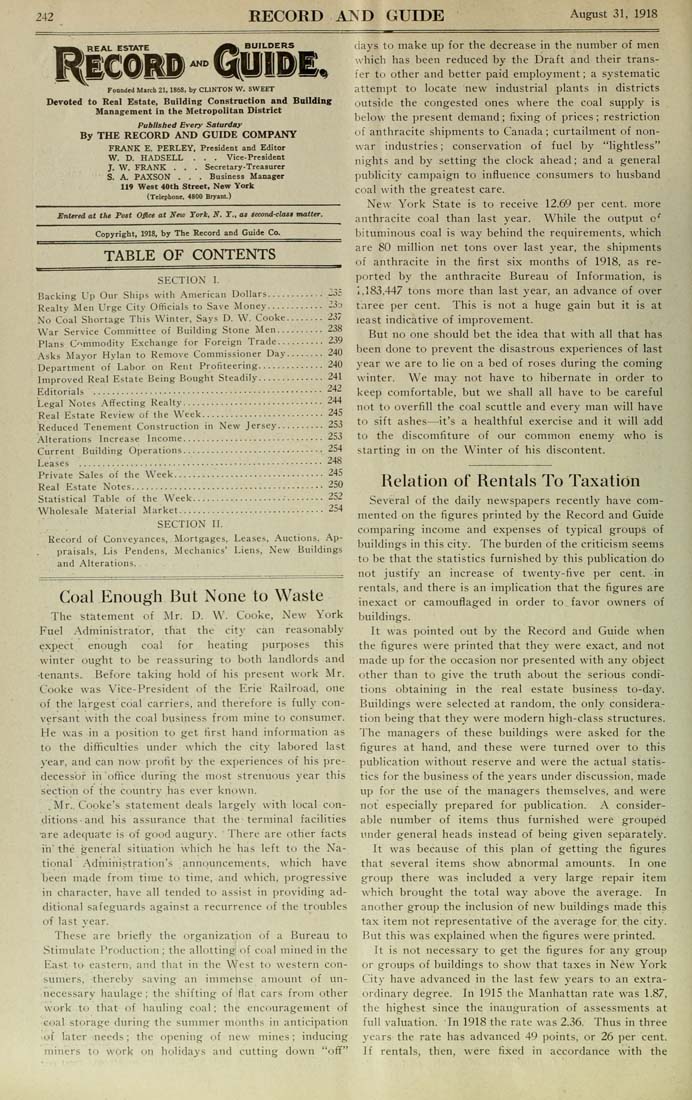
242 RECORD A^D GUIDE August 31, 1918 Fonncitd Mírcb 21. 1868, by CLINTON W. SWEET Devoted to Real Estate, Bnilding Constrnction and Bnndlng Management in tiie Metropolitan District Publlsbed Every Saturday By THE RECORD AND GUIDE COMPANY FRANK E. PERLEY, President and Editor W. D. HADSELL . . . 'Vice-President J. W. FRANK . . . Secretary-Treasurer S. A. PAXSON . . . Business Manager 119 West 40th Street, New York (TclEpbone, 4800 Bryanl.) Bntired at the Post OMce at New Tork, N. T., aa tecond-claii matter. Copyright, 1918, by The Record and Guide Co. TABLE OF CONTENTS SECTION I. Backing Vp Oiir Sliips with Americaii DoUars............ -3; Realty Men Urge City Officials to Save Money............ -3o No Coal Shortage This Winter, Says D. VV. Cooke........ 237 War Service Committee of Building Stone Men.......... 238 Plans C'^mmodity Exchange for Foreign Trade.......... 239 Asks Mayor Hylan to Remove Commissioner Day........ 240 Department of Labor on Reiit Profiteering.............. 240 Improved Real Estate Being Bought Steadily.............. 241 Editorials ................................................. 242 Legal Notes Affecting Realty.............................. 244 Real Estate Review of the Week.......................... 245 Reduced Tenement Construction in New Jersey.......... 253 .Alterations Increase Income.............................. 233 Current Building Operations.............................. 254 Leases .................................................... 248 Private Sales of the Week................................ 245 Real Estate Notes......................................... 250 Statistical Table of the Week............................ 252 Wholesale Material Market............................... 254 SECTION II. Eecord of Conveyances, Mortgages, Leases, .\uctions. Ap- praisals, Lis Pendens, Mechanics' Liens, New Buildings and Alterations.. days to make iip for tlie decrease in the number of men Avhich has been reduced by the Draft and their trans- fer to other and better paid employment; a systematic attempt to locate new industrial plants in districts outside the congested ones where the coal supply is below the ])resent demand; fixing of prices; restriction of anthracite shipnients to Canada ; curtailment of non- war industries; conservation of fuel by "lightless" nights and by setting the clock ahead; and a general publicity campaign to influence consumers to husband coal with the greatest care. New York State is to receive 12.69 per cent. more anthracite coal than last year. While the outptit c'' bituminous coal is way behind the reciuirements, which are 80 million net tons over last year, the shipnients of anthracite in the first six months of 1918, as re- pnrted by the anthracite Bureau of Information, is 1,183,-147 tons niore than last year, an advance of over t.iree per cent. This is not a huge gain but it is at least indicative of improvement. But no one should bet the idea that with all that has been done to prevent the disastrous experiences of last year we are to lie on a bed of roses during the coming winter. We may not have to hibernate in order to keep comfortable, but we shall all have to be careful not to overfill the coal scuttle and every man will Iiave tn sift ashes—it's a healthful exercise and it wiU add to the discomfiture of our commoii eiiemy who is starting in on the Winter of his discontent. Coal Enoiigh But None to Waste The sfatement of Mr. D. W. Cooke, New York Fuel Administrator, that the city can reasonably expect enough coaî for heating j^urposes this winter ought to be reassuring to both landlords and ■tenants. Before taking hold of his present work Mr. Cooke was Vice-President of the Erie Railroad, one of the largest coal carriers, and therefore is fully con- versant with the coal business from mine to consumer. He was in a position to get first hand information as to the difficulties under which the city labored last year, and can now profit by the experiences of his pre- decess'oĩ^ ih office during the most strenuous year this section of the country has ever kndwn. .Mr., Cooke's statement deals largely with local con- dition-sand his assurance that the terminal facilities ■are adeciuale is of good augury. There are other facts in thé gener'al sitiiation which he has left to the Na- tional .\dministration's announcements. whicli have been made froni time to tinie, and whicli, progressive in character, have all tended to assist in providing ad- ditional safeguards against a recurrence of the troubles of last year. These are briefly the organization of a Bureau to Stimulate Production ; the allotting of coal mined in the East to eastern, and that in the West to western con- sumers, thereby saving an immeiise aniount of un- iiecessary haulage ; thc shifting of flat cars froni other work to that of hauling coal; the encouragement of Goal storage during the summer moiiths in anticipation • of later needs; the opening of new mines; inducing miners to work on holidays aiid cutting down "ofif" Kelation of Rentals To Taxation Several of the daily newspapers recently have coni- mented on the figures printed by the Record and Guide comparing income and expenses of typical groups of buildings in this city. The burden of the criticism seems to be that the statistics furnished by this publication do not justify an increase of twenty-five per cent. iii rentals, and there is an implication that the figures are inexact or camouflaged in order to favor owners of buildings. It was pointed out by the Record and Guide when the figures were printed that they were exact, and not made up for the occasion nor presented with any object other than to give the truth about the serious condi- tions obtaining in the real estate business to-day. Buildings were selected at random, the only considera- tion being that they were modern high-class structures. The managers of these buildings were asked for the figures at hand, and these were turned over to this publication without reserve and were the actual statis- tics for the business of the years under discussion, made up for the use of the managers themselves, and were not especially prepared for publication. A consider- able number of items thus furnished were grouped under general heads instead of beiiig given separately. It was because of this plan of getting the figures that several items show abnormal amounts. In one group there was included a very large repair item which brought the total way above the average. In another group the inclusion of new buildings made this tax item not representative of the average for the city. But this was explained when the figures were printed. It is not necessary to get the figures for any group or groups of buildings to show that taxes in New York City have advanced iii the last few years to an extra- ordinary degree. In 1915 the Manhattan rate was 1.87, thc highest since the inauguration of assessments at full valuation. In 1918 the rate was 2.36. Thus in three ycars the rate has advanced 49 points, or 26 per cent. If rentals, then, were fixed in accordance with the