
Columbia University Libraries Digital Collections: The Real Estate Record
Use your browser's Print function to print these pages.
Real estate record and builders' guide: v. 102, no. 11 [2635]: [Articles]: September 14, 1918
Text version:
Please note: this text may be incomplete. For more information about this OCR, view About OCR text.
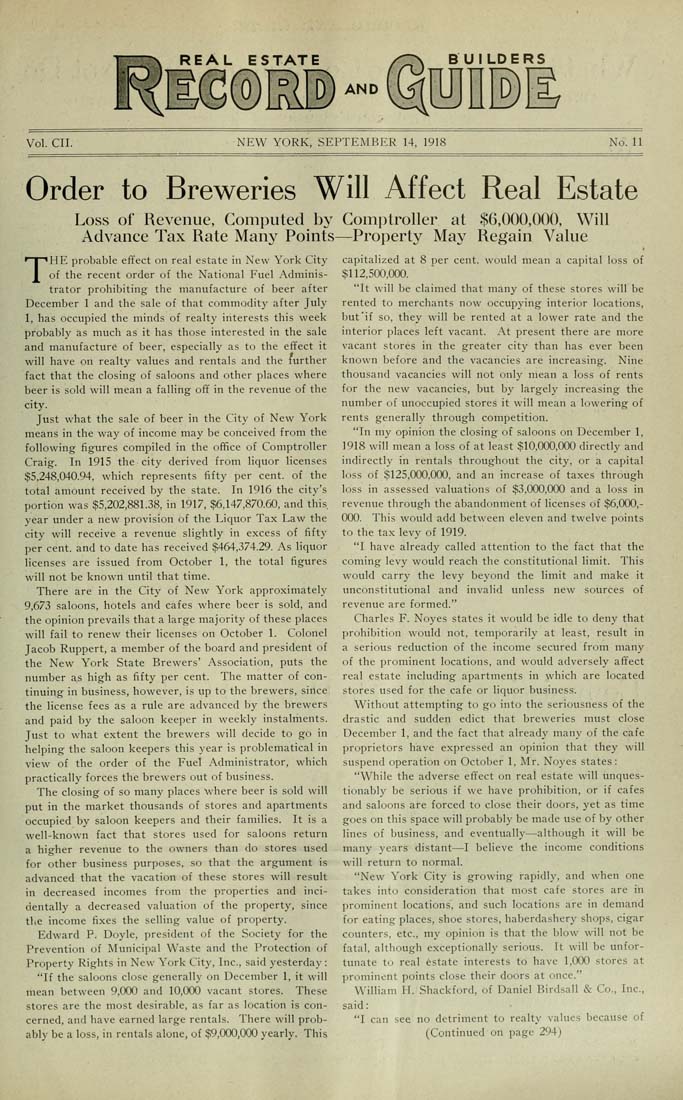
B U I LD E R S [)) AND Vol. CII. NEW YORK, SEPTEMBER 14, 1918 No. 11 Order to Breweries Will Affect Real Estate Loss of Revcnue, Computed by Advance Tax Rate Many Points THE prol)able efifect on real estate in New York City of the recent order of the National Fuel Adniinis- trator prohibiting the manufacture of beer after December 1 and the sale of that commodity after July 1, has occupied the minds of realty interests this week probably as much as it has those interested iii the sale and manufacture of beer, especially as to the efîect it will have on realty values and rentals and the further fact that thc closing of saloons and other places where beer is sold will mean a falHng off in the revenue of the city. Just what the sale of beer in the City of New York means in the way of inconie may be conceived from the following figures compiled in the office of Comptroller Craig. In 1915 the city derived from liquor licenses $5,248,040.94, which represents fifty per cent. of the total amount received by the state. In 1916 the city's portion was $5,202,881.38, in 1917, $6,147,870.60, and this, year under a new provision of the Liquor Tax Law the city will receive a revenue slightly in excess of fifty per cent. and to date has received $464,374.29. As liquor licenses are issued from October 1, the total figures will not be known until that time. There are in the City of New York approximately 9,673 saloons, hotels and cafes where beer is sold, and the opinion prevails that a large majority of these places will fail to renew their Hcenses on October 1. Colonel Jacob Ruppert, a member of the board and president of the New York State Brewers' Association, puts the number a.s high as fifty per cent. The matter of con- tinuing in business, however, is up to the brewers, since the Hcense fees as a rule are advanced by the brewers and paid by the saloon keepcr in weekly instalments. Just to what extent the brewers wiU decide to go in helping the saloon keepers this year is problematical in view of the order of the Fuel .\dniinistrator, which practicahy forces the brewers out of business. The closing of so niany places where beer is sold will put in the market thousands of stores and apartments occupied by saloon keepers and their famiHes. It is a well-known fact that stores used for saloons return a higher revenue to the owners than do stores used for other business purposes, so that the argument is advanced that the vacation of these stores wiU result in decreased incomes from the properties and inci- dentally a decreased valuation of the property, since the income fixes the sehing value of property. Edward P. Doyle, president of the Society for the Preventiun of Municipal Waste and the Protection of Property Rights in New York City, Inc, said yesterday: "If the saloons close generally on December 1, it wiH mean between 9,000 and 10,000 vacant stores. These stores are the most dcsirable, as far as location is con- cerned, and have earned large rentals. There will prob- ably be a loss, in rcntals alone, of $9,000,000 yearly. This Comi)trollcr at $6,000,000, WiU —Property May Regain Value capitaHzed at 8 per cent. woukl mean a capital loss of $112,500,000. "It will be claimed that many of these stores will be rented to merchants now occupying interior locations, but'if so, they wiU be rented at a lower rate and the interior places left vacant. At present there are more vacant stores in the greater city than has ever been known before and the vacancies are increasing. Nine thousand vacancies will not only mean a loss of rents for the new vacancies, but by largely increasing the number of unoccupied stores it wiH mean a lowering of rents generally through competition. "In my opinion the closing of saloons on Deccmber 1, 1918 will niean a loss of at least $10,000,000 directly and indirectly in rentals throughout the city, or a capital loss of $125,000,000, and an increase of taxes through loss in assessed valuations of $3,000,000 and a loss in revenue through the abandonment of licenses ôf $6,000,- 000. This woukl add between eleven and twelve points to the tax levy of 1919. "I have already called attention to the fact that the coniing levy would reach the constitutional liniit. This woukl carry the levy beyond the limit and make it unconstitutional and invalid imless new sources of revenue are formed." Charles F. Noyes states it would be idle to deny that prohibition would not, temporarily at least, result in a serious reduction of the income secured from many of the prominent locations, and would adversely affect real estate including apartments in which are located stores used for the cafe or liquor business. Without attempting to go into the seriousness of the drastic and sudden edict that breweries must close December 1, and the fact that already many of the cafe proprietors have expressed an opinion that they will suspend operation on October 1, Mr. Noyes states: "While the adverse effect on real estate will unques- tionably be serious if we have prohibition, or if cafes and saloons are forced to close their doors, yet as time goes on this space will probably be made use of by other lines of business, and eventually—although it will be many ycars distant—I believe the income conditions will return to normal. "New York City is growing rapidly. and when one takes into consideration that most cafe stores are in promincnt locations, and such locations are in demand for eating pkices, shoe stores, haberdashery shops, cigar counters, etc, my opinion is that thc blow will not be fatal, although exceptionally serious. It will be unfor- tunate to real éstate interests to have 1,000 stores at prominont points close their doors at once." WiIIiam H. Shackford, of Daniel Birdsall & Co., Inc, said: "I can see no detriment to realty values because of (Continued on page 294)