
Columbia University Libraries Digital Collections: The Real Estate Record
Use your browser's Print function to print these pages.
Real estate record and builders' guide: v. 102, no. 20 [2644]: [Articles]: November 16, 1918
Text version:
Please note: this text may be incomplete. For more information about this OCR, view About OCR text.
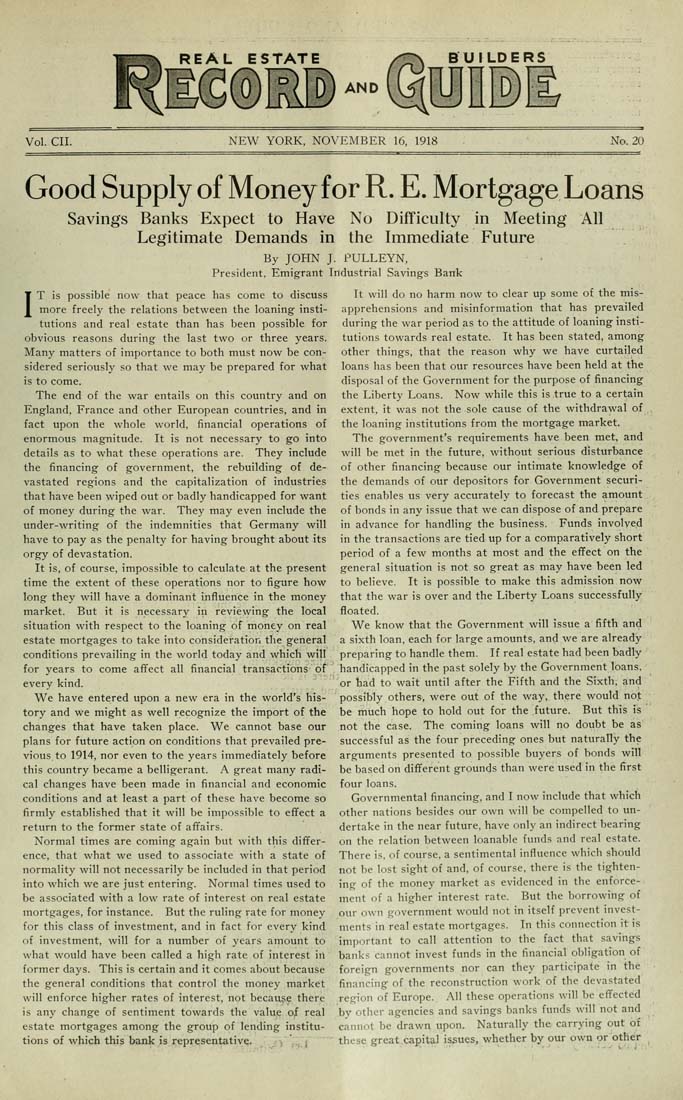
REAL ESTATE P) AND LDERS Vol. CII. NEW YORK, NOVEMBER 16, 1918 No. 20 Good Supply of Money for R. E. Mortgage Loans Savings Banks Expect to Have No Difficulty in Meeting All fitimate Demands in the Immediate Future Legi By JOHN J. PULLEYN, President, Emigrant Industrial Savings Bank 1T is possible now that peace has come to discuss more freely the relations between the loaning insti- tutions and real estate than has been possible for obvious reasons during the last two or three years. Many matters of importance to both must now be con- sidered seriously so that we may be prepared for what is to come. The end of the war entails on this country and on England. France and other European countries, and in fact upon the whole world, financial operations of enormous magnitude. It is not necessary to go into details as to what these operations are. They include the financing of government, the rebuilding of de- vastated regions and the capitalization of industries that have been wiped oiit or badly handicapped for want of money during the war. They may even include the under-writing of the indemnities that Germany will have to pay as the penalty for having brought about its orgy of devastation. It is, of course, impossible to calculate at the present time the extent of these operations nor to figure how long they will have a dominant influence in the money market. But it is necessary in reviewing the local situation with respect to the loaning of money on real estate mortgages to take into consideration the general conditions prevailing in the world today and whicli ^vill It will do no hann now to clear up some of the mis- apprehensions and misinformation that has prevailed during the war period as to the attitude of loaning insti- tutions towards real estate. It has been stated, among other things, that the reason why we have curtailed loans has been that our resources have been held at the disposal of the Government for the purpose of financing the Liberty Loans. Now while this is true to a certain e.xtent, it was not the sole cause of the withdrawal of the loaning institutions from the mortgage market. The government's requirements have been met, and wiU be met in the future, without serious disturbance of other financing because our intimate knowledge of the demands of our depositors for Government securi- ties enables us very accurately to forecast the amount of bonds in any issue that we can dispose of and prepare in advance for handhng the business. Funds involved in the transactions are tied up for a comparatively short period of a few months at most and the efĩect on the general situation is not so great as may have been led to believe. It is possible to make this admission now that the war is over and the Liberty Loans successfully floated. We know that the Government wiU issue a fifth and a sixth loan, each for large amounts, and we are already preparing to handle them. If real estate had been badly for years to come afifect all financial transactioTiS'"df'"' handicapped in the past solely by the Government loans, every kind. ^ \"'"ot had to wait until after the Fifth and the Sixth, and We have entered upon a new era in the world's his- possibly others, were out of the way, there would not tory and we might as well recognize the import of the changes that have taken place. We cannot base our plans for future action on conditions that prevailed pre- vious to 1914, nor even to the years immediately before this country became a belh'gerant. A great many radi- cal changes have been made in financial and economic conditions and at least a part of these have become so firmly estabh'shed that it will be impossible to eflfect a return to the former state of afifairs. Normal times are coming again but with this dififer- ence, that what we used to associate with a state of normality will not necessarily be included in that period into which we are just entering. Nornial times used to be associated with a low rate of interest on real estate mortgages, for instance. But the ruling rate for money for this class of investment, and in fact for every kind of investment, will for a number of years amount to what would have been called a high rate of interest in foriner days. This is certain and it comes about because the general conditions that control the money market will enforce higher rates of interest, not becaus^ there be much hope to hold out for the future, But this is not the case. The coming loans will no doubt be as successful as the four preceding ones but naturally the arguments presented to possible buyers of bonds will be based on dififerent grounds than were used in the first four loans. Governmental financing, and I now include that which other nations besides our own will be coinpelled to un- dertake in the near future, have only an indirect bearing on the relation between loanable funds and real estate. There is, of course, a sentimental influence which should not be lost sight of and, of course, there is the tighten- ing of the money market as evidenced in the enforce- ment of a higher interest rate. But the borrowing of our own government would not in itself prevent invest- ments in real estate mortgages. In this connectĩon it is imp(5rtant to call attention to the fact that savings banks cannot invest funds in the financial obligation of foreign governments nor can they participate in the financing of the reconstruction work of the devastated region of Europe. All these operations will be eff'ected is any change of sentiment towards the value of real by other agencies and savings banks funds will not and estate mortgages among the group of lending institu- cannot be drawn upon. Naturally the carrying out or tions of which this bank is representative. : , j these great capital issues, whether by our own or otheY