
Columbia University Libraries Digital Collections: The Real Estate Record
Use your browser's Print function to print these pages.
Real estate record and builders' guide: v. 102, no. 22 [2646]: [Articles]: November 29, 1918
Text version:
Please note: this text may be incomplete. For more information about this OCR, view About OCR text.
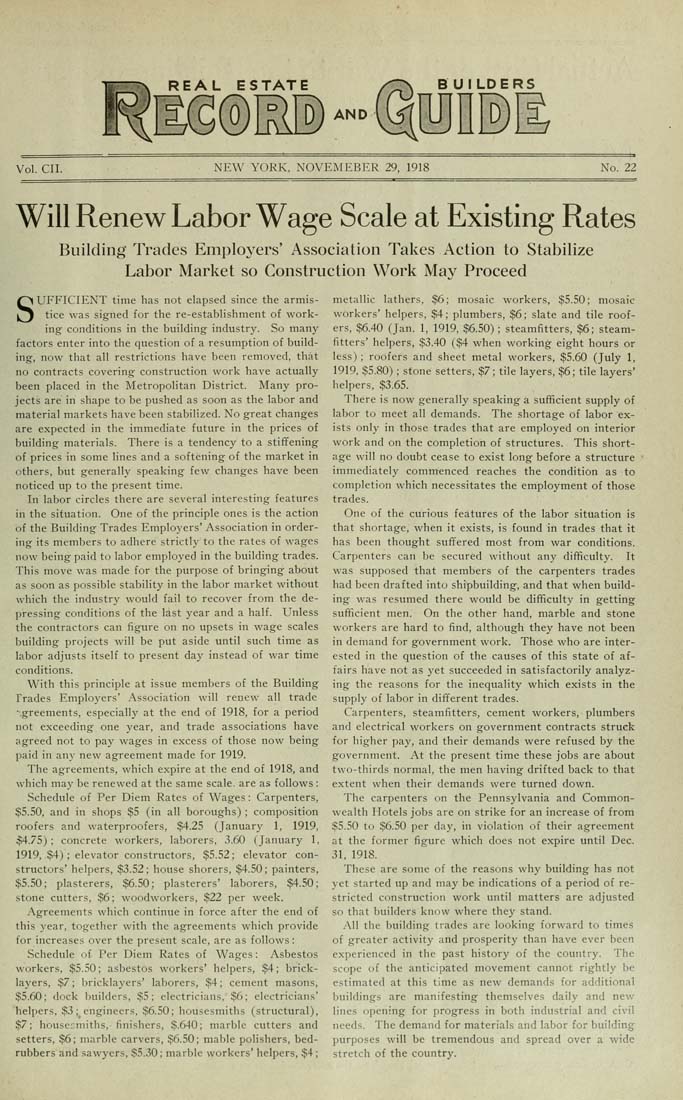
Vol. CII. AND B UILDERS NEW YORK, NOVEMEBKR 29, 1918 No. 22 Will Renew Labor Wage Scale at Existing Rates Building Trades Employers' Association Takes Action to Stabilize Labor Market so Construction Work Mav Proceed SUFFICIENT time has not elapsed since the armis- tice was signed for the re-establishment of work- ing conditions in the building industry. So many factors enter into the question of a resumption of build- ing, now that all restrictions have been removed, thát no contracts covering construction work have actually been placed in the Metropolitan District. Many pro- jects are in shape to be pushed as soon as the labor and material markets have been stabilized. No great changes are expected in the immediate future in the prices of building materials. There is a tendency to a stiffening of prices in some hnes and a softening of the market in others, but generally speaking few changes have been noticed up to the present time. In labor circles there are several interesting features in the situation. One of the principle ones is the action of the Building Trades Employers' Association in order- ing its members to adhere strictly to the rates of wages now being paid to labor employed in the building trades. This move was made for the purpose of bringing about as soon as possible stability in the labor market without which the industry would fail to recover from the de- ])ressing conditions of the last year and a half. Unless ihe contractors can íĩgure on no upsets in wage scales building projects wiU be put aside until such time as labor adjusts itself to present day instead of war time conditions. With this principle at issue members of the Building Trades Employers' Association will reuew all trade ■•.greements, especiahy at the end of 1918, for a period iiot exceeding one year, and trade associations have agreed not to pay wages in excess of those now being paid in any new agreement made for 1919. The agreements, which expire at the end of 1918, and which may be renewed at the same scale. are as follows: Schedule of Per Diem Rates of Wages: Carpenters, $5.50, and in shops $5 (in all boroughs) ; composition roofers and waterproofers, $4.25 (January 1, 1919, $4.75); concrete workers, laborers, 3.60 (January 1, 1919, $4); elevator constructors, $5.52; elevator con- structors' helpers, $3.52; house shorers, $4.50; painters, $5.50; plasterers, $6.50; plasterers' laborers, $4.50; stone cutters, $6; woodworkers, $22 per week. -'Xgreements which continue in force after the end of this year, together with the agreements which provide for increases over the present scale, are as follows: Schedule of Per Diem Rates of Wages: Asbestos workers, $5.50; asbestos workers' helpers, $4; brick- layers, $7; bricklayers' lalíorers, $4; cemeiit masons, $5.60; dock t)uilders, $5; electricians, $6; electricians' helpers, $3 ;_ engineers, $6.50; housesmiths (structural), $7; houseEiniths,- finishers, $.640; marble cutters and setters, $6; marble carvers, $6.50; mable polishers, bed- rubbers and sawyers, $5.30; marble workers' helpers, $4; metalhc hithers, $6; mosaic workers, $5.50; mosaic workers' helpers, $4; plumbers, $6; slate and tile roof- ers, $6.40 (Jan. 1, 1919, $6.50); steamfitters, $6; steam- fitters' helpers, $3.40 ($4 when working eight hours or less) ; roofers and sheet metal workers, $5.60 (July 1, 1919, $5.80) ; stone setters, $7; tile layers, $6; tile layers' helpers, $3.65. There is now generally speaking a sufficient supply of labor to meet all demands. The shortage of labor ex- ists only in those trades that are employed on interior work and on the completion of structures. This short- age will no doubt cease to exist long before a structure immediately commenced reaches the condition as to completion which necessitates the employment of those trades. One of the curious features of the labor situation is that shortage, when it exists, is found in trades that it has been thought suffered most from war conditions. Carpenters can be secured without any difficulty. It was supposed that members of the carpenters trades had been drafted into shipbuilding, and that when build- ing was resumed there would be difîĩculty in getting sufficient men. On the other hand, mârble and stone workers are hard to find, although they have not been in demand for government work. Those who are inter- ested in the question of the causes of this state of af- fairs have not as yet succeeded in satisfactorily analyz- ing the reasons for the inequality which exists in the supply of labor in different trades. Carpenters, steamfitters, cement workers, plumbers and electrical workers on government contracts struck for higher pay, and their demands were refused by the government. At the present time these jobs are about two-thirds normal, the men having drifted back to that extent when their demands were turned down. The carpenters on the Pennsylvania and Common- wealth Hotels jobs are on strike for an increase of from $5.50 to $6.50 per day, in violation of their agreement at the former figure which does not expire until Dec. 31, 1918. These are sonie of the reasons why building has not yet started up and may be indications of a period of re- stricted construction work until matters are adjusted so that builders know where they stand. All the building trades are looking forward to times of greater activity and prosperity than have ever been experienced in the past history of the country. The scope of the anticipated movement cannot rightly be estimated at this time as new demands for additional buildings are manifesting themselves daily and new lines opening for progress in both industrial and civil needs. The demand for materials and labor for building purposes will be tremendous and spread over a wide stretch of the country.