
Columbia University Libraries Digital Collections: The Real Estate Record
Use your browser's Print function to print these pages.
Real estate record and builders' guide: v. 102, no. 23 [2647]: [Articles]: December 7, 1918
Text version:
Please note: this text may be incomplete. For more information about this OCR, view About OCR text.
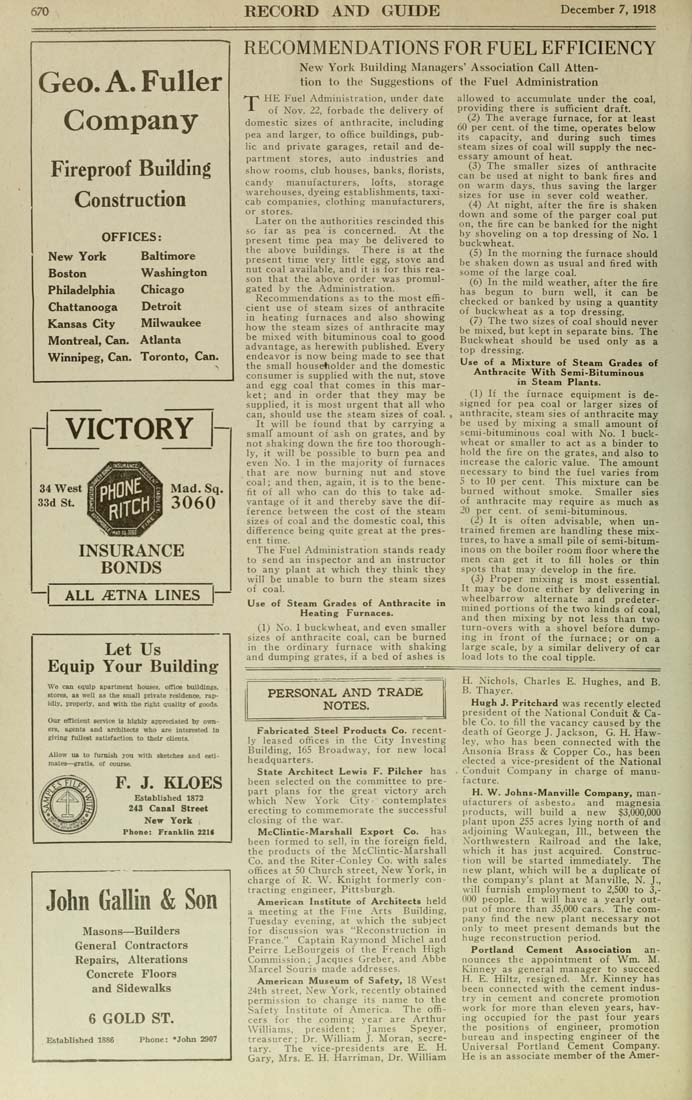
670 RECORD AND GUIDE December 7, 1918 Geo. A. FuUer Company Fireproof Building Construction OFFICES: New York Baltimore Boston Philadelphia Chattanooga Kansas City Montreal, Can. Winnipeg, Can. Washington Chicago Detroit Milwaukee Atlanta Toronto, Can. VICTORY 34West 33d St. ím. Mad.Sq. 3060 INSURANCE BONDS ALL ÆTNA LINES Let Us Equip Your Building We can equlp apartment houaes, offioe buUdlngs, etores, as wcU as the Bmall private residence, rap- ídly, properly, and wilh the right quallty of goods. Our efficient service \s highly appredated by own- ers, agentB and architects who are interested 1d giving fulleat satlsfactlon to their dients. Allow us to fumish you with sfcetches and oBti- mates—gratis, of course. F. J. KLOES Established 1872 243 Canal Stre«t New York Phone: Franklin 221* John Gallin & Son Masons—Builders General Contractors Repairs, Alterations Concrete Floors and Sidewalks 6 GOLD ST. Established 1886 Phone: •John 2907 RECOMMENDATIONS FOR FUEL EFFICIENCY New York Building Managers' Assoeiation Call Atten- tion to the Suggestions of the Fuel Administration 'Tp HE Fue! Administration, under date -■■ of Nov. 22, forbade tlie delivery of domestic sizes of anthracite, including pea and larger, to office buildings, pub- lic and private garages, retail and de- partment stores, auto industries and show rooms, club houses, banks, florists, candy manufacturers, lofts, storage warehouses, dyeing establishments, taxi- cab companies, clothing manufacturers, or stores. Later on the authorities rescinded this so far as pea is concerned. At the present time pea may be deHvered to the above buildings. There is at the present time very little egg, stove and nut coal available, and it is for this rea- son that the above order was promul- gated by the .Vdministration. Recommendations as to the most effi- cient use of steam sizes of anthracite in heating furnaces and also showing how the steam sizes of anthracite may be mixed with bituminous coal to good advantage, as herewith pubHshed. Every endeavor is now being made to see that the small house*io!der and the domestic consumer is supplied with the nut, stove and egg coal that comes in this mar- ket; and in order that they may be supplied, it is most urgent that all who can, should use the steam sizes of coal. It will be found that by carrying a smair amount of ash on grates, and by not shaking down the fire too thorough- ly, it will be possible to burn pea and even No. 1 in the majority of furnaces that are now burning nut and stove coal; and then, again, it is to the bene- fit of all who can do this to take ad- vantage of it and thereby sáve the dif- ference between the cost of the steam sizes of coal and the domestic coal, this difiference being quite great at the pres- ent time. The Fuel Administration stands ready to send an inspector and an instructor to any plant at which they think they will be unable to burn the steam sizes of coal. Use of Steam Grades of Anthracite in Heating Furnaces. (l) Xo. 1 buckvvheat, and even smaller sizes of anthracite coal, can be burned iii the ordinary furnace vvith shaking and dumping grates, if a bed of ashes is allowed to accumulate under the coal, providing there is sufficient draft. (2) The average furnace, for at least 60 per cent. of the time, operates below its capacity, and during such times steam sizes of coal will supply the nec- essary amount of heat. (3) The smaller sizes of anthracite can be used at night to bank fires and on warm days, thus saving the larger sizes for use in sever cold weather. (4) At night, after the fire is shaken down and some of the parger coal put on, the fire can be banked for the night by shoveling on a top dressing of No. 1 buckwheat. (5) In the morning the furnace should be shaken down as usual and fired with some of the large coal. (6) In the mild weather, after the fire has begun to burn well, it can be checked or banked by using a quantity of buckwheat as a top dressing. (7) The two sizes of coal should never be mixed, but kept in separate bins. The Buckwheat should be used only as a top dressing. Use of a Mixture of Steam Grades of Anthracite With Semi-Bituminous in Steam Plants. (1) If the íurnace equipment is de- signed for pea coal or larger sizes of anthracite, steam sies of anthracite may be used by mixing a small amount of semi-bituminous coal with No. 1 buck- vvheat or smaller to act as a binder to hold the fire on the grates, and also to increase the caloric value. The amount necessary to bind the fuel varies from .ĩ to 10 per cent. This mixture can be burned without snioke. Smaller sies of anthracite may require as much as 20 per cent. of semi-bituminous. (2) ít is oíten advisable, when un- trained firemen are handling these mix- tures, to have a small pile of semi-bitum- inous on the boiler room floor where the men can get it to fill holes or thin spots that may develop in the fire. (3) Proper mixing is most essential. It may be done either by delivering in wheelbarrow alternate and predeter- mined portions of the two kinds of coal, aiid then mixing by not less than two turn-overs with a shovel before dump- ing in front of the furnace; or on a large scale, by a similar delivery of car load lots to the coal tipple. PERSONAL AND TRADE NOTES. Fabricated Steel Products Co. recent- ly leased offices in the City Investing Building, 165 Broadway, for new local headquarters. State Architect Lewis F. Pilcher has been selected on the committee to pre- part plans for the great victory arch vvhich Nevv York City' contemplates erecting to commemorate the successful closing of the war. McClintic-Marshall Export Co. has been lormed to sell, in the foreign field, the products of the McCIintic-Marshall Co. and the Riter-Conley Co. with sales offices at 50 Church street, New York, in charge of R. W. Knight formerly con- tracting engineer, Pittsburgh. American Institute of Architects held a meeting at the Fine .\rts Building, Tuesday evening, at vvhich the subject for discussion was "Reconstruction in France." Captain Raymond Michel and Peirre LeBourgeis of the French High Commission; Jacques Greber, and Abbe Marcel Souris made addresses. American Museum of Safety, 18 West 24th street, Nevv York, recently obtained permission to change its name to the Safety Institute of America. The offi- cers for the coming year are Arthur WiIIiams, president; James Speyer, treasurer; Dr. William J. Moran, secre- tary. The vice-presidents are E. H. Gary, Mrs. E. H. Harriman, Dr. William H. Nichols, Charles E. Hughes, and B, B. Thayer. Hugh J. Pritchard was recently elected president of the National Conduit & Ca- ble Co. to fill the vacancy caused by the death of George J. Jackson, G. H. Haw- ley, vvho has been connected with the Ansonia Brass & Copper Co., has been L'Iected a vice-president of the National Conduit Company in charge of manu- facture. H. W. Johns-Manville Company, man- ufacturers of asbestoo and magnesia products, will build a new $3,000,000 plant upon 255 acres lying north of and adjoining Waukegan, III., between the .Xorthwestern Railroad and the lake, vvhich it has just acquired. Construc- tion will be started immediately. The nevv plant, which will be a duplicate of the company's plant at ManviIIe, N. J., will furnish employment to 2,500 to 3,- 1)00 people. It will have a yearly out- put of more than 35,000 cars. The com- pany find the new plant necessary not only to meet present demands but the huge reconstruction period. Portland Cement Association an- nounces the appointment of Wm. M. Kinney as general manager to succecd H. E. Hiltz, resigned. Mr. Kinney has been connected with the cement indus- try in cement aiid concrete promotion work for more than eleven years, hav- ing occupied for the past four years the positions of engineer, promotion bureau and inspecting engineer of the Universal Portland Cement Company. He is an associate member of the Amer-