
Columbia University Libraries Digital Collections: The Real Estate Record
Use your browser's Print function to print these pages.
Real estate record and builders' guide: v. 102, no. 25 [2649]: [Articles]: December 21, 1918
Text version:
Please note: this text may be incomplete. For more information about this OCR, view About OCR text.
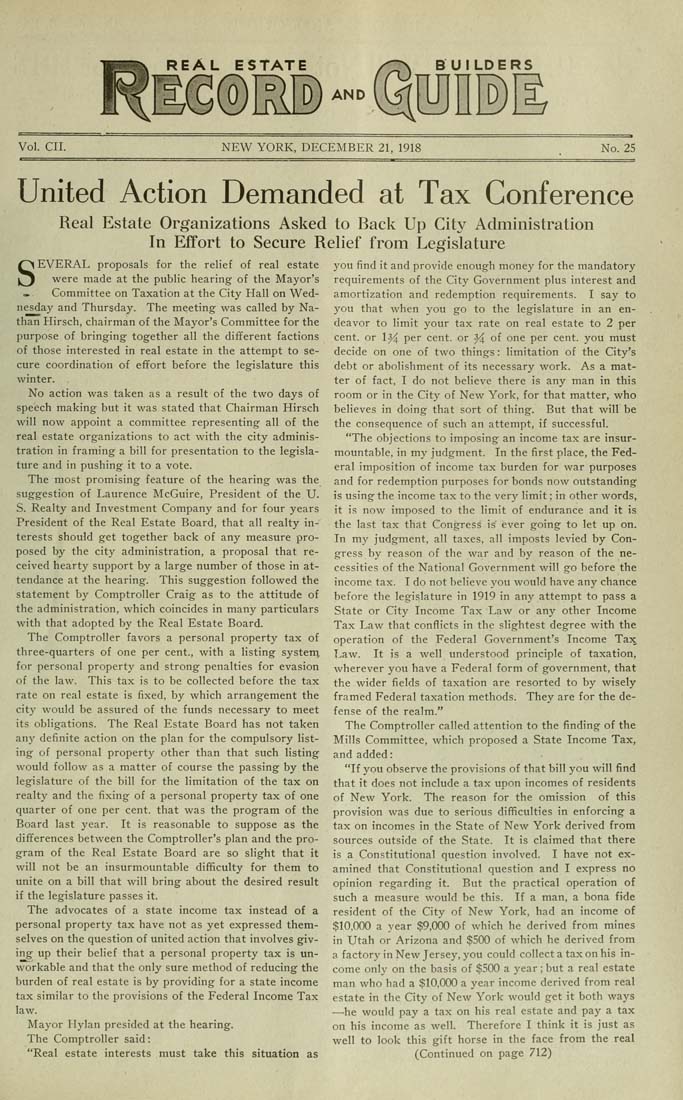
RREAL m REAL ESTATE m B UILDERS P) AND Vol. CII. NEW YORK, DECEMBER 21, 1918 No. 25 United Action Demanded at Tax Conference Real Estate Organizations Asked to Back Up City Administration In Effort to Secure Relief from Leífislature SEVERAL proposals for the relief of real estate were made at the public hearing of the Mayor's » Committee on Taxation at the City Hall on Wed- nesday and Thursday. The meeting was called by Na- than Hirsch, chairman of the Mayor's Committee for the purpose of bringing together all the different factions of those interested in real estate in the attempt to se- cure coordination of eft'ort before the legislature this winter. No action was taken as a result of the two days of speech making but it was stated that Chairman Hirsch will now appoint a committee representing all of the real estate organizations to act with the city adminis- tration in framing a bill for presentation to the legisla- ture and in pushing it to a vote. The most promising feature of the hearing was the suggestion of Laurence McGuire, President of the U. S. Realty and Investment Company and for four years President of the Real Estate Board, that all realty in- terests should get together back of any measure pro- posed by the city administration, a proposal that re- ceived hearty support by a large number of those in at- tendance at the hearing. This suggestion followed the statement by Comptroller Craig as to the attitude of the administration, which coincides in many particulars with that adopted by the Real Estate Board. The Comptroller favors a personal property tax of three-quarters of one per cent., with a listing systern. for personal property and strong penalties for evasion of the law. This tax is to be collected before the tax rate on real estate is fixed, by which arrangement the city would be assured of the funds necessary to meet its obligations. The Real Estate Board has not taken any definite action on the plan for the compulsory list- ing of personal property other than that such listing would follow as a matter of course the passing by the legislature of the bill for the limitation of the tax on realty and the fixing of a personal property tax of one quarter of one per cent. that was the program of the Board last year. It is reasonable to suppose as the differences between the Comptroller's plan and the pro- gram of the Real Estate Board are so slight that it wiU not be an insurmountable difficulty for them to unite on a bill that will bring about the desired result if the legislature passes it. The advocates of a state income tax instead of a personal property tax have not as yet expressed them- selves on the question of united action that involves giv- ing up their belief that a personal property tax is un- workable and that the only sure method of reducing the burden of real estate is by providing for a state income tax similar to the provisions of the Federal Income Tax law. Mayor Hylan presided at the hearing. The ComptroUer said: "Real estate interests must take this situation as you find it and provide enough money for the mandatory requirements of the City Government plus interest and amortization and redemption requirements. I say to you that when you go to the legislature in an en- deavor to limit your tax rate on real estate to 2 per cent. or l^ per cent. or ^ of one per cent. you must decide on one of two things: limitation of the City's debt or abolishment of its necessary work. As a mat- ter of fact, I do not believe there is any man in this room or in the City of New York, for that matter, who believes in doing that sort of thing. But that will be the consequence of such an attempt, if successful. "The objections to imposing an income tax are insur- mountable, in my judgment. In the first place, the Fed- eral impositĩon of income tax burden for war purposes and for redemption purposes for bonds now outstanding is using the income tax to the very limit; in other words, it is now imposed to the limit of endurance and it is the last tax that Congress is ever going to let up on. In my judgment, all taxes, all imposts levied by Con- gress by reason of the war and by reason of the ne- cessities of the National Government will go before the income tax. I do not believe you would have any chance before the legislature in 1919 in any attempt to pass a State or City Income Tax Law or any other Income Tax Law that conflicts in the sHghtest degree with the operation of the Federal Government's Income Tax Law. It is a well understood principle of taxation, wherever you have a Federal form of government, that the wider fields of taxation are resorted to by wisely framed Federal taxation methods. They are for the de- fense of the realm." The Comptroller called attention to the finding of the MiIIs Committee, which proposed a State Income Tax, and added: "If you observe the provisions of that bill you will find that it does not include a tax upon incomes of residents of New York. The reason for the omission of this provision was due to serious difficulties in enforcing a tax on incomes in the State of New York derived from sources outside of the State. It is claimed that there is a Constitutional question involved. I have not ex- amîned that Constitutional question and I express no opinion regarding it. But the practical operation of such a measure would be this. If a man, a bona fide resident of the City of New York, had an income of $10,000 a year $9,000 of which he derived from mines in Utah or Arizona and $500 of which he derived from a factory in New Jersey, you could collect a tax on his in- come only on the basis of $500 a year; but a real estate man who had a $10,000 a year income derived from real estate in the City of New York would get it both ways —he would pay a tax on his real estate and pay a tax on his income as well. Therefore I think it is just as well to look this gift horse in the face from the real (Continued on page 712)