
Columbia University Libraries Digital Collections: The Real Estate Record
Use your browser's Print function to print these pages.
Real estate record and builders' guide: [v. 103, no. 25: Articles]: June 21, 1919
Text version:
Please note: this text may be incomplete. For more information about this OCR, view About OCR text.
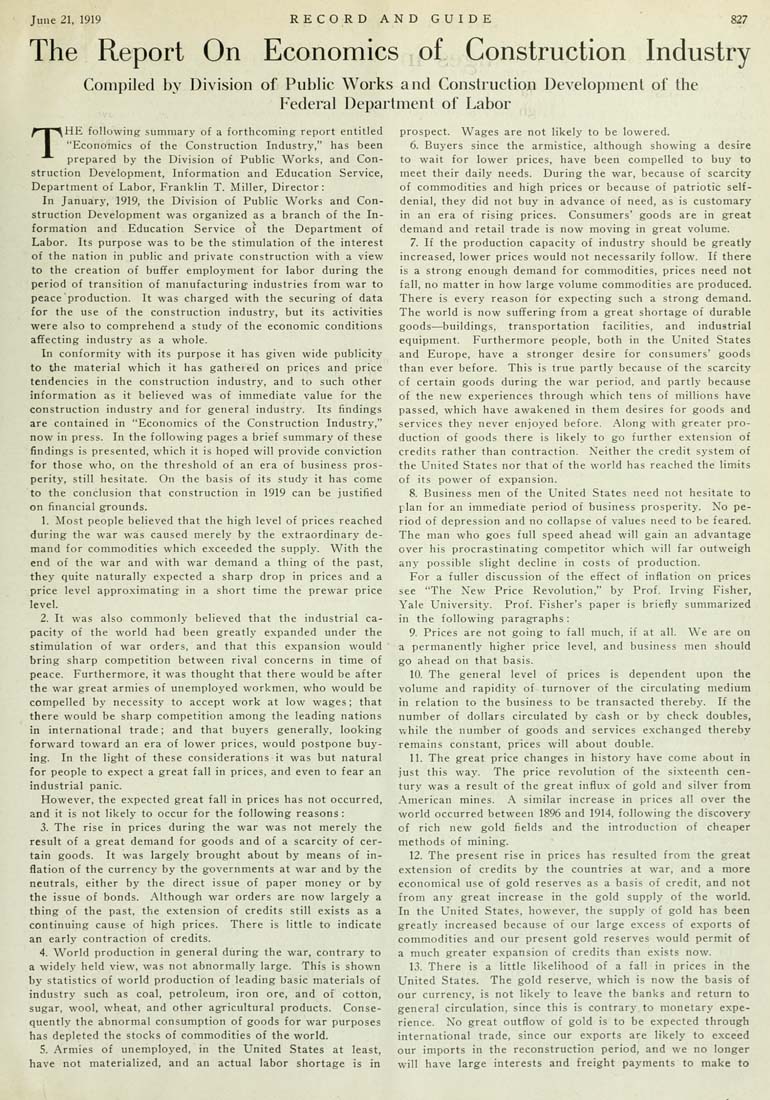
June 21. 1919 RECORD AND GUIDE 827 The Report On Economics of Construction Industry Compiled by Division of Public Works and Construction Development of the Federal ]3epartment of Labor THE following summary of a forthcoming report entitled "Economics of the Construction Industry," has been prepared by the Division of Public Works, and Con¬ struction Development, Information and Education Service, Department of Labor, Franklin T. Miller, Director: In January, 1919, the Division of Public Works and Con¬ struction Development was organized as a branch of the In¬ formation and Education Service oi the Department of Labor. Its purpose was to be the stimulation of the interest of the nation in public and private construction with a view to the creation of buffer employment for labor during the period of transition of manufacturing industries from war to peace production. It was charged with the securing of data for the use of the construction industry, but its activities were also to comprehend a study of the economic conditions affecting industry as a whole. In conformity with its purpose it has given wide publicity to the material which it has gatheied on prices and price tendencies in the construction industry, and to such other information as it believed was of immediate value for the construction industry and for general industry. Its findings are contained in "Economics of the Construction Industry," now in press. In the following pages a brief summary of these findings is presented, which it is hoped will provide conviction for those who, on the threshold of an era of business pros¬ perity, still hesitate. On the basis of its study it has come to the conclusion that construction in 1919 can be justified on financial grounds. 1. Most people believed that the high level of prices reached during the war was caused merely by the extraordinary de¬ mand for commodities which exceeded the supply. With the end of the war and with war demand a thing of the past. they quite naturally expected a sharp drop in prices and a price level approximating in a short time the prewar price level, 2. It was also commonly believed that the industrial ca¬ pacity of the world had been greatly expanded under the stimulation of war orders, and that this expansion would bring sharp competition between rival concerns in time of peace. Furthermore, it was thought that there would be after the war great armies of unemployed workmen, who would be compelled by necessity to accept work at low wages; that there would be sharp competition among the leading nations in international trade; and that buyers generally, looking forward toward an era of lower prices, would postpone buy¬ ing. In the light of these considerations it was but natural for people to expect a great fall in prices, and even to fear an industrial panic. However, the expected great fall in prices has not occurred, and it is not likely to occur for the following reasons: 3. The rise in prices during the war was not merely the result of a great demand for goods and of a scarcity of cer¬ tain goods. It was largely brought about by means of in¬ flation of the currency by the governments at war and by the neutrals, either by the direct issue of paper money or by the issue of bonds. Although war orders are now largely a thing of the past, the extension of credits still exists as a continuing cause of high prices. There is little to indicate an early contraction of credits. 4. World production in general during the war, contrary to a widely held view, was not abnormally large. This is shown by statistics of world production of leading basic materials of industry such as coal, petroleum, iron ore, and of cotton, sugar, wool, wheat, and other agricultural products. Conse¬ quently the abnormal consumption of goods for war purposes has depleted the stocks of commodities of the world. 5. Armies of unemployed, in the United States at least, have not materialized, and an actual labor shortage is in prospect. Wages are not likely to be lowered. 6. Buyers since the armistice, although showing a desire to wait for lower prices, have been compelled to buy to meet their daily needs. During the war, because of scarcity of commodities and high prices or because of patriotic self- denial, they did not buy in advance of need, as is customary in an era of rising prices. Consumers' goods are in great demand and retail trade is now moving in great volume. 7. If the production capacity of industry should be greatly increased, lower prices would not necessarily follow. If there is a strong enough demand for commodities, prices need not fall, no matter in how large volume commodities are produced. There is every reason for expecting such a strong demand. The world is now suffering from a great shortage of durable goods—buildings, transportation facilities, and industrial equipment. Furthermore people, both in the United States and Europe, have a stronger desire for consumers' goods than ever before. This is true partly because of the scarcity cf certain goods during the war period, and partly because of the new experiences through which tens of millions have passed, which have awakened in them desires for goods and services they never enjoyed before. Along with greater pro¬ duction of goods there is likely to go further extension of credits rather than contraction. Neither the credit system of the United States nor that of the world has reached the limits of its power of expansion. 8. Business men of the United States need not hesitate to flan for an immediate period of business prosperity. No pe¬ riod of depression and no collapse of values need to be feared. The man who goes full speed ahead will gain an advantage over his procrastinating competitor which will far outweigh any possible slight decline in costs of production. For a fuller discussion of the effect of inflation on prices see "The New Price Revolution," by Prof. Irving Fisher, Yale University. Prof. Fisher's paper is briefly summarized in the following paragraphs: 9. Prices are not going to fall much, if at all. We are on a permanently higher price level, and business men should go ahead on that basis. 10. The general level of prices is dependent upon the volume and rapidity of turnover of the circulating medium in relation to the business to be transacted thereby. If the number of dollars circulated by cash or by check doubles, while the number of goods and services exchanged thereby remains constant, prices will about double. 11. The great price changes in history have come about in just this way. The price revolution of the sixteenth cen¬ tury was a result of the great influx of gold and silver from American mines. A similar increase in prices all over the world occurred between 1896 and 1914, following the discovery of rich new gold fields and the introduction of cheaper methods of mining. 12. The present rise in prices has resulted from the great extension of credits by the countries at war, and a more economical use of gold reserves as a basis of credit, and not from any great increase in the gold supply of the world. In the United States, however, the supply of gold has been greatly increased because of our large excess of exports of commodities and our present gold reserves would permit of a much greater expansion of credits than exists now. 13. There is a little likelihood of a fall in prices in the United States. The gold reserve, which is now the basis of our currency, is not likely to leave the banks and return to general circulation, since this is contrary to monetary expe¬ rience. No great outflow of gold is to be expected through international trade, since our exports are likely to exceed our imports in the reconstruction period, and we no longer will have large interests and freight payments to make to