
Columbia University Libraries Digital Collections: The Real Estate Record
Use your browser's Print function to print these pages.
Real estate record and builders' guide: [v. 104, no. 8: Articles]: August 23, 1919
Text version:
Please note: this text may be incomplete. For more information about this OCR, view About OCR text.
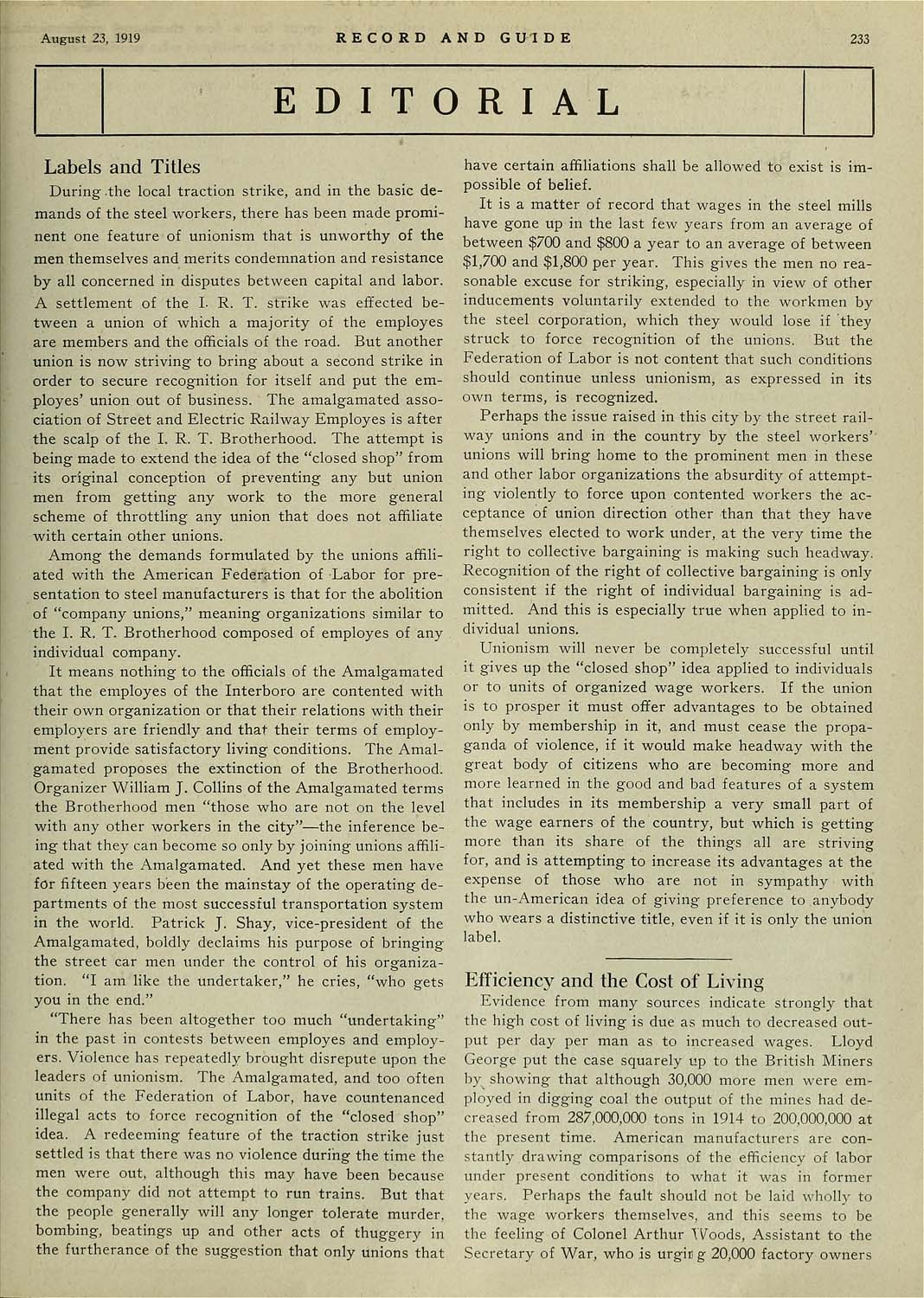
August 23, 1919 RECORD AND GUIDE 233 Labels and Titles During .the local traction strike, and in the basic de¬ mands of the steel workers, there has been made promi¬ nent one feature of unionism that is unworthy of the men themselves and merits condemnation and resistance by all concerned in disputes between capital and labor. A settlement of the I- R. T. strike was effected be¬ tween a union of which a majority of the employes are members and the officials of the road. But another union is now striving to bring about a second strike in order to secure recognition for itself and put the em¬ ployes' union out of business. The amalgamated asso¬ ciation of Street and Electric Railway Employes is after the scalp of the I. R. T. Brotherhood. The attempt is being made to extend the idea of the "closed shop" from its original conception of preventing any but union men from getting any work to the more general scheme of throttling any union that does not affiliate with certain other unions. Among the demands formulated by the unions affili¬ ated with the American Federation of Labor for pre¬ sentation to steel manufacturers is that for the abolition of "company unions," meaning organizations similar to the I. R. T. Brotherhood composed of employes of any individual company. It means nothing to the officials of the Amalgamated that the employes of the Interboro are contented with their own organization or that their relations with their employers are friendly and that their terms of employ¬ ment provide satisfactory living conditions. The Amal¬ gamated proposes the extinction of the Brotherhood. Organizer William J. Collins of the Amalgamated terms the Brotherhood men "those who are not on the level with any other workers in the city"—the inference be¬ ing that they can become so only by joining unions affili¬ ated with the Amalgamated. And yet these men have for fifteen years been the mainstay of the operating de¬ partments of the most successful transportation system in the world. Patrick J. Shay, vice-president of the Amalgamated, boldly declaims his purpose of bringing the street car men under the control of his organiza¬ tion. "I am hke the undertaker," he cries, "who gets you in the end." "There has been altogether too much "undertaking" in the past in contests between employes and employ¬ ers. Violence has repeatedly brought disrepute upon the leaders of unionism. The Amalgamated, and too often units of the Federation of Labor, have countenanced illegal acts to force recognition of the "closed shop" idea. A redeeming feature of the traction strike just settled is that there was no violence during the time the men were out, although this may have been because the company did not attempt to run trains. But that the people generally will any longer tolerate murder, bombing, beatings up and other acts of thuggery in the furtherance of the suggestion that only unions that have certain affihations shall be allowed to exist is im¬ possible of belief. It is a matter of record that wages in the steel mills have gone up in the last few years from an average of between $700 and $800 a year to an average of between $1,700 and $1,800 per year. This gives the men no rea¬ sonable excuse for striking, especially in view of other inducements voluntarily extended to the workmen by the steel corporation, which they would lose if "they struck to force recognition of the unions. But the Federation of Labor is not content that such conditions should continue unless unionism, as expressed in its own terms, is recognized. Perhaps the issue raised in this city by the street rail¬ way unions and in the country by the steel workers' unions will bring home to the prominent men in these and other labor organizations the absurdity of attempt¬ ing violently to force upon contented workers the ac¬ ceptance of union direction other than that they have themselves elected to work under, at the very time the right to collective bargaining is making such headway. Recognition of the right of collective bargaining is only consistent if the right of individual bargaining is ad¬ mitted. And this is especially true when applied to in¬ dividual unions. Unionism will never be completely successful until it gives up the "closed shop" idea applied to individuals or to units of organized wage workers. If the union is to prosper it must offer advantages to be obtained only by membership in it, and must cease the propa¬ ganda of violence, if it would make headway with the great body of citizens who are becoming more and more learned in the good and bad features of a system that includes in its membership a very small part of the wage earners of the country, but which is getting more than its share of the things all are striving for, and is attempting to increase its advantages at the expense of those who are not in sympathy with the un-American idea of giving preference to anybody who wears a distinctive title, even if it is only the union label. Efficiency and the Cost of Living Evidence from many sources indicate strongly that the high cost of living is due as much to decreased out¬ put per day per man as to increased wages. Lloyd George put the case squarely up to the British Miners by^ showing that although 30,000 more men were em¬ ployed in digging coal the output of the mines had de¬ creased from 287,000,000 tons in 1914 to 200,000,000 at the present time. American manufacturers are con¬ stantly drawing comparisons of the efficiency of labor under present conditions to what it was in former years. Perhaps the fault should not be laid wholly to the wage workers themselves, and this seems to be the feehng of Colonel Arthur Woods, Assistant to the Secretary of War, who is urgiii g 20,000 factory owners