
Columbia University Libraries Digital Collections: The Real Estate Record
Use your browser's Print function to print these pages.
Real estate record and builders' guide: [v. 104, no. 11: Articles]: September 13, 1919
Text version:
Please note: this text may be incomplete. For more information about this OCR, view About OCR text.
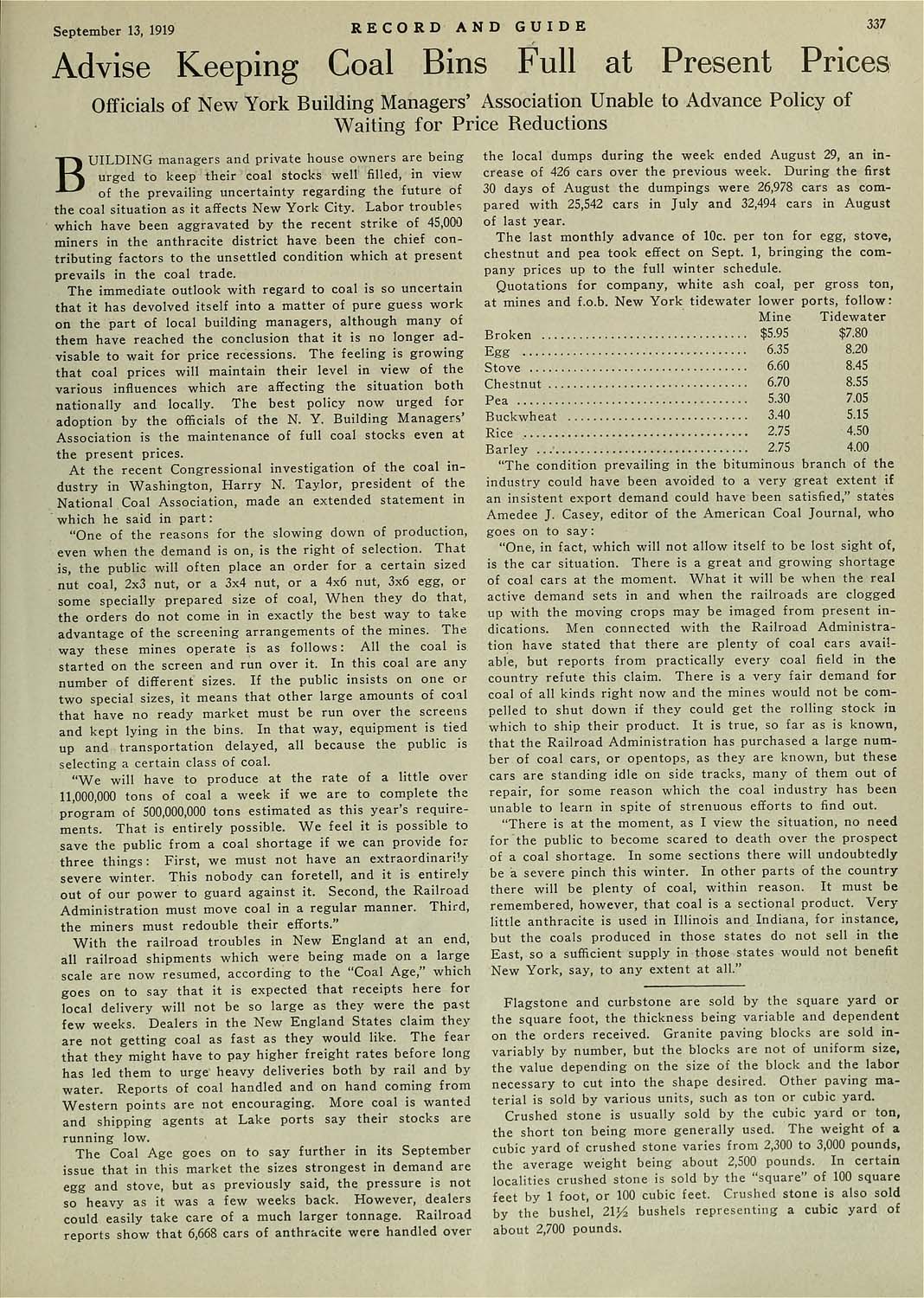
^^t^^SnS, 1919 ^^^^^^^B RECORD ^^^^^^^^^^^^ 337 Advise Keeping Coal Bins Full at Present Prices Officials of New York Building Managers' Association Unable to Advance Policy of j Waiting for Price Reductions < BUILDING managers and private house owners are being the local dumps during the week ended August 29, an in- urged to keep their coal stocks well filled, in view crease of 426 cars over the previous week. During the first of the prevailing uncertainty regarding the future of 30 days of August the dumpings were 26,978 cars as com- the coal situation as it affects New York City. Labor troubles pared with 25,542 cars in July and 32,494 cars in August which have been aggravated by the recent strike of 45,000 of last year. miners in the anthracite district have been the chief con- The last monthly advance of 10c. per ton for egg, stove, tributing factors to the unsettled condition which at present chestnut and pea took effect on Sept. 1, bringing the com- prevails in the coal trade. Pany prices up to the full winter schedule. ' The immediate outlook with regard to coal is so uncertain Quotations for company, white ash coal, per gross ton, that it has devolved itself into a matter of pure guess work at mines and f.o.b. New York tidewater lower ports, follow: on the part of local building managers, although many of Mine Tidewater them have reached the conclusion that it is no longer ad- Broken ................................. $5.95 $7.80 ! visable to wait for price recessions. The feeling is growing Egg .................................... 6.35 8.20 | that coal prices will maintain their level in view of the Stove ................................... 6.60 8.45 j various influences which are affecting the situation both Chestnut................................ 6.70 8.55 nationally and locally. The best policy now urged for Pea ..................................... 5.30 7.05 adoption by the officials of the N. Y. Building Managers' Buckwheat ............................. 3.40 5.15 Association is the maintenance of full coal stocks even at Rice .................................... 2.75 4.50 j the present prices. Barley .. .■............................... 2.75 4.00 At the recent Congressional investigation of the coal in- "The condition prevailmg m the bitummous branch of the dustry in Washington, Harry N. Taylor, president of the industry could have been avoided to a very great extent if National Coal Association, made an extended statement in an insistent export demand could have been satisfied," states which he said in part: Amedee J. Casey, editor of the American Coal Journal, who "One of the reasons for the slowing down of production, goes on to say: even when the demand is on, is the right of selection. That "One, in fact, which will not allow itself to be lost sight of, is, the public will often place an order for a certain sized is the car situation. There is a great and growing shortage nut coal, 2x3 nut, or a 3x4 nut, or a 4x6 nut, 3x6 egg, or of coal cars at the moment. What it will be when the real some specially prepared size of coal, When they do that, active demand sets in and when the railroads are clogged the orders do not come in in exactly the best way to take up with the moving crops may be imaged frora present in- advantage of the screening arrangements of the mines. The dications. Men connected with the Railroad Administra- way these mines operate is as follows: All the coal is tion have stated that there are plenty of coal cars avail- started on the screen and run over it. In this coal are any able, but reports from practically every coal field in the number of different sizes. If the public insists on one or country refute this claim. There is a very fair demand for two special sizes, it means that other large amounts of coal coal of all kinds right now and the mines would not be com- that have no ready market must be run over the screens pelled to shut down if they could get the rolling stock in and kept lying in the bins. In that way, equipment is tied which to ship their product. It is true, so far as is known, up and transportation delayed, all because the public is that the Railroad Administration has purchased a large num^ selecting a certain class of coal. ber of coal cars, or opentops, as they are known, but these "We will have to produce at the rate of a little over cars are standing idle on side tracks, many of them out of 11000 000 tons of coal a week if we are to complete the repair, for some reason which the coal industry has been program of 500,000,000 tons estimated as this year's require- unable to learn in spite of strenuous efforts to find out. ments That is entirely possible. We feel it is possible to "There is at the moment, as I view the situation, no need save the public from a coal shortage if we can provide for for "the public to become scared to death over the prospect three things- First, we must not have an extraordinarily of a coal shortage. In some sections there will undoubtedly severe winter This nobody can foretell, and it is entirely be a severe pinch this winter. In other parts of the country out of our power to guard against it. Second, the Railroad there will be plenty of coal, within reason. It must be Administration must move coal in a regular manner. Third, remembered, however, that coal is a sectional product. Very the miners must redouble their efforts." little anthracite is used in Illinois and Indiana, for instance. With the railroad troubles in New England at an end. but the coals produced in those states do not sell in the all railroad shipments which were being made on a large East, so a sufficient supply in those states would not benefit scale are now resumed, according to the "Coal Age," which New York, say, to any extent at all." goes on to say that it is expected that receipts here for local delivery will not be so large as they were the past Flagstone and curbstone are sold by the square yard or few weeks. Dealers in the New England States claim they the square foot, the thickness being variable and dependent are not getting coal as fast as they would like. The fear on the orders received. Granite paving blocks are sold in- that they might have to pay higher freight rates before long variably by number, but the blocks are not of uniform size, has led them to urge heavy deliveries both by rail and by the value depending on the size of the block and the labor water Reports of coal handled and on hand coming from necessary to cut into the shape desired. Other pavmg ma- Western points are not encouraging. More coal is wanted terial is sold by various units, such as ton or cubic yard, and shipping agents at Lake ports say their stocks are Crushed stone is usually sold by the cubic yard or ton. nninff low the short ton being more generally used. The weight ot a '^The" Coal Age goes on to say further in its September cubic yard of crushed stone varies from 2,300 to 3,000 pounds. issue that in this market the sizes strongest in demand are the average weight being about 2 500 pounds. In certam egg and stove, but as previously said, the pressure is not localities crushed stone is sold by the square of 100 squa e so heavy as it was a few weeks back. However, dealers feet by 1 foot, or 100 cubic feet. Crushed stone is also sold could easily take care of a much larger tonnage. Railroad by the bushel, 21/^ bushels representing a cubic yard of reports show that 6,668 cars of anthracite were handled over about 2,700 pounds.