
Columbia University Libraries Digital Collections: The Real Estate Record
Use your browser's Print function to print these pages.
Real estate record and builders' guide: v. 106, no. 3: [Articles]: July 17, 1920
Text version:
Please note: this text may be incomplete. For more information about this OCR, view About OCR text.
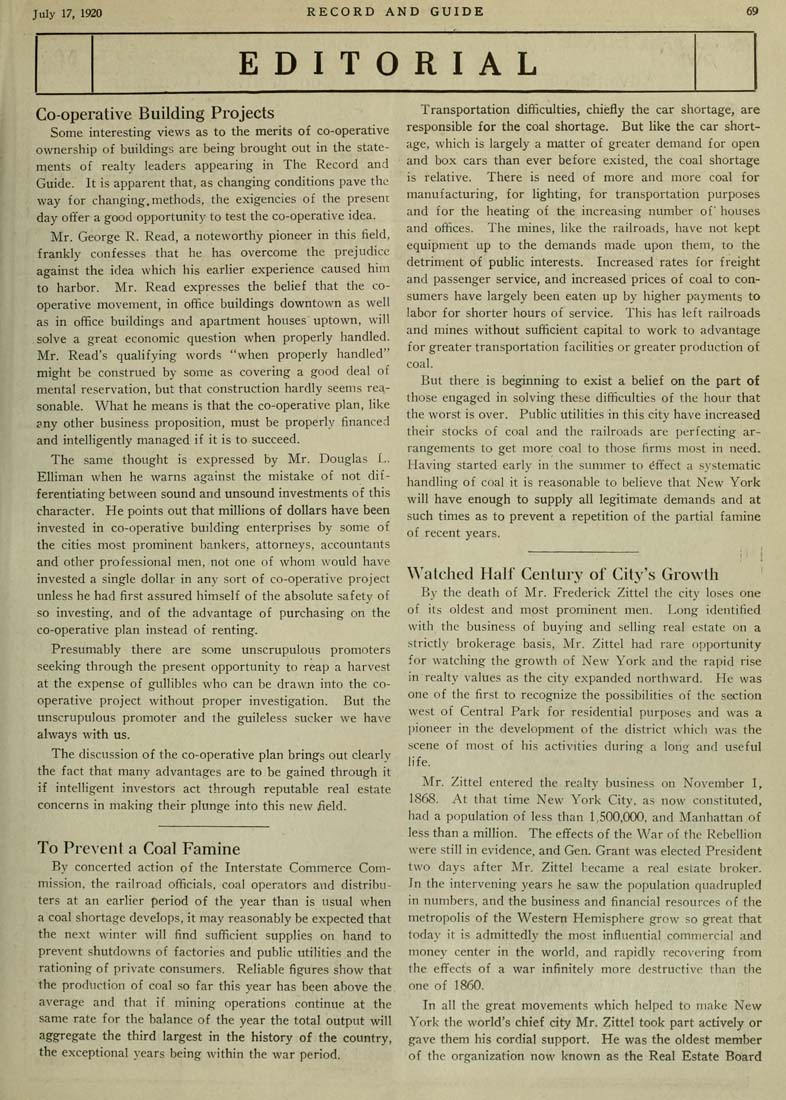
July 17, 1920 RECORD AND GUIDE 69 Co-operative Building Projects Some interesting views as to the merits of co-operative ownership of buildings are being brought out in the state¬ ments of realty leaders appearing in The Record and Guide. It is apparent that, as changing conditions pave the way for changing, methods, the exigencies of the present day offer a good opportunity to test the co-operative idea. Mr. George R. Read, a noteworthy pioneer in this field, frankly confesses that he has overcome the prejudice against the idea which his earlier experience caused him to harbor. Mr. Read expresses the belief that the co¬ operative movement, in office buildings downtown as well as in office buildings and apartment houses uptown, will solve a great economic question when properly handled. Mr. Read's qualifying words "when properly handled" might be construed by some as covering a good deal of mental reservation, but that construction hardly seems rea¬ sonable. What he means is that the co-operative plan, like ?ny other business proposition, must be properly financed and intelligently managed if it is to succeed. The same thought is expressed by Mr. Douglas L. Elliman when he warns against the mistake of not dif¬ ferentiating between sound and unsound investments of this character. He points out that millions of dollars have been invested in co-operative building enterprises by some of the cities most prominent bankers, attorneys, accountants and other professional men, not one of whom would have invested a single dollar in any sort of co-operative project unless he had first assured himself of the absolute safety of so investing, and of the advantage of purchasing on the co-operative plan instead of renting. Presumably there are some unscrupulous promoters seeking through the present opportunity to reap a harvest at the expense of gullibles who can be drawn into the co¬ operative project without proper investigation. But the unscrupulous promoter and the guileless sucker we have always with us. The discussion of the co-operative plan brings out clearly the fact that many advantages are to be gained through it if intelligent investors act through reputable real estate concerns in making their plunge into this new field. To Prevent a Coal Famine By concerted action of the Interstate Commerce Com¬ mission, the railroad officials, coal operators and distribu¬ ters at an earlier period of the year than is usual when a coal shortage develops, it may reasonably be expected that the next winter will find sufficient supplies on hand to prevent shutdowns of factories and public utilities and the rationing of private consumers. Reliable figures show that the production of coal so far this year has been above the average and that if mining operations continue at the same rate for the balance of the year the total output will aggregate the third largest in the history of the country, the exceptional years being within the war period. Transportation difficulties, chiefly the car shortage, are responsible for the coal shortage. But like the car short¬ age, which is largely a matter of greater demand for open and box cars than ever before existed, the coal shortage is relative. There is need of more and more coal for manufacturing, for lighting, for transportation purposes and for the heating of the increasing number of houses and offices. The mines, like the railroads, have not kept equipment up to the demands made upon them, to the detriment of public interests. Increased rates for freight and passenger service, and increased prices of coal to con¬ sumers have largely been eaten up by higher payments to labor for shorter hours of service. This has left railroads and mines without sufficient capital to work to advantage for greater transportation facilities or greater production of coal. But there is beginning to exist a belief on the part of those engaged in solving these difficulties of the hour that the worst is over. Public utilities in this city have increased their stocks of coal and the railroads are perfecting ar¬ rangements to get more coal to those firms most in need. Having started early in the summer to effect a systematic handling of coal it is reasonable to believe that New York will have enough to supply all legitimate demands and at such times as to prevent a repetition of the partial famine of recent years. !' i Watched Half Century of City's Growth By the death of Mr. Frederick Zittel the city loses one of its oldest and most prominent men. Long identified with the business of buying and selling real estate on a strictly brokerage basis, Mr. Zittel had rare opportunity for watching the growth of New York and the rapid rise in realty values as the city expanded northward. He was one of the first to recognize the possibilities of the section west of Central Park for residential purposes and was a pioneer in the development of the district which was the scene of most of his activities during a long and useful life. Mr. Zittel entered the realty business on November 1, 1868. At that time New York City, as now constituted, had a population of less than 1,500,000, and Manhattan of less than a million. The effects of the War of the Rebellion were still in evidence, and Gen. Grant was elected President two days after Mr. Zittel became a real estate broker. Tn the intervening years he saw the population quadrupled in numbers, and the business and financial resources of the metropolis of the Western Hemisphere grow so great that today it is admittedly the most influential commercial and money center in the world, and rapidly recovering from the effects of a war infinitely more destructive than the one of 1860. In all the great movements which helped to make New York the world's chief city Mr. Zittel took part actively or gave them his cordial support. He was the oldest member of the organization now known as the Real Estate Board