
Columbia University Libraries Digital Collections: The Real Estate Record
Use your browser's Print function to print these pages.
Real estate record and builders' guide: v. 106, no. 7: [Articles]: August 14, 1920
Text version:
Please note: this text may be incomplete. For more information about this OCR, view About OCR text.
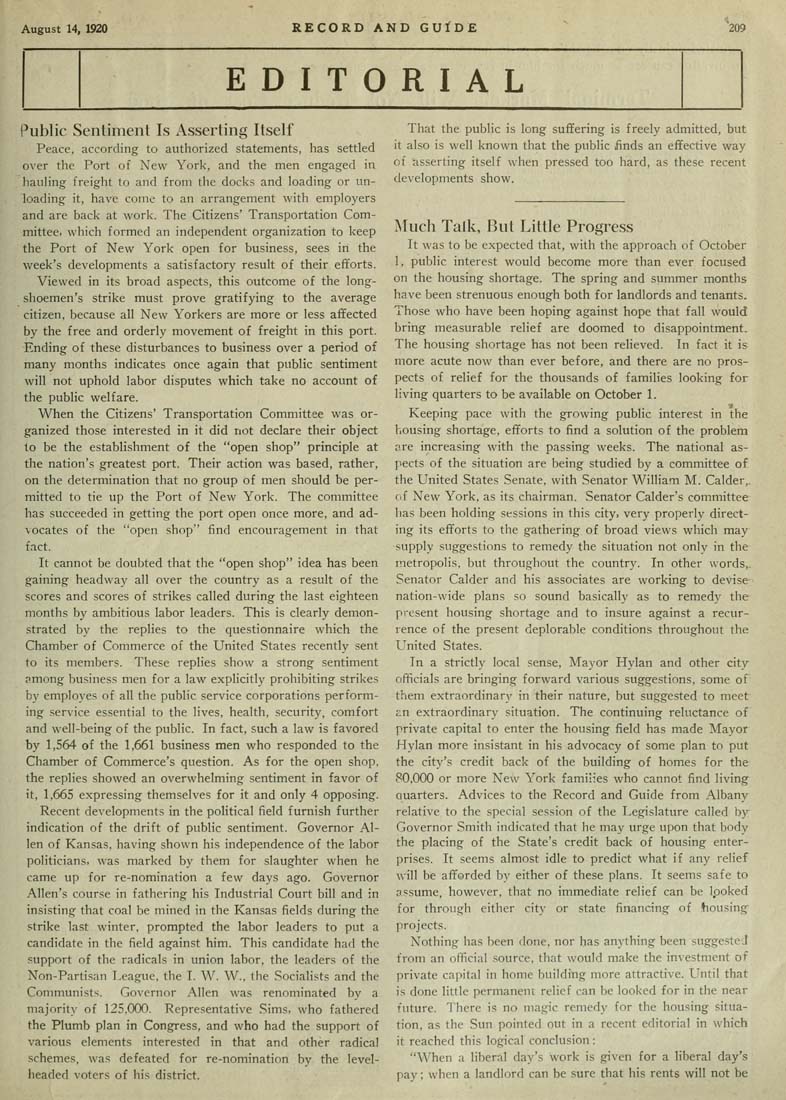
August 14, 1920 RECORD AND GUfDE 209 Public Sentiment Ls Asserting Itself Peace, according to authorized statements, has settled over the Port of New York, and the men engaged in hauHng freight to and from the docks and loading or un¬ loading it, have come to an arrangement with employers and are back at work. The Citizens' Transportation Com¬ mittee, which formed an independent organization to keep the Port of New York open for business, sees in the week's developments a satisfactory result of their efforts. Viewed in its broad aspects, this outcome of the long- shoemen's strike must prove gratifying to the average citizen, because all New Yorkers are more or less affected by the free and orderly movement of freight in this port. Ending of these disturbances to business over a period of many months indicates once again that public sentiment will not uphold labor disputes which take no account of the public welfare. When the Citizens' Transportation Committee was or¬ ganized those interested in it did not declare their object to be the establishment of the "open shop" principle at the nation's greatest port. Their action was based, rather, on the determination that no group of men should be per¬ mitted to tie up the Port of New York. The committee has succeeded in getting the port open once more, and ad¬ vocates of the "open shop" find encouragement in that fact. It cannot be doubted that the "open shop" idea has been gaining headway all over the country as a result of the scores and scores of strikes called during the last eighteen months by ambitious labor leaders. This is clearly demon¬ strated by the replies to the questionnaire which the Chamber of Cominerce of the United States recently sent to its members. These replies show a strong sentiment among business men for a law explicitly prohibiting strikes by employes of all the public service corporations perform¬ ing service essential to the lives, health, security, comfort and well-being of the public. In fact, such a law is favored by 1,564 of the 1,661 business men who responded to the Chamber of Commerce's question. As for the open shop. the replies showed an overwhelming sentiment in favor of it, 1,665 expressing themselves for it and only 4 opposing. Recent developments in the political field furnish further indication of the drift of public sentiment. Governor Al¬ len of Kansas, having shown his independence of the labor politicians, was marked by them for slaughter when he came up for re-nomination a few days ago. Governor Allen's course in fathering his Industrial Court bill and in insisting that coal be mined in the Kansas fields during the strike last winter, prompted the labor leaders to put a candidate in the field against him. This candidate had the support of the radicals in union labor, the leaders of the Non-Parti-san League, the I. W. W., the Socialists and the Communists. Governor Allen was renominated by a majority of 125.000. Representative .Sims, who fathered the Plumb plan in Congress, and who had the support of various elements interested in that and other radical schemes, was defeated for re-nomination by the level¬ headed voters of his district. That the public is long suffering is freely admitted, but it also is well known that the public finds an effective way of asserting itself when pressed too hard, as these recent developments show. Much Talk, But Little Progress It was to be expected that, with the approach of October 1, public interest would become more than ever focused on the housing shortage. The spring and summer months have been strenuous enough both for landlords and tenants. Those who have been hoping against hope that fall would bring measurable relief are doomed to disappointment. The housing shortage has not been relieved. In fact it is more acute now than ever before, and there are no pros¬ pects of relief for the thousands of families looking for living quarters to be available on October 1. Keeping pace with the growing public interest in the housing shortage, efforts to find a solution of the problem are increasing with the passing weeks. The national as¬ pects of the situation are being studied by a committee of the United States Senate, with Senator Willia.'n M. Calder,. Cif New York, as its chairman. Senator Calder's committee has been holding sessions in this city, very properly direct¬ ing its efforts to the gathering of broad views which may supply suggestions to remedy the situation not onlv in the metropolis, but throughout the country. In other words,. Senator Calder and his associates are working to devise nation-wide plans so sound basically as to remedy the present housing shortage and to insure against a recur¬ rence of the present deplorable conditions throughout the United States. In a strictly local sense, Mayor Hylan and other city officials are bringing forward various suggestions, some of them extraordinary in their nature, but suggested to meet an extraordinary situation. The continuing reluctance of private capital to enter the housing field has made Mayor Hylan more insistant in his advocacy of some plan to put the city's credit back of the building of homes for the 80,000 or more New York families who cannot find living Quarters. Advices to the Record and Guide from Albany relative to the special session of the Legislature called by Governor Smith indicated that he may urge upon that body the placing of the State's credit back of housing enter¬ prises. It seems almost idle to predict what if any relief will be afforded by either of these plans. It seems safe to assume, however, that no immediate relief can be Ipoked for through either city or state financing of liousing projects. Nothing has been done, nor has anything been suggested from an official source, that would make the investment of private cajjital in home building more attractive. LIntil that is done little permanent relief can be looked for in the near future. There is no magic remedy for the housing situa¬ tion, as the Sun pointed out in a recent editorial in which it reached this logical conclusion: "When a liberal day's work is given for a liberal day's pay; when a landlord can be sure that his rents will not be