
Columbia University Libraries Digital Collections: The Real Estate Record
Use your browser's Print function to print these pages.
Real estate record and builders' guide: v. 109, no. 6: February 11, 1922
Text version:
Please note: this text may be incomplete. For more information about this OCR, view About OCR text.
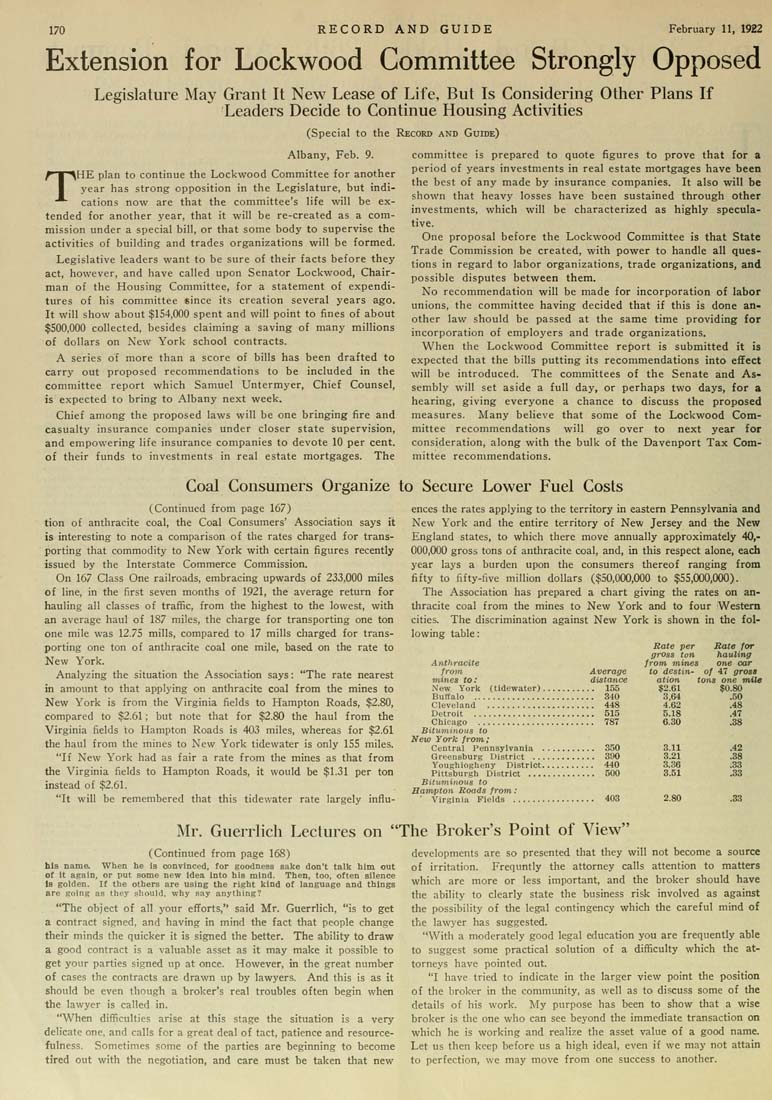
170 RECORD AND GUIDE February 11, 1922 Extension for Lockwood Committee Strongly Opposed Legislature May Grant It New Lease of Life, But Is Considering Other Plans If Leaders Decide to Continue Housing Activities (Special to the Record and Guide) Albany, Feb, 9. THE plan to continue the Lockwood Committee for another year has strong opposition in the Legislature, but indi¬ cations now are that the committee's life will be ex¬ tended for another year, that it will be re-created as a com¬ mission under a special bill, or that some body to supervise the activities of building and trades organizations will be formed. Legislative leaders want to be sure of their facts before they act, however, and have called upon Senator Lockwood, Chair¬ man of the Housing Committee, for a statement of expendi¬ tures of his committee since its creation several years ago. It will show about $154,000 spent and will point to fines of about $500,000 collected, besides claiming a saving of many millions of dollars on New York school contracts. A series of more than a score of bills has been drafted to carry out proposed recommendations to be included in the committee report which Samuel Untermyer, Chief Counsel, is expected to bring to Albany next week. Chief among the proposed laws will be one bringing fire and casualty insurance companies under closer state supervision, and empowering life insurance companies to devote 10 per cent, of their funds to investments in real estate mortgages. The committee is prepared to quote figures to prove that for a period of years investments in real estate mortgages have been the best of any made by insurance companies. It also will be shown that heavy losses have been sustained through other investments, which will be characterized as highly specula¬ tive. One proposal before the Lockwood Committee is that State Trade Commission be created, with power to handle all ques¬ tions in regard to labor organizations, trade organizations, and possible disputes between them. No recommendation will be made for incorporation of labor unions, the committee having decided that if this is done an¬ other law should be passed at the same time providing for incorporation of employers and trade organizations. When the Lockwood Committee report is submitted it is expected that the bills putting its recommendations into effect will be introduced. The committees of the Senate and As¬ sembly will set aside a full day, or perhaps two days, for a hearing, giving everyone a chance to discuss the proposed measures. Many believe that some of the Lockwood Com¬ mittee recommendations will go over to next year for consideration, along with the bulk of the Davenport Tax Com- inittee recommendations. Coal Consumers Organize to Secure Lower Fuel Costs (Continued from page 167) tion of anthracite coal, the Coal Consumers' Association says it is interesting to note a comparison of the rates charged for trans¬ porting that commodity to New York with certain figures recently issued by the Interstate Commerce Commission. On 167 Class One railroads, embracing upwards of 233,000 miles of line, in the first seven months of 1921, the average return for hauling all classes of traffic, from the highest to the lowest, with an average haul of 187 miles, the charge for transporting one ton one mile was 12.75 mills, compared to 17 mills charged for trans¬ porting one ton of anthracite coal one mile, based on the rate to New York. Analyzing the situation the Association says: "The rate nearest in amount to that applying on anthracite coal from the mines to New York is from the Virginia fields to Hampton Roads, $2.80, compared to $2.61; but note that for $2,80 the haul from the Virginia fields to Hampton Roads is 403 miles, whereas for $2.61 the haul from the mines to New York tidewater is only 155 miles. "If New York had as fair a rate from the mines as that from the Virginia fields to Hampton Roads, it would be $1.31 per ton instead of $2.61. "It will be reiTiembered that this tidewater rate largely influ¬ ences the rates applying to the territory in eastern Pennsylvania and New York and the entire territory of New Jersey and the New England states, to which there move annually approximately 40,- 000,000 gross tons of anthracite coal, and, in this respect alone, each year lays a burden upon the consumers thereof ranging from fifty to fifty-five million dollars ($50,000,000 to $55,000,000). The Association has prepared a chart giving the rates on an¬ thracite coal from the mines to New York and to four Western cities. The discrimination against New York is shown in the fol¬ lowing table: Anthracite from Average mines to: distance New York (tidewater)........... 155 Buffalo ......................... 340 Cleveland ...................... 448 Detroit ......................... 515 Chicago ........................ 787 Bituminous to New York from ,* Central Pennsylvania ........... 350 Greensburg District ............. 390 Youghiogheny District........... 440 Pittsburgh District .............. 500 Bituminous to Hampton Roads from: Virginia Fields ................. 403 Rate per Bate for gross ton hauling from mines one car to destin' of 47 gross ation tons one mile $2.61 $0.80 3,64 .50 4.62 .48 5.18 .47 6.30 .38 3.11 .42 3.21 .38 3.36 .33 3.51 .33 2.80 .33 Mr. Guerrlich Lectures on "The Broker's Point of View" (Continued from page 168) his name. When he is convinced, for goodness sake don't talk him out of It again, or put some new idea into his mind. Then, too, often silence Is golden. If the others are using the right kind of language and things are going as they should, why say anything? "The object of all your efforts," said Mr. Guerrlich, "is to get a contract signed, and having in mind the fact that people change their minds the quicker it is signed the better. The ability to draw a good contract is a valuable asset as it may make it possible to get your parties signed up at once. However, in the great number of cases the contracts are drawn up by lawyers. And this is as it should be even though a broker's real troubles often begin when the lawyer is called in. "When difficulties arise at this stage the situation is a very delicate one, and calls for a great deal of tact, patience and resource¬ fulness. Sometimes some of the parties are beginning to become tired out with the negotiation, and care must be taken that new developments are so presented that they will not become a source of irritation. Frequntly the attorney calls attention to matters which are more or less important, and the broker should have the ability to clearly state the business risk involved as against the possibility of the legal contingency which the careful mind of the lawyer has suggested. "With a moderately good legal education you are frequently able to suggest some practical solution of a difficulty which the at¬ torneys have pointed out. "I have tried to indicate in the larger view point the position of the broker in the community, as well as to discuss some of the details of his work. My purpose has been to show that a wise broker is the one who can see beyond the immediate transaction on which he is working and realize the asset value of a good name. Let us then keep before us a high ideal, even if we may not attain to perfection, we may move from one success to another.