
Columbia University Libraries Digital Collections: The Real Estate Record
Use your browser's Print function to print these pages.
Real estate record and builders' guide: v. 109, no. 21: May 27, 1922
Text version:
Please note: this text may be incomplete. For more information about this OCR, view About OCR text.
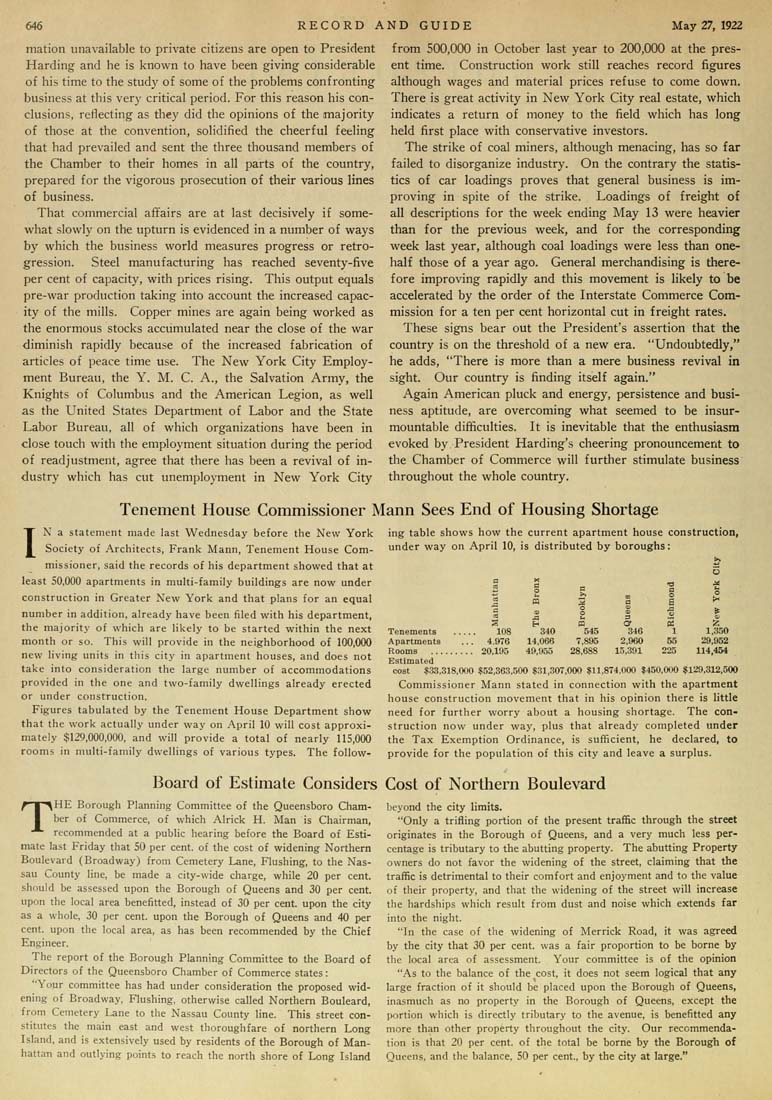
646 RECORD AND GUIDE May 27, 1922 mation unavailable to private citizens are open to President Harding and he is known to have been giving considerable of his time to the study of some of the problems confronting business at this very critical period. For this reason his con¬ clusions, reflecting as they did the opinions of the majority of those at the convention, solidified the cheerful feeling that had prevailed and sent the three thousand members of the Chamber to their homes in all parts of the country, prepared for the vigorous prosecution of their various lines of business. That commercial affairs are at last decisively if some¬ what slowly on the upturn is evidenced in a number of ways by which the business world measures progress or retro¬ gression. Steel manufacturing has reached seventy-five per cent of capacity, with prices rising. This output equals pre-war production taking into account the increased capac¬ ity of the mills. Copper mines are again being worked as the enormous stocks acctimulated near the close of the war diminish rapidly because of the increased fabrication of articles of peace time use. The Nevv York City Employ¬ ment Bureau, the Y. M. C. A., the Salvation Army, the Knights of Columbus and the American Legion, as well as the United States Department of Labor and the State Labor Bureau, all of which organizations have been in close touch with the employment situation during the period of readjustment, agree that there has been a revival of in¬ dustry which has cut unemployment in New York City from 500,000 in October last year to 200,000 at the pres¬ ent time. Construction work still reaches record figures although wages and material prices refuse to come down. There is great activity in New York City real estate, which indicates a return of money to the field which has long held first place with conservative investors. The strike of coal miners, although menacing, has so far failed to disorganize industry. On the contrary the statis¬ tics of car loadings proves that general business is im¬ proving in spite of the strike. Loadings of freight of all descriptions for the week ending May 13 were heavier than for the previous week, and for the corresponding week last year, although coal loadings were less than one- half those of a year ago. General merchandising is there¬ fore improving rapidly and this movement is likely to be accelerated by the order of the Interstate Commerce Com¬ mission for a ten per cent horizontal cut in freight rates. These signs bear out the President's assertion that the country is on the threshold of a new era. "Undoubtedly," he adds, "There is more than a mere business revival in sight. Our country is finding itself again." Again American pluck and energy, persistence and busi¬ ness aptitude, are overcoming what seemed to be insur¬ mountable difficulties. It is inevitable that the enthusiasm evoked by President Harding's cheering pronouncement to the Chamber of Commerce will further stimulate business throughout the whole country. Tenement House Commissioner Mann Sees End of Housing Shortage TN a statciiieiit made last Wednesday before the New York Society of Architects, Frank Mann, Tenement House Com¬ missioner, said the records of his department showed that at least 50,000 apartments in multi-family buildings are now under construction in Greater New York and that plans for an equal number in addition, already have been filed with his department, the majority of which are likely to be started within the next month or so. This will provide in the neighborhood of 100,000 new living units in this city in apartment houses, and does not take into consideration the large number of accommodations provided in the one and two-family dwellings already erected or under construction. Figures tabulated by the Tenement House Department show that the work actually under way on April 10 will cost approxi¬ mately $129,000,000, and will provide a total of nearly 115,000 rooms in multi-family dwellings of various types. The follow¬ ing table shows how the current apartment house construction, under way on April 10, is distributed by boroughs: n •d a o a s Eh B a K 2; 108 3-10 545 346 1 1,350 4.976 14,066 7.895 2,960 55 29,952 20,195 49,955 28,688 15,391 225 114,454 Tenements Apartments Rooms ..... Estimated cost $.33,318,000 $52,363,500 $31,307,000 $11,874,000 $450,000 $129,312,500 Commissioner Mann stated in connection with the apartment house construction movement that in his opinion there is little need for further worry about a housing shortage. The con¬ struction now under way, plus that already completed under the Ta.x Exemption Ordinance, is sufficient, he declared, to provide for the population of this city and leave a surplus. Board of Estimate Considers Cost of Northern Boulevard THE Borough Planning Committee of the Queensboro Cham¬ ber of Commerce, of which Alrick H. Man is Chairman, recommended at a public hearing before the Board of Esti¬ mate last Friday that 50 per cent, of the cost of widening Northern Boulevard (Broadway) from Cemetery Lane, Flushing, to the Nas¬ sau County line, be made a city-wide charge, while 20 per cent, should be assessed upon the Borough of Queens and 30 per cent, upon the local area benefitted, instead of 30 per cent, upon the city as a whole, 30 per cent, upon the Borough of Queens and 40 per cent, upon the local area, as has been recommended by the Chief Engineer. The report of the Borough Planning Comraittee to the Board of Directors of the Queensboro Chamber of Commerce states: "Your committee has had under consideration the proposed wid¬ ening of Broadway, Flushing, otherwise called Northern Bouleard, from Cemetery Lane to the Nassau County line. This street con¬ stitutes the main east and west thoroughfare of northern Long Island, and is extensively used by residents of the Borough of Man- hatt.-ni and outlying points to reach the north shore of Long Island beyond the city limits. "Only a trifling portion of the present traffic through the street originates in the Borough of Queens, and a very much less per¬ centage is tributary to the abutting property. The abutting Property owners do not favor the widening of the street, claiming that the traffic is detrimental to their comfort and enjoyment and to the value of their property, and that the widening of the street will increase the hardships which result from dust and noise which extends far into the night. "In the case of the widening of Merrick Road, it was agreed by the city that 30 per cent, was a fair proportion to be borne by the local area of assessment. Your committee is of the opinion "As to the balance of the cost, it does not seem logical that any large fraction of it should be placed upon the Borough of Queens, inasmuch as no property in the Borough of Queens, except the portion which is directly tributary to the avenue, is benefitted any more than other property throughout the city. Our recommenda¬ tion is that 20 per cent, of the total be borne by the Borough of Queens, and the balance, 50 per cent., by the city at large."