
Columbia University Libraries Digital Collections: The Real Estate Record
Use your browser's Print function to print these pages.
Real estate record and builders' guide: v. 32, no. 800: July 14, 1883
Text version:
Please note: this text may be incomplete. For more information about this OCR, view About OCR text.
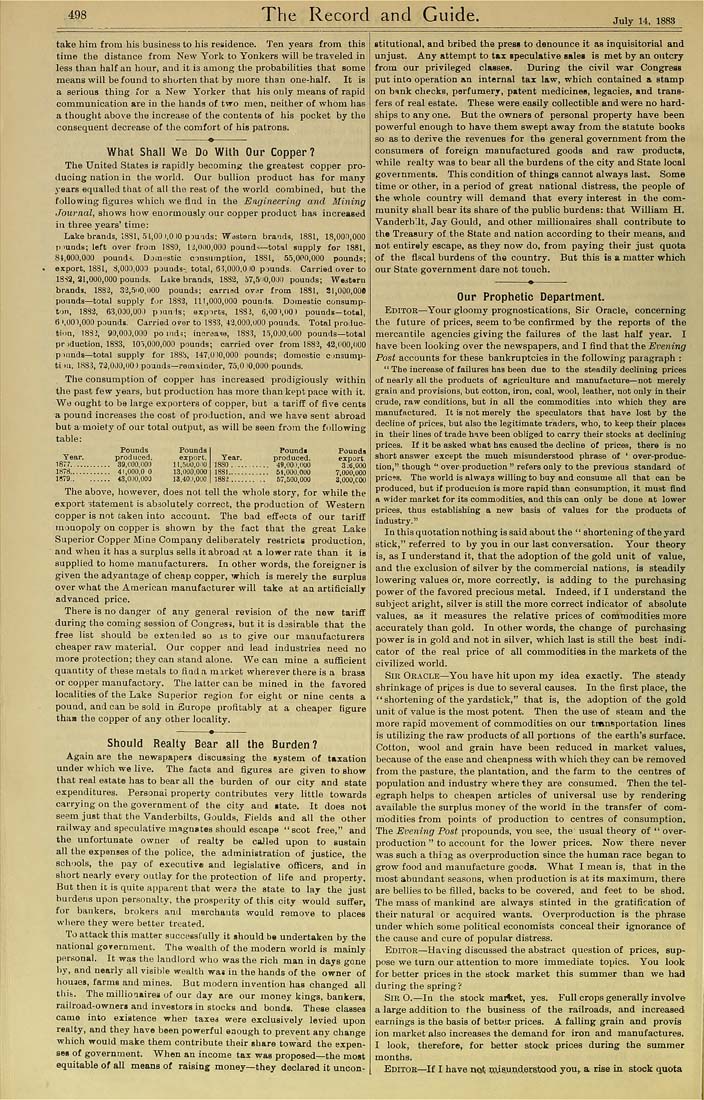
^^B^^^^take hii ^0 time tt The Record and Guide. July 14, 1883 'ake him from his business to his residence. Ten years from this time the distance from New York to Yonkers will be traveled in less than half an hour, and it is among tbe probabilities that some means will be found to shorten that by more than one-half. It is a serious thing for a New Yorker that his only means of rapid communication are in the bands of two men, neither of whom has a thought above the increase of the contents of his pocket by the consequent decrease of the comfort of bis patrons. What Shall We Do With Our Copper? The United States is rapidly becominK the greatest copper pro¬ ducing nation iu tbe world. Our bullion product has for many years equalled that o£ all the rest of the world combined, but the following figures whicli we flad in the Engineering and Mining (/owrftai, shows how enormously our copper product ha.s increased in three years' time: Lake hrands, "lSSI, .51,00 ),0 10 pmids; Wdstern bra'ids, 18SI, 18,000,000 inunds; left over from 18S0, I i,OiJO,000 pound-;—total supply for 188L, 81,000.000 pouudi. Djrtisstic cmsiimption, 18S1, 3.5,00(1,000 pounds; eicport, 18SL, S.OOO.OOO pjuuds-. total, 6S,000.0 JO pDutids. Carried over to 18sa, 31.000,000 pounds. Lake hrands, 1882, 57,5')0,00il pounds; Western brands, 183-3, 33,.5'i0,l)00 pounds; oarriad ov.ir from 1881, 31,000,006 pounds—total supply (or 1883, 111,000,000 pouQ-ls. Domestic consump- t'ln, 1832, 63,000,001 p tun is; eKpirCs, ISS3, 6,00 >,U0) pounds—total, fi 1,001,000 pounds. Carried over to 1333, 43,000,000 pounds. Total produc¬ tion, I8S3, 90,OOJ,000 poinds inorea'se, ISS^J, 15,000,000 pounds—total pr iduction, 1883, iOi,O0O,OO0 pounds; carried over from 1883, 48,li00,ii00 p unnds—totftl supply for 18S'3, 147,010,000 pounds; domestic cinsump- ti 111, 1885, 73,000,(10 1 pounds—remiiuder, 75,0 iO,0(lO pounds. The consumption of copper has increased prodigiously within the past few years, but production has more than kept pace with it. We ought to be large exporters of copper, but a tariff of five cents a pound increases the cost of production, and we have sent abroad but a moiety of our total output, as will be seen from the following table: PouDds Pounds j Year. produced. eiport. 187?............ 39,(;oo.noo ii.sou.Oi'O | IKTiJ............ 41,000,0 0 13,1100.000 I 1879........ «,O:JO,O0a 13,40.i,OU0 | Pound* Pounds Tear. produced, eiport ISaO........... 49,00 i.lUJO 3:6,000 1831............ 51,000.000 7,000,1X10 l88i......... 57,500,000 3,00O,CO0 The above, however, does not tell the whole story, for while the export statement is absolutely correct, the production of Western copper is not taken into account. The bad effects of our tariff monopoly on copper is shown by the fact that the great Lake Superior Copper Mine Company deliberately restricts production, and when it has a surplus sells it abroad ,at a lower rate than it is supplied to home manufacturers. In other words, the foreigner is giveu the advantage of cheap copper, which is merely the surplus over what the American manufacturer will take at an artificially advanced price. There is no danger of any general ■ revision of the new tariff during the coming session of Congresi, but it is dasirable that the free list should be extended ao is to give our mauufacturers cheaper raw material. Our copper and lead industries need no more protection; they can stand alone. We can mine a sufficient quantity of these metals to find a mirket wherever there is a brass or copper manufactory. The latter can be mined in the favored localities of tbe Lake Superior region for eight or nine cents a pound, and can be sold in Europe profitably at a cheaper figure than the copper of any other locality. Should Realty Bear all the Burden? Again are tbe newspapers discussing the system of taxation under which we live. The facts and figures are given to show ibat real estate has to bear all the burden of our city and state expenditures. Personal property contributes very little towards carrying on the government of the city aud itate. It does not seem just that the Vanderbilts, Goulds, Fields and all the other railway and speculative magnates should escape "scot free," and the unfortunate owner of realty be called upon to sustain all the expenses of the police, the administration of justice, the Bcb'jols, the pay of executive and legislative oflicers, and in short nearly every outlay for the protection of life and property. But then it is quite ai>pafent that wera the state to lay the just burdens upon personalty, the prospej'ity of this city would suffer, fur bankers, brokers and merchants would remove to places where they were better treated. To attack this matter succi'ssrully it should ha undertaken by the national goTerument. The wealth of the modern world is mainly personal. It was the landlord who was the rich man in days gone by, and nearly all vieihie wealth was in the hands of the owner of houses, farms and mines. But modern invention baa changed all thib, Themillioa»irea of our day are our money kings, bankers, railroad-owner! and investors in stocks and bonds. These classes came into existence when taxes were exclusively levied upon realty, and they have been powerful enough to prevent any change which would make them contribute their share toward the expen¬ ses of government. When an income tax was proposed—the moat equitable of all means of raising money—they declared it uncon- etitutional, and bribed the press to denounce it as inquisitorial and unjust. Any attempt to tax speculative sales is met by an outcry from our privileged classes. During the civil war Congress put into operation an internal tax law, which contained a stamp on b>ink checks, perfumery, patent medicines, legacies, and trans¬ fers of real estate. These were easily collectible and were no hard¬ ships to anyone. But the owners of personal property have been powerful enough to have them swept away from the statute books BO as to derive the revenues for the general government from the consumers of foreign manufactured goods and raw products, while realty was to bear all the burdens of the city and State local governments. This condition of things cannot always last. Some time or other, in a period of great national distress, the people of the whole country will demand that every interest in the com¬ munity shall bear its share of the public burdens: that William H. Vanderb'.lt, Jay Gould, and other millionaires shall contribute to th« Treasury of the State and nation according to their means, and not entirely escape, as they now do, from paying their just quota of the fiscal burdens of the country. But this is a matter which our State government dare not touch. Our Prophetic Department. Editor—Your gloomy prognostications, Sir Oracle, concerning the future of prices, seem to'be confirmed by the reports of the mercantile agencies giving the failures of the last half year. I have been looking over tbe newspapers, and I find that the Evening Post accounts for these bankruptcies in the following paragraph : " The increase of failures has been due to the steadily declining prices of nearly all the products of agriculture and manufacture—not merely grain and provisions, hut cotton, iron, coal, wool, leather, not only in their crude, raw conditions, but in all the commodities into which they are manufactured. It is not merely the speculators that have lost by the decline of prices, hut also the legitimate traders, who, to keep their places in their lines of trade have heen obliged to carry their stocks at declining prices. If it be asked what has caused the decline of prices, there is no short answer except the much misunderstood phrase of ' over-produc¬ tion," though " over production " refers oaly to the previous standard of prices. The world is always willing to buy and consume all that can be produced, but if production is more rapid than consumption, it must find a wider market for its commodities, and this can only be done at lower prices, thus eatablishing a new basis of values for the products of industry." Inthisquocationnothing is said about the " shortening of the yard stick," referred to by you in our last conversation. Your theory is, as I understand it, that the adoption of the gold unit of value, and the exclusion of silver by the commercial nations, is steadily lowering values or, more correctly, is adding to the purchasing power of the favored precious metal. Indeed, if I understand the subject aright, silver is still the more correct indicator of absolute values, as it measures the relative prices of commodities more accurately than gold. In other words, the change of purchasing power is in gold and not in silver, which last is still the best indi¬ cator of the real price of all commodities in the markets of the civilized world. Sir Oracle^You have hit upon my idea exactly. The steady shrinkage of prices is due to several causes. In the first place, the "shortening of the yardstick," that is, the adoption of the gold unit of value is the most potent. Then tbe use of steam and the more rapid movement of commodities on our tmnsportation lines is utilizing tbe raw products of all portions of the earth's surface. Cotton, wool and grain have been reduced in market values, because of tbe ease and cheapness with which they can be removed from the pasture, the plantation, and the farm to the centres of population and industry where they are consumed. Then tbe tel¬ egraph helps to cheapen articles of universal use by rendering available the surplus monev of the world in the transfer of com¬ modities from points of production to centres of consumption. The Evening Post propounds, vou see, the' usual theory of " over¬ production " to account for the lower prices. Now there never was such a thi^g as overproduction since the human race began to grow food and mauufacture goods. What I mean is, that in the most abundant seasons, when production is at its maximum, there are bellies to be filled, backs to be covered, and feet to be shod. The mass of mankind are always stinted in tbe gratification of their natural or acquired wants. Overproduction is the phrase under which some political economists conceal their ignorance of the cause and cure of popular distress. Editor—Having discussed the abstract question of prices, sup¬ pose we turn our attention to more immediate topics. You look for better prices in the atock market this summer than we had during the spring ? Sir 0.—In the stock maitet, yes. Full crops generally involve a large addition to the business of the railroads, and increased earnings is the basis of bettor prices. A falling grain and provis ion market also increases the demand for iron and manufactures, I look, therefore, for better stock prices during the summer months. Editor—If I have not oa,is.und.eratQod you^ a rise in stock quota