
Columbia University Libraries Digital Collections: The Real Estate Record
Use your browser's Print function to print these pages.
The Record and guide: v. 38, no. 977: December 4, 1886
Text version:
Please note: this text may be incomplete. For more information about this OCR, view About OCR text.
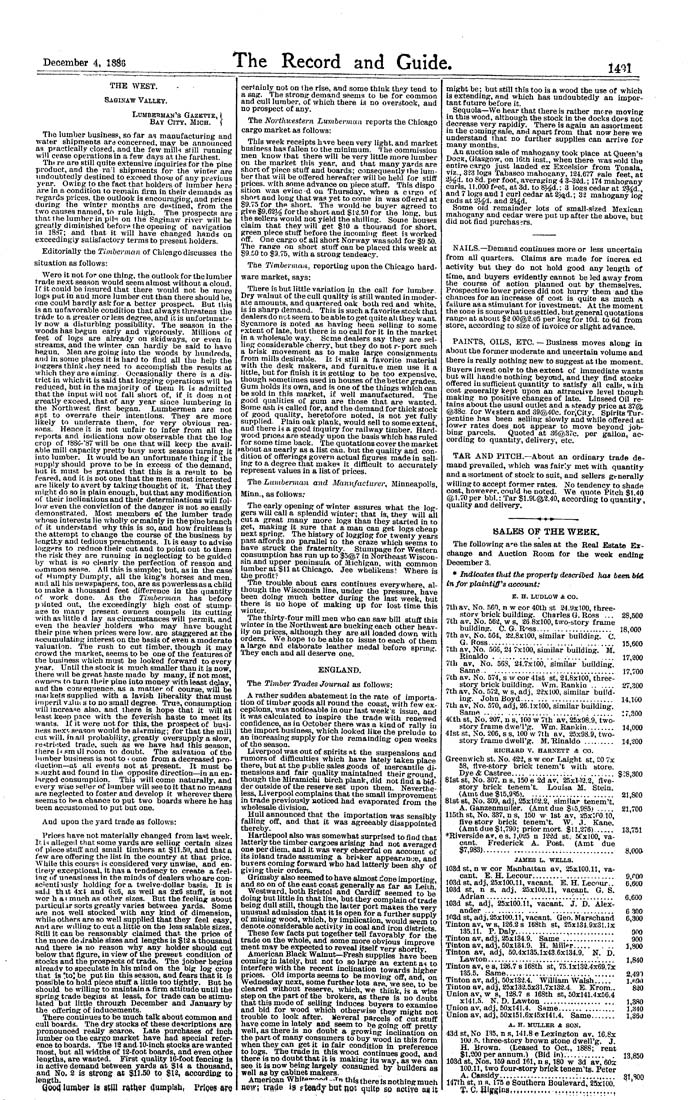
December 4, 18^8 The Record and Guide. u^i THE WEST. Saginaw Vallky. Lumberman's Gazette, ) Bay City, Mich. ( The lumber business, so far as manufacturing and water shipments are concerned, mav be announced as practically closed, and the few milk still running will cease operations in a few days at the farthest. Tht re are still quite extensive inquiries for the pine product, and the ra'l shipments for the winter are undoubtedly destined to exceed those of any previous year. Owing to the fact that holders of lumber here are in a condition to remain firm in their demands as regards prices, the outlook is encouraging, and prices during the winter months are destined, fi-om the two causes named, to rule high. The prospects are that the lumber in pil'^ on the Saginaw river will be greatly diminished before the opening of navigation in 18S7; and that it will have changed hands on exceedingly satisfactory terms to present holders. Editorially the Timberman of Chicago discusses the situation as follows: Were it not for one thing, the outlook for the lumber trade next season would seem almost without a cloud. If it could be insured that there would not be more logs put in and more lumber cut than there should be, one could hardly ask for a better prospect. But this is an unfavorable condition that always threatens the trade to a greater or less degree, and it is unfortunate¬ ly now a disturbing possibility. The season in the woods has begun early and vigorously. Millions of feet of logs are already on skidways, or even in streams, and the winter can hardly be said to have begun. Men are going into the woods by hundreds, and in some places it is hard to find all the help the loegers think.hey need to accomplish the results at whioh they are aiming. Occasionally there is a dis¬ trict in which it is said that logging oj^erations will be reduced, but in the majority of them It is admitted that the input will not fall short of, if it does not greatly exceed, that of any year since lumbering in the Northwest flrst began. Lumbermen are not apt to overrate their intentions. They are more likely to underrate them, for very obvious rea¬ sons. Hence it is not unfair to infer from all the reports and indications now observable that the log crop of l880-'87 will be one that will keep the avail¬ able mill capacity pretty busy next season turning it into lumber. It would be an unfortunate thing if the wjpply should prove to be in excess of the demand, but it must be granted that this is a re=ult to be feared, and it is not one that the men most interested are likely to avert by taking thought of it. That they might do so is plain enough, but that any modification of their inclinations and their determinations will fol¬ low even the conviction of the danger is not so easily demonstrated. Most members of the lumber trade whose interests lie wholly or mainly in the pine branch of it under.'itand why this is so, and how fruitless is the attempt to change the course of the business by lengthy and tedious preachments. It is easy to advise loggers to reduce their cut and to point out to them the risk they are running in neglecting to be guided by what is so clearly the perfection of reason and common sense. All this is simple; bnt, as in the case of Humpty Dumpty, all the king's horses and men. and all his newspapers, too, are as powerless as a child to make a tliousand feet difference in the quantity of work done. As the Timberman has before punted out, the exceedingly high cost of stump- asre to many present owners compels its cutting with as little d lay as circumstances will permit, and even the heavier holders who may have bought their pine when prices were low. are staggered at the accumulating interest on the basis of even a moderate valuation. The rush to cut timber, though it may crowd the market, seems to be one of the features of the business which must be looked forward to every year. Until the stock is much smaller than it is now, there will be great haste made by many, if not most, owners to turn their pine into money with least delay, and the consequence, as a matter of course, will be I nai ket s supplied with a lavish liberality that must imperil va.hu s to no small degree. True, consumption will mcrease also, and there is hope that it will at least keep pace with the feverish haste to meet its wants. If it were not for this, the prospect of busi¬ ness nexr, season would be alarming; for that the mill cut will, in all probability, greatly oversupply a slow, re-itricted trade, such as we have had this season, there i-usly holding fora twelve-dollar basis; It is said th It 4x4 and 6.x:6, as well as 2x6 stuff, is not wor h a i much as other sizes. But the feeling about pariicuUr sorts greatly varies between yards. Some are not well stocked with any kind of dimension, while others are so well supplied that they feel easy, and are wdling to cut a little on the less salablei sizes. Still it can be reasonably claimed that the price of the more de,irable sizes and lengths is $12 a thousand and there is no reason why any holder should cut below that flgure, in view of the present condition of stocks and the prospects of trade. The jobber begins alreadv to speculate in his mind on the big log crop that is !to^ be put Un this season, and fears that it is possible to hold piece stufl a little too tightly. But he should be willing to maintain a flrm attitude until the spring trade begins at least, for trade can be stimu¬ lated but little through December and January by the offering of inducements. There continues to be much talk about common and cull boards. The dry stocks of these de'^criptions are pronounced really scarce. Late purchases of inch lumber on the cargo market have had special refer¬ ence to boards. The 12 and. 10-inch stocks are wanted most, but all widths of 12-foot boards, and even other lengths, are wanted. First quality 16-foot fencing Is in active demaud between yards at $14 a thousand, and No. 2 is strong at $11.50 to $12, according to length. Qoo4 lumber Is 8(1)1 ri^tUer lumpish, Priges are certainly not on the rise, and some think they tend to a sag. The strong demand seems to be for common and cull lumber, of which there is no overstock, and no prospect of any. The Northwestern Lumberman reports the Chicago cargo market as follows: This week receipts have been very light, and market business has fallen to the minimum. The commission men know that there will be very little more lumber on the market this year, and that many yards are short of piece stuff and boards; consequeotly the lum¬ ber that will be offered hereafter will be held for stiff prices, with some advance on piece stuff. This dispo sition was evinc-d ou Thursday, when a cirgo of short and long that was yet to come in was offered at $9.75 for the short. The would he buyer agreed to give$9.62i4forthe short and $12.50 for the long, but the sellers would not yield the shilling. Some houses claim that they will get $10 a thou?and for short, greenpiecestuff before the incoming fleet is worked off. One cargo of all short Norway was sold for $9 50. The range on short stuff can be placed this week at $9.50 to $9.75, with a strong tendency. The Timberman, reporting upon the Chicago hard¬ ware market, says: There is but little variation in the call for lumber Dry walnut of the cull quality is still wanted in moder¬ ate amounts, and quartered oak both red and white is in sharp demand. This is such a favorite stock that dealers do not seera to be able to get quite ah they want. Sycamore is noted as having been selling to some extent of late, but there is no call for it in the market in a wholesale way. Some dealers say they are sel¬ ling considerable cherry, but they do not r-port such a brisk movement as to make large consignments from mills desirable. It is still a favorite material with the desk makers, and furnitu.e men use it a little, but for flnish it is getting to be too expensive, though sometimes used in houses of the better grades Gum holds ils own, and is one of the things which can be sold in this market, if well manufactured. The good qualities of gum are those that are wanted. Some ash is called for, and the demand for thick stock of good quality, heretofore noted, is not yet fully supplied. Plain oak plank, would sell to some extent, and there is a good inquiry for railway timber. Hard¬ wood price.^ are steady upon the basis which has ruled for some time back. The quotations cover the market fabout as nearly as a list can, but the quality and con¬ dition of offerings govern actual flgures made in sell¬ ing to a degree that make'^ it difficult to accurately represent values in a list of prices. The Lumbennan and Manufacturer, Minneapolis, Minn., as follows; The early opening of winter assures what the log¬ gers will call a splendid winter; that is, they will all cut a great many more logs than they started in to get, making it sure that a man can get logs cheap next spring. The histsry of logging for twenty years past affords no parallel to the craze which seems to have struck the fraternity. Stumpage for Western consumption has run up to $5@7 in Northeast Wiscon¬ sin and upper peninsula of Michigan, with common lumber at $11 at Chicago. Jee whelikens! Where is the profit? The trouble about cars continues everywhere, al¬ though the Wisconsin line, under the pressure, have been doing much better during the last week, but there is uo hope of making up for lost time this winter. The thirty-four mill men who can saw bill stuff this winter in the Northwest are bucking each other heav¬ ily on prices, although they are all loaded down with orders. We hope to be able to issue to each of them a large and elaborate leather medal before sprm!; They each and all deserve one. »- k- ENGLAND. The Timber Trades Journal as follows: A rather sudden abatement in the rate of importa¬ tion of timber goods all round the coast, with few ex¬ ceptions, was noticeable in our last week's issue, and it was calculated to inspire the trade with renewed confldence, as in October there was a kind of rally in the import business, which looked like the prelude to an increasing supply for the remainding open weeks of the season. Liverpool was out of spirits at the suspensions and rumors of difficulties which have lately taken place there, but at the public sales goods of mercantile di¬ mensions and fair quality maintained their ground though the Miramiehi birch plank, did not flnd a bid¬ der outside of the reserve set upon them. Neverthe¬ less, Liverpool complains that the small improvement in trade previously noticed had evaporated from the wholesale division. Hull announced that the importation was sensibly falling off, and that it was agreeably disappointed thereby. Hartlepool also was somewhat surprised to find that latterlythe timber cargoes arising had not averaged one per diem, and it was very cheerful on account of its inland trade assuming a brisker appearance and buyers coming forward who had latterly been shy of giving their orders. Grimsby also seemed to have almost done importing and so on of the east coast generally as far as Leiih' Westward, both Bristol and Cardiff seemed to be doing but little in that line, but they complain of trade being dull still, though the latter port makes the very unusual admission that it is open for a further supply of mining wood, which, by implication, would seein to denote .considerable activity in coal and iron districts These few facts put together tell favorably for the trade on the whole, and some more obvious improve ment may be expected to reveal itself very shortly American Black Walnut—Fresh supplies have been coming in lately, but not to so large an extent as to interfere with the recent incUnation towards higher prices. Old imports seems to be moving off and on Wednesday next, some further lots are, we see to be cleared without reserve, which, we think is a wise step on the part of the brokers, as there is' no doubt that this mode of selling induces buyers to examine and bid for wood which otherwise they might not trouble to look after. Several parcels of cut stuff have come in lately and seem to be going off prettv well, as there is no doubt a growing inclination on the part of many consumers to buy wood in this form when they can get it in fair condition in preference to logs. The trade m this wood continues good, and thereisnodoubtthatitis making its way as we can see it is now bemg largely consumed by builders as well as by cabinet makers. "' American Whit^-"-"-!-Tn this there Is nothing much new; trftde is steady but Rot quitp go active agit naight be; but still this too is a wood the use of which IS extending, and which has undoubtedly an impor¬ tant future before it. Sequoia—We hear that there is rather mere moving in this wood, although the stock in the docks does not decrease very rapidly. There is again an assortment m the coming sale, and apart from that now here we understand that no further supplies can arrive for many months. An auction sale of mahogany took place at Queen's Dock, Glasgow, on 16th inst., when there was sold the entire cargo just landed ex Excelsior from Tonala, VIZ., 333 logs Tabasco mahogany, 124.677 pale feet, at 2>^d. to 8d. per foot, averaging 4 3-32d.; 174 mahogany curls, 11.000 f«>et, at 3d. to SJ^d.; 3 loss cedar at 25^d and 7 logs and 1 curl cedar at Zy^d.; 32 mahogany los ends at 2i.^d. and 2i4d. e > "K Some old remainder lots of small-sized Mexican mahogany and cedar were put up after the above, but did not flnd purchasers. NAILS.—Demand continues more or less uncertain from all quarters. Claims are made for increa ed activity but they do not hold good any length of time, and buyers evidently cannot be led away from the course of action planned out by themselves. Prospective lower prices did not hurry them and the chances for an increase of cost is quite as much a failure as a stimulant for investment. At the moment the tone is somewhat unsettled, but general quotations rangrt at about $2 00@2.U5 per keg for lOd. to 6d from store, according to size of invoice or slight advance. PAINTS, OILS, ETC. — Business moves along in about the former moderate and uncertain volume and there is really nothing new to suggest at the moment. Buyers invest onlv to the extent of immediate wants but will handle nothing beyond, and they flnd stocks offered in sufflcient quantity to satisfy all calls, w ith cost generally kept upon an attractive level though making no positive changes of late. Linseed Oil re¬ tains about the usual outlet and a steady price at 37(a, @38c. for Western and 39@40c. for^City. Spirits Tur¬ pentine has been selling slowly and while offered at lower rates does not appear to move beyond job¬ bing parcels. Quoted at 36@3rc. per gallon, ac¬ cording to quantity, delivery, etc. TAR AND PITCH.—About an ordinary trade de¬ mand prevailed, which was fair'.y met with quantity and assortment of stock to suit, and sellers generally willing to accept former rates. No tendency to shade cost, however, could he noted. We quote Pitch $1 40 @1.70per bbl.: Tar $1.9t@2.40, according to quantity, quality and delivery. BALES OF THE WEEK. The following a^e the sales at the Real Estate Ex¬ change and Auction Room for the week ending December 3. * Indicates that the property described has been IM in for plaintiff's account: B. H. LUDLOW & CO. 7th av. No. bOO, n w cor 40th st 84.9x100, three- storv brick building. Charles G. Ross ... 28,500 7th av. No. 562, w s, 26 8x100, two-story frame building. C.G.Ross..................... 18,000 7th av. No. 564, 22.8x100, similar building. C. G. Boss................................ 15,600 Tth av. No. 566, 24 7x100, similar building. M. Rinaldo......................... 17,200 7th av. No. 563, 24.7x100, similar building. Same..................................... 17,700 7th av. No. 574, s w cor 41st st, 21.8x100, three¬ story brick building. Wm. Bankia...... 27.300 7th av. No. 572, w s, adj, 22x100, similar build¬ ing. John Boyd....... .................. 14,100 7th av, No. 570, adj, 26.1x100, similar building. Same ..........................'...... i ;• ,soo 4Cth st, No. 207, n s, 100 w 7th av, 25x98.9, two¬ story frame dwe'l'g. Wm. Rankin........ 14,000 41st st. No. 206, s s, 100 w 7th av, 25x98.9, two¬ story frame dweirg. M. "Rinaldo ......... 14,200 RICHARD V. HARNETT & CO. Greenwich st. No. 422, s w cor Laight st, £0 7x 58, flve-story brick tenem't with store. Dye & Castree..........................$28,300 Slst st. No. 307. n s, 150 e 2d av, 25x1.12.2, flve- story brick tenem't. Louisa M. Stein. (Amt due $15,9S5)........................ 21,800 Slst st. No. 309, adj, 25xin2.2, similar tenem't. A. Ganzenmuiler. (Amt due $i5,9S5) ..... 21,700 115th st, No. 337, n s, 150 w 1st av, 25x:n0.10, flve story brick tenem't. W. .7. Kane. (Amt due $1,790; prior mort. $11,276)...... 13,751 ♦Riverside av, 6 s, 1,025 n 122d st. 5Cxl00, va¬ cant. Frederick A. Post. (Amt due $7,983)..................................... 8,00ft JAMES L. WELLS. 103dst, nw cor Munbattan av, 25x100.11, va¬ cant. E. H. Lecour........................ 9,roo 103d St. adj, 25x100.11, vacant. E. H. Lecour.. 6,600 103d st, n s. adj, 25x100.11, vacant. G. S. Adrian..........................;......... 6,600 103d st, adj, 25x100.11, vacant. J. D. Alex¬ ander ................................ 6 300 inSdst, adj, 25x100.11, vacant. Geo. Marschand 6,300 Tinton av, w s, 126.2 s 168th st, 25x134.9x31.Ix 135.11. P.Daly.............................. 900 Tinton av, adj, 25x134.9. Same............... 900 Tinton av, adj, 50x131.9. H. MillT........ 1,800 Tmton av, adj, 50.4x135.1x43.6x134.9. N. D. Lawton.........................^........... j 840 Tinton av, e s, 126.7 s 168th st, 75.1x132.4x69.7x 135.5. Same............................... 2,491 Tinton av, adj, 50x132.4. William Walsh..... i.Hno Tinton av, adj, 25x132.5x31.7x132.4. E. Krom.. 820 Union av, w s, 128.7 s 168th st, 50x141.4x56.4 X141.5. N. D. Lawton.................... ],.3fi0 Union av, adj, 50x141.4. Same................ 1,;^40 Union av, adj, 50x151.6x45x141.4. Same........ 1,36J A. B. MUIxLER & SON. 43d st. No 135, n s, 141.8 e Lexington av. 16.8x 100.5. three-story brown stone dwell'g. J. H. Brown. (Leased to Oct., 1888; rent $1,200 per annum.) (Bid in)............. 13 850 103d st, Nos. 159 and 161, n s, 180 w 3d av, 6O2 100.11, two four-story brick tenem'ts. Peter A. Cassidy......................:........... 81,SOO 147th st, n a, 175 e Southern Boulevard, 25x100. ' T.C, Rigging............ ,....,,.......,..,